

Flat Roof Extension Compliance With Planning Policy.
1.1 Introduction
Our planning proposal involves the roof reconfiguration from a double-pitched to flat roof on the extension of the commercial building.
The picture below provides an aerial view of the entire building, including the double-roofed extension.
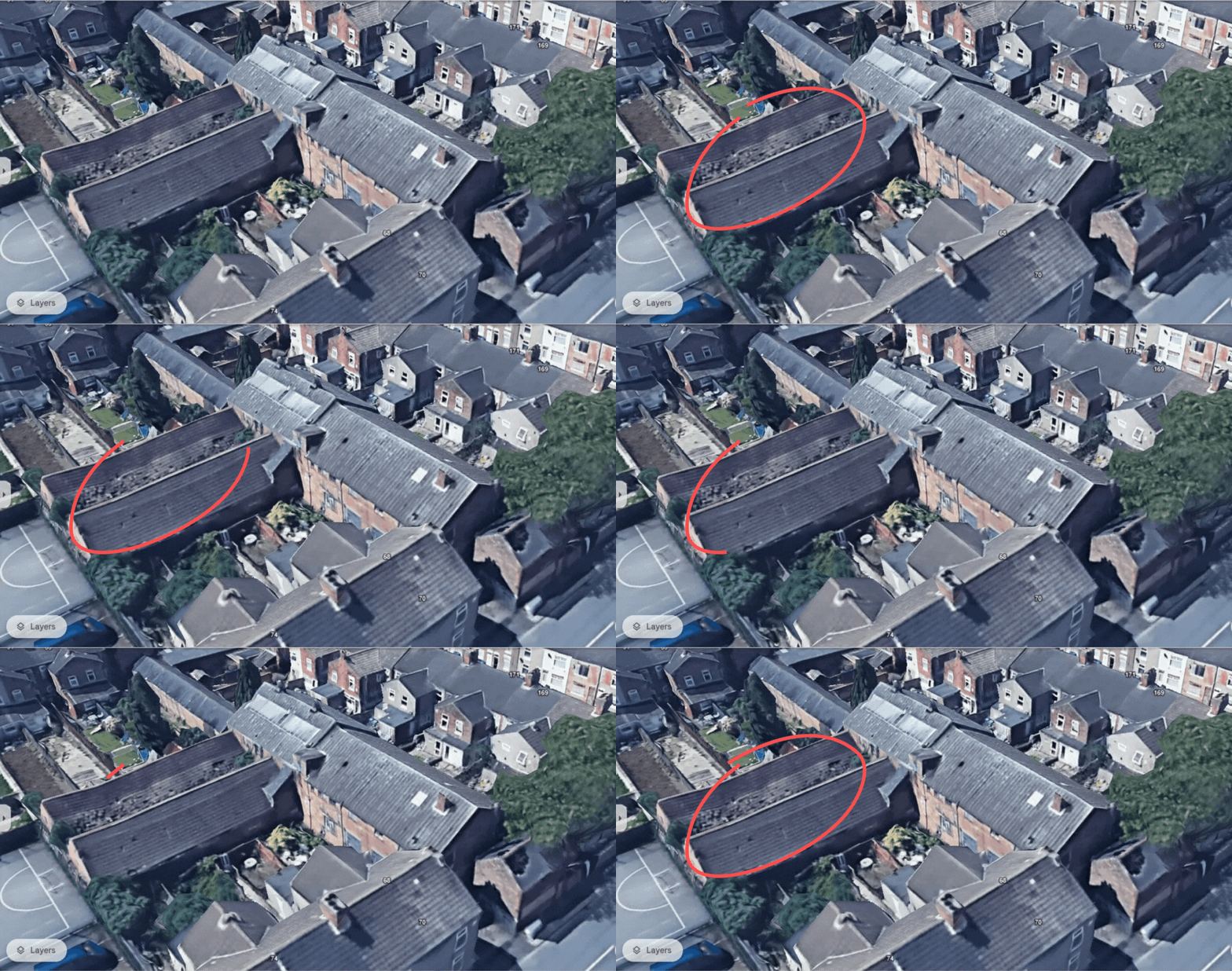
Figure 1.1 We can see the two double-pitched roofs of the extension. Our proposal is to alter the extension to place a flat roof at the height of the existing roof ridges. Therefore, the top height of the extension will remain the same. Note that the main building’s top ridge height is a comparable height to the existing houses surrounding it. Because of this, the main building (which is higher than the extension) is not visible from the main roads. The height of the top ridges of the extension is one storey lower than the main building. Therefore, the extension is even less likely to be seen from any main road. The building as a whole is concealed by the surrounding houses.
Click Here To View Existing Drawings Of Flat Roof (Before)
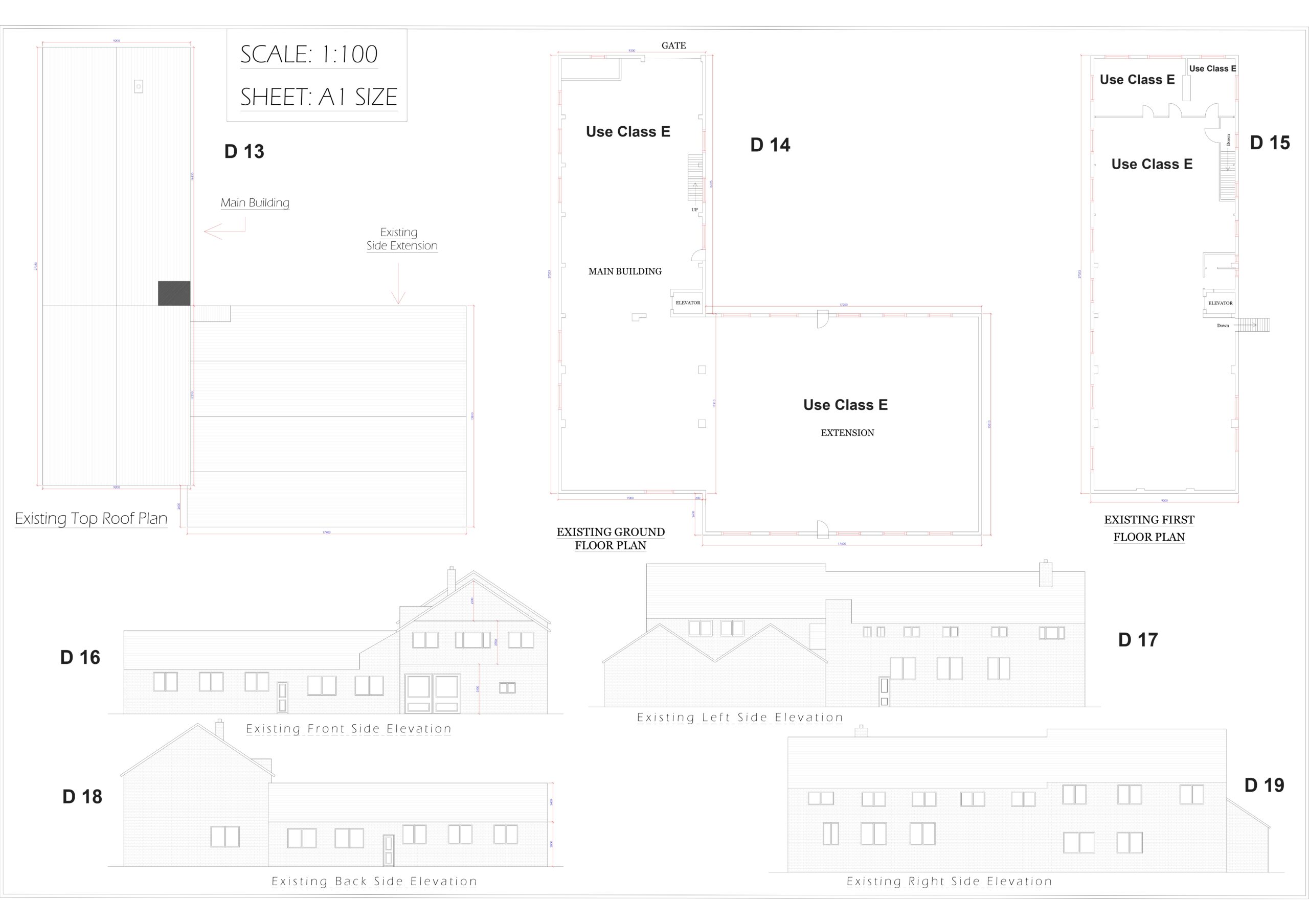
Figure: 1.1.2
Click Here To View: Updated Elevation Drawings Proposed Side Extension(After)
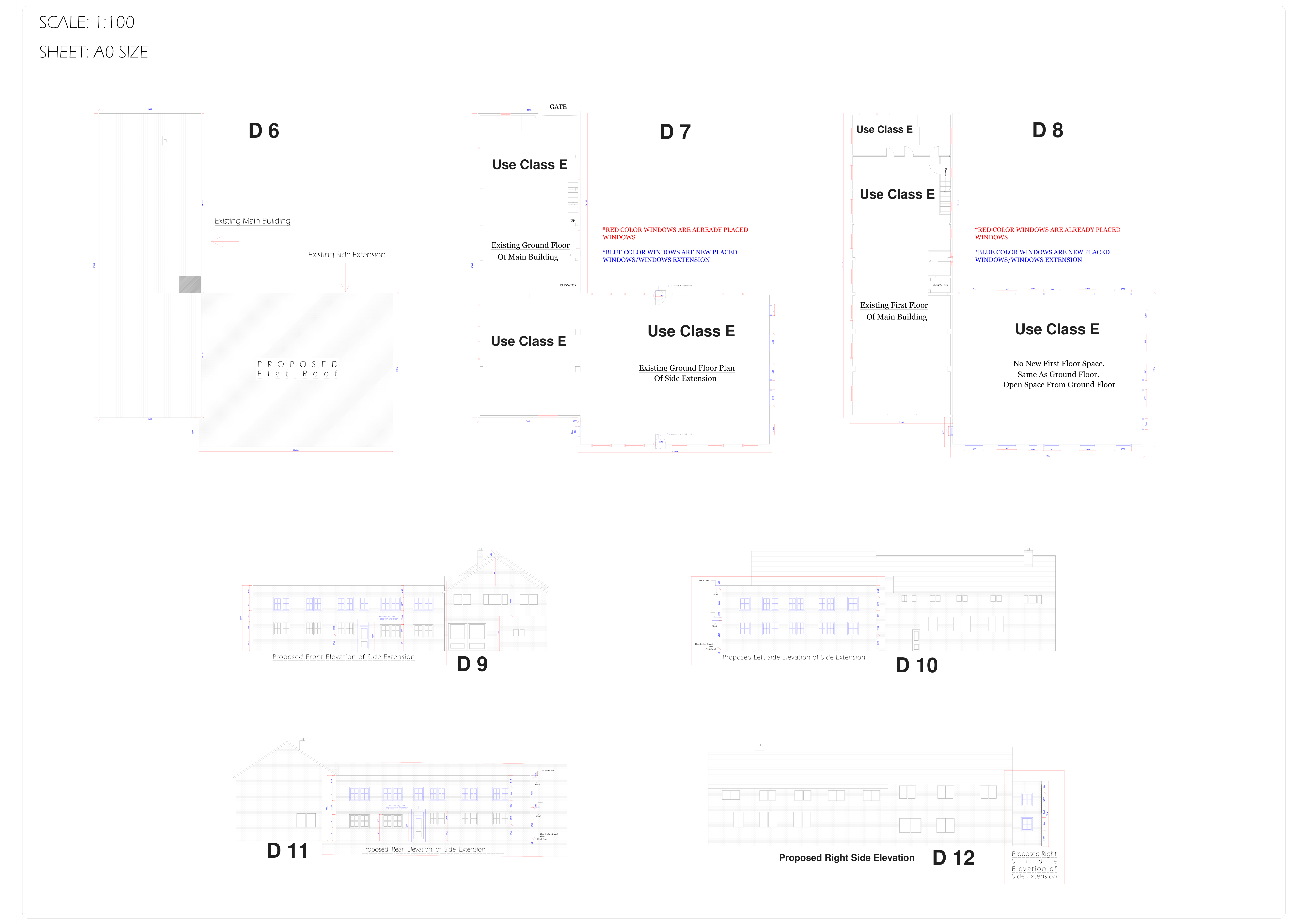
Figure: 1.1.3
Below is the side extension with a flat roof. The height is in line with the current roof’s ridge height. The building as a whole is hidden from full view of Harold Street and the main roads. The extension is particularly hidden due to its lower height than the surrounding buildings. The design is perfectly in line and blends in with the existing building and the character of the area. Virtually, even if it is not easily visible, the proposed design is much more pleasing than the present design.
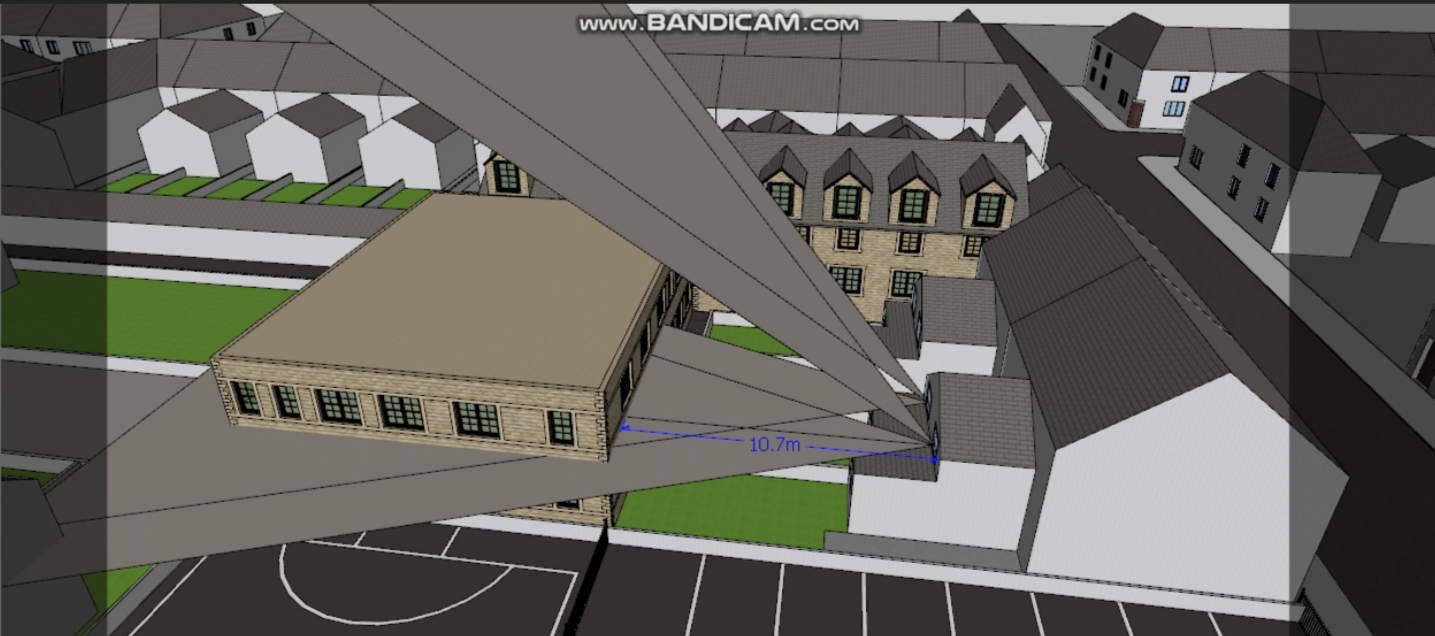
Figure 1.2 This CGI was made as part of our compliance studies to determine whether different alterations and solutions would cause loss of light. This image is referred to here to show how the height of the modified extension (being the same as the existing extension top height) is lower than ALL the surrounding buildings. Its view is completely concealed from all main roads. It is only possible to view part of it from the private car park and playground. The view of this extension from Harold Street is mainly concealed.
1.2 Windows
There are existing windows on both sides of the extension overlooking both the backyards of the properties in Castle Street and Harold Street.
The privacy concerns in connection with any windows facing any of these properties have been extensively studied, and it is clear that no rights are infringed on by any of these properties, even if there were no existing windows and entrance doors in place on both sides of the extension. As we have examined extensively, no right would be infringed even if these windows did not previously exist.
The pre-existence of windows on both sides of the extension eliminates completely any possibility of objecting to any additional windows on the upper levels.
1.2.1: Context and Existing Situation
-
The existing building already contains windows on both the side and rear elevations which currently overlook the same areas that would be visible from the proposed new windows.
-
These existing windows have long-established sightlines over adjacent properties, particularly towards the rear of properties on Castle Street and Harold Street.
-
The proposed windows are neither introducing new vantage points nor altering the character of visibility already established by the current fenestration.
1.2.2: Planning Policy Position
-
Materiality: For a concern such as overlooking to be a material planning consideration, it must give rise to new harm. In this case, no new overlooking is introduced.
-
Precedent: Case law and guidance from Planning Inspectors repeatedly affirm that overlooking from a new window which duplicates an existing view does not materially worsen privacy and therefore is not a valid ground for refusal (e.g. East Staffordshire BC v Secretary of State [2001]).
-
The National Planning Policy Framework (NPPF) promotes development that makes efficient use of land and encourages well-designed spaces. The proposal does not infringe on this principle.
-
The additional windows in this planning application do not cause any material harm as amply demonstrated below.
-
A review of local planning decisions in the area shows consistent approval for window additions where no novel overlooking is caused.
The windows facing the playground do not cause any privacy concerns. They are facing land that is already developed and activity conducted on this land is considered public, not private.
Please refer to our detailed studies on this matter further along in this document.
1.3 Our proposed development is minor in nature because
1: It does not increase the footprint of the building. The footprint of the building remains unchanged.
Key Legal Principle: No Material Harm = No Grounds for Refusal
Under planning law, planning permission should be granted unless the development causes material harm.
Because this minor building alteration does not increase the footprint:
- It does not lead to loss of garden/amenity space, over-development, or drainage/flooding issues.
- It improves the appearance of the building, and clearly its physical impact at ground level stays the same — which is often key for neighbouring amenity and site constraints.
“Secondary legal principle: the fact that the footprint remains unchanged means there’s no intensified land use, and thus no risk of breaching local spatial policies or causing material harm.”
2: It does not increase the top height of the building.
No Increase in Height = No Additional Impact on Neighbours
From a planning law perspective, building height is a material consideration. The new flat roof:
- Does not exceed the original ridge height,
- A detailed shadow study has been conducted for the proposed extension at 68 Harold Street, in accordance with BRE Guidelines (BR209). Shadow simulations for March 21, June 21, and December 21 at 9am, 12pm, and 3pm show no material increase in overshadowing to neighbouring homes or amenity spaces. The development complies fully with accepted overshadowing thresholds and does not impact the light access or enjoyment of surrounding properties. A full shadow study report is included as part of this submission.
Download The Complete Shadow Study Report
Then there is no material harm to neighbouring properties.
Legal principle: A development that does not materially harm neighbouring amenities is generally permissible under planning law.
3: This minor development involves only minor changes to the external envelope of the building. In this case, the only increase in height is at the two edges of the extension, while the top height of the extension is unchanged.
In planning law, a local planning authority can only refuse an application if the proposal causes material planning harm or conflicts with the local development plan.
In this case, the overall extension height remains unchanged, which means:
- No new overshadowing or daylight, as proven extensively by relevant studies.
- No increase in visual dominance. This is evident and self-explanatory, especially due to the height of the extension remaining unchanged.
- The change to two-edge heights is a minor design variation on the original massing of the building.
Therefore, there is no material harm, and under UK planning law (and similarly in many legal systems), that means the application should be permitted.
This minor development does not breach local policy (it is perfectly in line with it as amply demonstrated) , and there are no overriding material considerations against it. Therefore, it should be approved.
Minor External Changes = Minor Development
This proposal involves:
- No increase in footprint
- No increase in ridge/top height
- Only minor height adjustment to part of the extension to match it with the top height of the original extension.
This type of development is often classified as “minor” in planning terms, meaning:
- It falls well below the scale of development that would have strategic or cumulative impacts
- It is to be assessed primarily on design, appearance, and impact on neighbours, not major policy issues.
The design and appearance have been discussed at length, and it is clear that not only is this a substantial improvement, but while it fits really well in this area, it is mainly hidden by the surrounding houses of Harold Street and Castle Street.
Since it does not negatively affect any neighbouring properties, amenity, character, or infrastructure as amply demonstrated, there is no lawful basis to refuse it.
1.3.1: No Impact on Neighbouring Amenity or Character
- Visual continuity is maintained, as the top height stays the same
- The bulk and form of the building are largely unchanged.
- It would not feel significantly different to observers or neighbours. However it is a significant improvement and most of the extension is hidden from view by the surrounding house which are one storey higher than the extension (even with the new proposed flat roof).
This aligns with core national and local planning principles (such as the NPPF in England, which emphasises good design without stifling innovation or minor architectural changes).
1.3.2: Preliminary Vertical Sky Component (VSC) Assessment
Download Full Vertical Sky Component (VSC) Compliance Report
To support our claim, we have conducted a preliminary Vertical Sky Component (VSC) analysis in line with BRE Guidelines (BR209). Based on the measured 7.5m distance from the proposed extension to the nearest neighbouring window, and an estimated height differential of approximately 1.5 metres, the angle of obstruction is calculated as approximately 11.3 degrees.
This is well below the BRE threshold of 25 degrees, suggesting that the proposed development will not materially impact the amount of diffuse daylight received by neighbouring properties. Therefore, the proposal complies with BRE standards and is unlikely to result in a significant loss of light or amenity to adjoining buildings.
1.4 Development merits review summary
From a planning perspective, this minor development is classed as a building envelope alteration. More specifically, a roof alteration, because we will not increase the height of the roof, we will only convert the roof from double-pitched to flat, keeping the flat rooftop height the same or lower height than the existing pitched roof’s ridges. Therefore, the top height of the extension will either remain unchanged or will be lowered slightly. This alteration will not increase the top height of the extension. To be clear, after the alterations is complete, the height of the extension will be the same as the top height as of today and lower than the height of all surrounding houses and buildings therefore not visible from the main roads in the same way as it is not easily visible today. Therefore, it is a very minor development. Because it only seeks to modify the roof configuration from a double-pitched to a flat roof.
This minor development is:
- Fully compliant with the national planning framework
- Fully compliant with local panning policy
- Our alteration does not increase the footprint of the building.
- It does not increase the internal square footage.
- It does not have any adverse impact on any neighbouring property.
- It does not infringe upon any rights of the neighbouring properties. No right of light, no privacy rights are infringed.
- It does not cause any overshadowing.
- Due to its location and its height, this building (both the main building and the extension) is not visible from any main roads.
- It adds a disproportionate value to the area while being a minor development and having no negative impact on any neighbouring properties.
- This proposed design choice renders private development a feasible proposition both in the medium and long term.
- Once the project is completed, it will foster further investment by occupying the premises, and it will very likely spark further investment in the area as explained in detail later on.
- This minor proposal is classed as sustainable development as per the definition of the national planning policy. Later on, it is clearly demonstrated how this is a sustainable development as defined by the national planning policy framework. As such, there is a very strong bias for approval as clearly stated by the national planning framework. This is clearly stated in the section “The presumption in favour of sustainable development”.
1.5 Minor Development/Alteration
This is considered a minor development of the building envelope or building alteration.
If it were feasible to restore this building utilising the existing construction style of the extension, this could be done without planning permission. However, given the various features of this double-pitched roof design, this building requires some minor modifications and design optimisation for the regeneration of the building to produce a “sustainable” building.
This is a minor development because:
- It does not increase the footprint of the extension or any part of the building, it only seeks a roof reconfiguration.
- It does not increase the top height of the extension.
- It seeks to regenerate and modernise this existing building with an optimal design,
- It does not increase the scale of the building.
Under these parameters, this proposal is classed as a minor development or minor building alteration.
1.5.1: The similarities of this alteration with permitted development rights of householders.
Permitted development rights of householders allow the extension of the part of the roof using dormers almost up to the edge of the eaves, provided that any part of the dormer is not higher than the top ridges of the roof. This is applicable to the part of the house that is not visible from any road (like in our case).
Although, in this instance, permitted developments do not apply, in our minor building alterations:
- The roof is only been converted from a double-pitched to a flat roof, and like permitted development rights for householders, the final roof is not higher than the top ridges of the original roof. In other words, the top height of the flat roof is going to either be the same height or slightly lower than the ridge of the existing roof.
- The extension is positioned in a location not easily visible from any main road. However, even if it were visible from the main road the impact would be positive since our design is an objective improvement form the original design and the current state of the double-pitched roof. Additionally, the flat roof would be much less expensive in terms of maintenance than current configuration in a double-pitched roof. As we will see, this fits well with the government’s definition of “Sustainable development”.
Given this stark similarity with permitted development rights of householders, it is one of the several factors in favour of the approval of this Minor Development/ Building Alteration.
1.5.2: The main building visibility and the full extent of the expansion are admissible of the extension from a planning perspective.
The non-visibility of the building from the main roads is an important factor in increasing the scope of what is admissible from a planning perspective.
The main building is two storeys high with a double-pitched roof. Its top roof ridge height matches the height of the surrounding houses. Because of the height of the surrounding houses being the same as the main building, this building cannot be seen from any main road. The whole building is not visible from Rutland Street, Castle Street and Harold Street.
The only part of the building that is visible from one of the main roads (Harold Street only) is the front access to the main building.
Additionally, the existing double-pitched roof extension is one storey lower than the main building and one storey lower than the surrounding houses. Therefore, it is even less likely to be seen from any main road and therefore completely concealed.
It is known that for a planning proposal to be allowable from an architectural perspective, it does not need to stand out. It has to merge seamlessly with the area and fall in line with the height of the surrounding buildings.
A two-storey alteration with a double-pitched roof configuration with its top roof ridge matching the height of the main building and the surrounding houses, would fit the criteria of what is allowable. This is because the height would be the same as the surrounding buildings. The double-pitched roof height would be the same as the main building and the surrounding houses. Because of this, a double-storey extension with a pitched roof matching the height of the existing building would not be visible from any main road. It would fit with the area’s look and feel. Therefore, this would be allowable in principle.
In other words, given that the main building is not visible from any main road, and it is two storeys high, therefore, if the extension were made two storeys high with a pitched roof and the top ridge matching the height of the main building, then the extension would still not be visible. Therefore, since the extension would match the height of the main building, and not visible from the main roads, this would make this double-storey alteration with a double-pitched roof allowable from an architectural point of view.
This double-storey design with a pitched roof on top of the extension would be allowed as long as the right of light and the other rights of the neighbouring properties are not impeded. Studies have been carried out with this alternative design, and it has been demonstrated that no rights of any neighbouring properties would be infringed.
The admissibility is due to three factors:
- Like the main building, a double-pitched roof configuration matching the main building’s height will still be hidden by all the surrounding houses.
- Right of light and other rights of the neighbouring properties would not be affected by the structure.
- Even if the extension design is made to match the main building in height, the claim of scale and dominance is also dismissed based on all the points discussed in the “scale and dominance” section, but also on the fact that this building is not visible from any main road in all circumstances.
Therefore, the scope of what is admissible from a mere planning perspective is much more than what our minor building alteration requires.
Although making the extension’s two-storey double-pitched roof is architecturally allowable from a planning standpoint, we put forward a more conservative design which fits the definition of sustainable development as defined by the national planning policy.
1.5.3: Our minor development/alteration is a much more conservative design than the full extent of what is allowable from an architectural point of view.
The extension is currently double-pitched and one storey lower than the main building. It is also one storey lower than the surrounding houses that block its view from the main streets. As it is easy to observe from the main streets, in particular Harold Street and Rutland Street, the main building, which is one storey higher than the extension, is completely covered by all the surrounding houses. This is because the top height of the main building matches the top height of the surrounding houses.
Therefore, even if the top height of the extension were to match the surrounding houses (it would be a double storey with a pitched roof or three storeys with a flat roof), it would still not be visible from any main road because its visibility would be obstructed by the surrounding houses.
Under this minor development proposal, the top height of the extension will remain the same as today. We will adopt a flat roof configuration and the top height of the flat roof will match the lower height of the present double-pitched roof extension.
Therefore, if the main building which is two storeys high with a pitched roof, the extension with a flat roof that reaches only the current ridge of the roof’s extension will not remain visible in the same way it is today.
1.6: Flat roof in line with the area’s look and feel, and better than the Phoenix academy.
The Phoenix Academy building has a flat roof structure all throughout and the closest part of the building is in the region of 20 to 25 metres from the extension. It has to be noted, therefore, that our construction a flat roof is similar tho that of the Phoenix building.
In particular, the Phoenix house has a sloped bubble-pitched roof. The slope is very low and similar to a flat roof due to is very low slope.
The Phoenix Academy is not concealed by any house or building, and it is visible from Harold Street.
The Phoenix Building Academy building complex has a simplistic type of construction in order to reduce building costs. This style of construction does not blend well with the area.
Our proposed building alteration, in contrast, is going to be constructed using the same or similar outer brick work as the surrounding houses, therefore blending in well with the surrounding area even if it is mainly hidden from view.
Additionally, the type of construction of our proposed building alteration is a much better fit than the Phoenix building, which is also very easily visible from Harolde Street.
Our minor building alteration, while it is lower than the surrounding houses (therefore it is hidden from direct view from Harold Street), is a better fit to the look and feel of the area. Additionally, the top height of our minor building alterations will match the existing roof ridges height and will still be lower or similar to the height of the Phoenix house. Our minor building alterations are of the same or similar height to the Phoenix building. However, since it is lower than the main building and the surrounding houses, it is hidden.
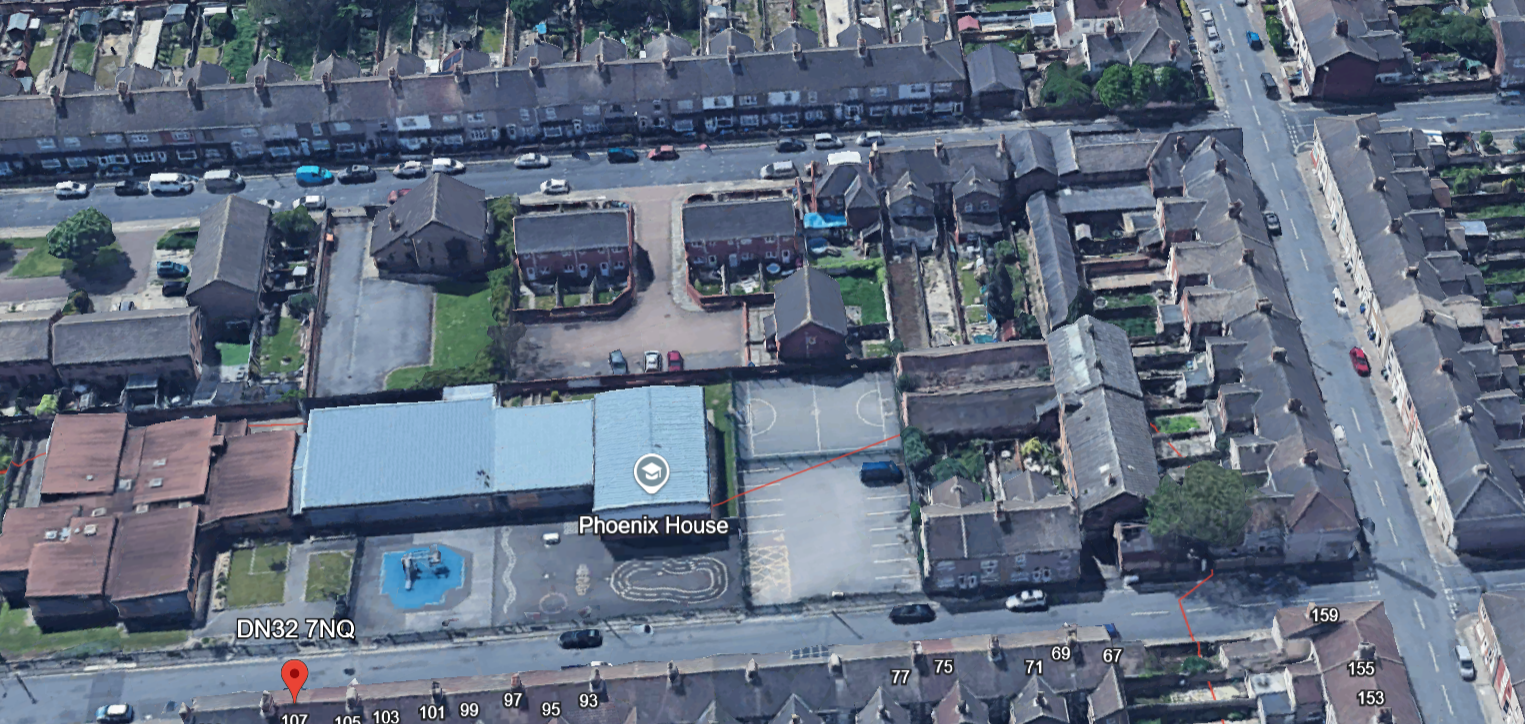
Figure 1.3 The Phoenix house was built using modern low-cost construction methods. From an aerial view, it seems as if they do not match really well with the look and feel of the area due to the method of construction. The blue colour especially stands out and, in contrast with the look and feel of the area, this building is clearly visible from Harold Street. The left part of the building is still of flat roof construction, but the colour construction choice blends it much better with the area.
To summarise the main advantages to our minor development versus the Phoenix building complex academy and, in particular, the Phoenix house:
- Our building is a much better fit with the area than the Phoenix building. As we know, the planning policy, both local and central governments prefer designs of buildings that fit with the area. In our case, the flat roof matches with the flat roofs already existing on the Phoenix Academy Building.
- Although our building is a much better fit with the area, it is mostly concealed from view from any major road. The Phoenix building is very well visible from Harold Street. The Phoenix building is not concealed whereas our building is concealed. Despite that, our construction using the original bricks is a much better fit than the Phoenix building, because the design of the Phoenix building was made with material that does not match the area as well and also a blue colour. Very likely this was done to save on construction costs.
In conclusion, it is clear from the above picture that a flat roof design blends really well with the look and feel of the area (as required by central and local planning policy) as long as the colour of the build is in line with the area’s colour and feel.
Our proposal fits very well with the look and feel of the area and the height of the extension will be lower than the surrounding houses. Therefore, although our design is a substantial improvement from the current configuration, and it is a better fit with the area, the alteration is not visible from any main road, and it does not directly influence the look and feel of the area.
As we have seen, and we will continue to demonstrate throughout this document, our building alteration is hidden from sight and the overall design is a very good fit with the area.
1.6.1: Scale, dominance, layout and density
The footprint of the extension will remain the same. Therefore, any objection in terms of the scale of footprint is dismissed on the simple basis that the footprint remains unchanged. Additionally, any claims of scale are also dismissed due to the fact that the height of the extension is not increased, since this minor development will seek to match the new flat roof with the current height, therefore not increasing the height of the extension.
In terms of height, the extension will keep the same top height (height of the exiting roof ridges). Therefore, the objection in terms of dominance due to the height is dismissed due to the fact that the height of the extension remains the same. As we have seen, the scope of what is admissible from a planning perspective is much larger than our proposal.
Additionally, this is dismissed because the extension cannot be dominant from a mere height point of view because it is lower than the main building and any surrounding neighbouring houses. By definition, a building to be dominant has to meet three criteria.
- It has to be taller than any other surrounding buildings.
- Even if it is taller, it has to be clearly visible from the main road.
- It has to be clearly visible and clearly stand out from all the neighbouring buildings or houses.
These three criteria have to be met in order for a legitimate and admissible claim of dominance to be made. A building that is lower than the surrounding houses and surrounding buildings, not easily visible from any main road, cannot by definition be dominant.
Furthermore, more simply, the building is not visible from any main road. Therefore, the claim of dominance is baseless also due to this mere reason.
From all the above, it is clear that any claim of dominance is clearly legally and factually baseless.
Not withstanding the above, in case an argument is made that the building is dominant because of the increased height of the boundary walls on the part facing Harold St and Castle Street, this is dismissed based on the following:
1. Dominance cannot occur because our minor development will not increase the height of the extension. It can only legitimately occur if all the three criteria above are met.
2. The current height of the ridges is lower than the height of the sounding houses. The height of the flat roof will either match the current roof’s ridge height or be slightly lower. Therefore, dominance claims cannot be made since the extension is currently lower and will remain lower than ANY existing houses surrounding it. So much so that the height of the surrounding houses does cover the view of the extension as well as the main building, which will remain 5 to 6 metres higher than the extension.
In other words, because our minor development will keep the top height of the extension unaltered, the extension will still not be visible because its view will still remain covered by the surrounding houses of Harold Street and Castle Street, which are approximately 5 to 6 metres higher than the top height of our extension alteration. To be clear, the height of the flat roof will be the same as the current roof’s ridges, and it is and will remain 5 to 6 metres lower than the surrounding houses. The claim could have some justification only if the height of the flat roof was higher than the existing ridges of the surrounding houses, and it would be somewhat visible from any of the main streets.
3. Claims of dominance due to overshadowing or loss of light are dismissed due to our study that extensively proves there is no loss of light or overshadowing. Our studies prove how even if the extension were made as a two-storey building with a pitched roof matching the main building construction, overshadowing would still not take place in any neighbouring house.
4. The claim due to overlooking is dismissed because there is no material harm and no loss of privacy as proven extensively. Our studies prove how even if the extension would be made as a two-storey building with a pitched roof matching the main building construction, material loss of privacy would still not take place to any neighbouring house.
Any claim in density or layout of development is dismissed since our minor development only involves the change in roof configuration from double-pitched to a flat roof. No increase in footprint is made nor are any internal alteration made. The development only seeks to change the roof configuration within the limits of its current ridge height. The current ridges height are lower than the ridges of all surrounding houses. Therefore, there is no increase in the density of the building in any way. No extra floor is added under this planning application. A claim on density could only be argued only if there is an application where the building would be extended beyond its original footprint (like a new extension, for example).
The external layout remains unchanged because this minor development involves the modification of the roof layout only. Therefore, any objection based on external layout is dismissed because there is no change in the footprint of the external layout of the building.
The external layout remains unchanged. Therefore, any dismissal in terms of internal layout is unsubstantiated or baseless.
1.7: Central Area, local deprivation, dilatated, boarded-up and unoccupied houses in the area.
The local policy map describes this as a central area. This is located right between Grimsby city centre and Cleethorpes city centre. It is easily accessible on foot from both Grimsby city centre and Cleethorpes city centre. Cyclist commuters from both Cleethorpes city centre and Grimsby city centre can reach this location within 5 to 10 minutes. But generally far less than 10 minutes on a slow bicycle ride.
Therefore, this area is very convenient for working-class families, and single people who have employment either locally or in the city centres.
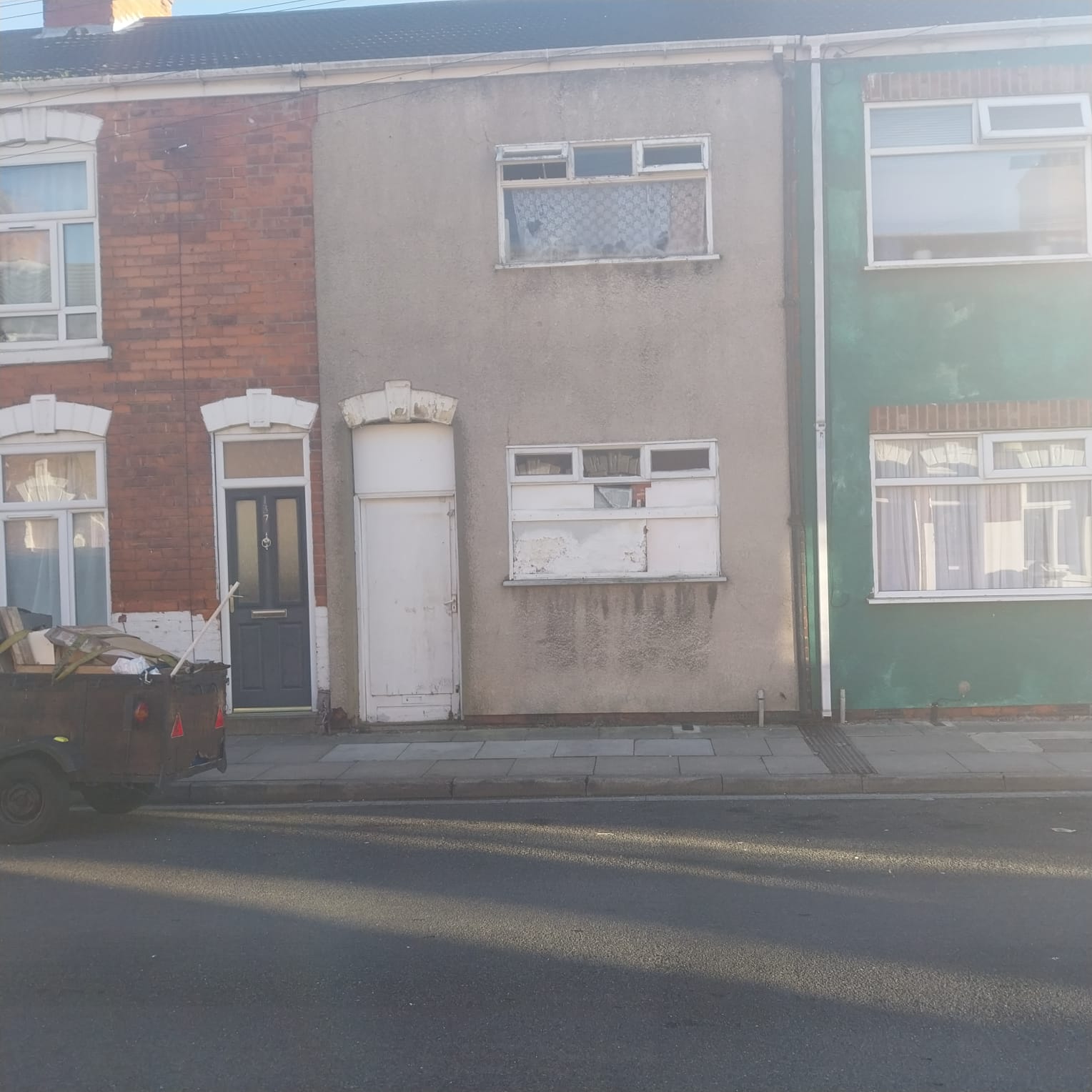
Figure 1.4 139 Rutlands Street, boarded up
However, the general look and feel of the area is of deprivation. The root cause of deprivation in this area is the systemic long-term lack of investment. This deterioration started 20 years prior and the area is currently still in a downward trend due to the continued lack of investment.
The area has progressively deteriorated in recent years and it presents several challenges. At present this is NOT considered a “place where people want to live” as defined by the local planning policy.
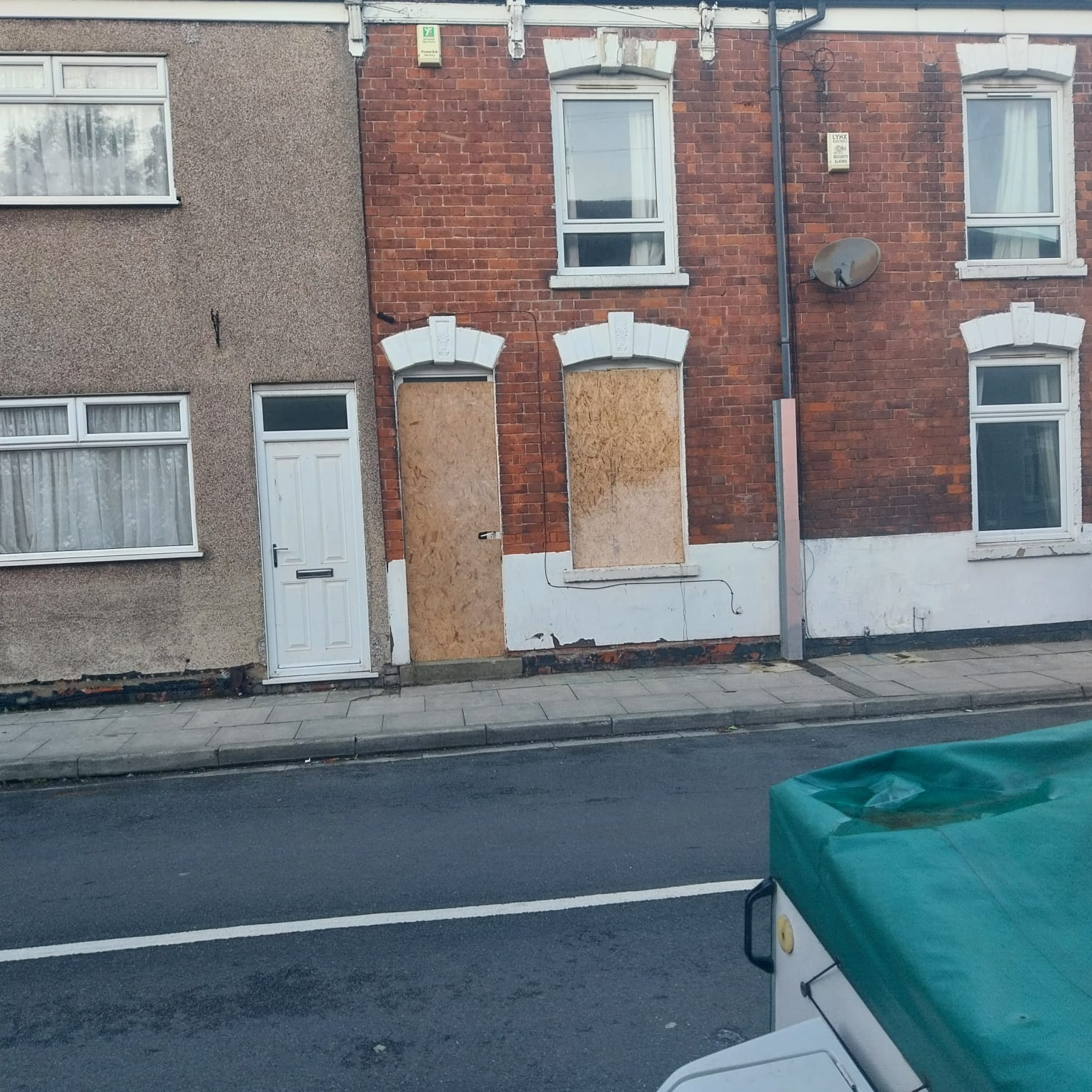
Figure 1.5 132 Rutland Street Boarded up, not occupied
The root cause of this is the systemic lack of private capital investment in the area. This is not due to the lack of business opportunities but the lack of public and private investment in the regeneration of the area.
It is possible to see more depicted and abandoned houses just by walking around the area. Also, the major challenges of the area are:
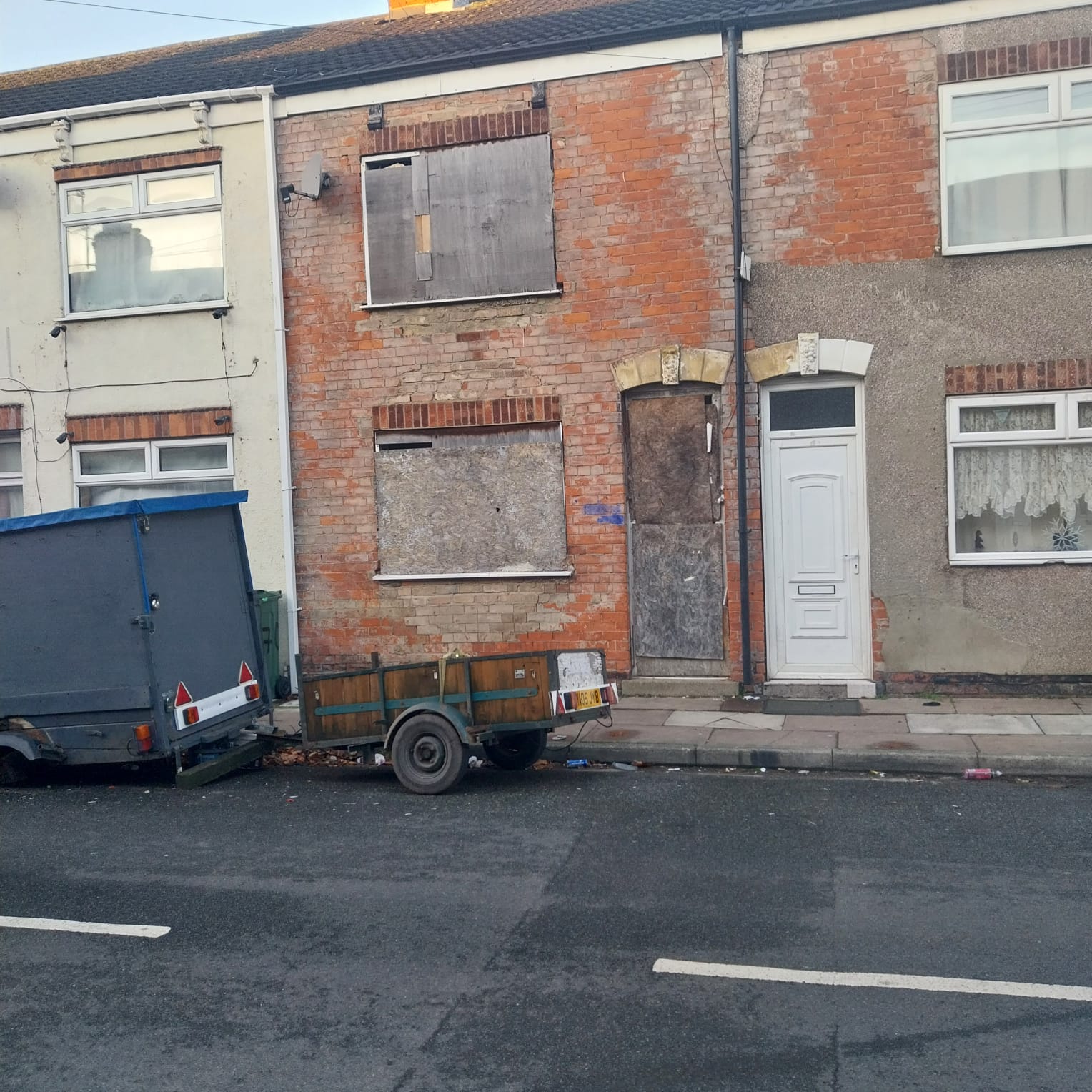
Figure 1.6 186 Rutland Street, boarded up and unoccupied for several years. Severe unreported damage internally. All windows and doors were boarded up.
Petty crimes, robberies, burglaries, fly-tipping, drug growth, drug use, the unsanitary appearance of the area, unclean pavements, litter all around and activities that discourage middle-class families to move into the area.
The area is very much in need of investment to revive it. There are a number of boarded up and/ or burned down empty properties.
The overall outlook of both Rutland Street and Harold street is poorly and this is not only palpable in the area but there is also hard evidence of this and can be easily verified independently.
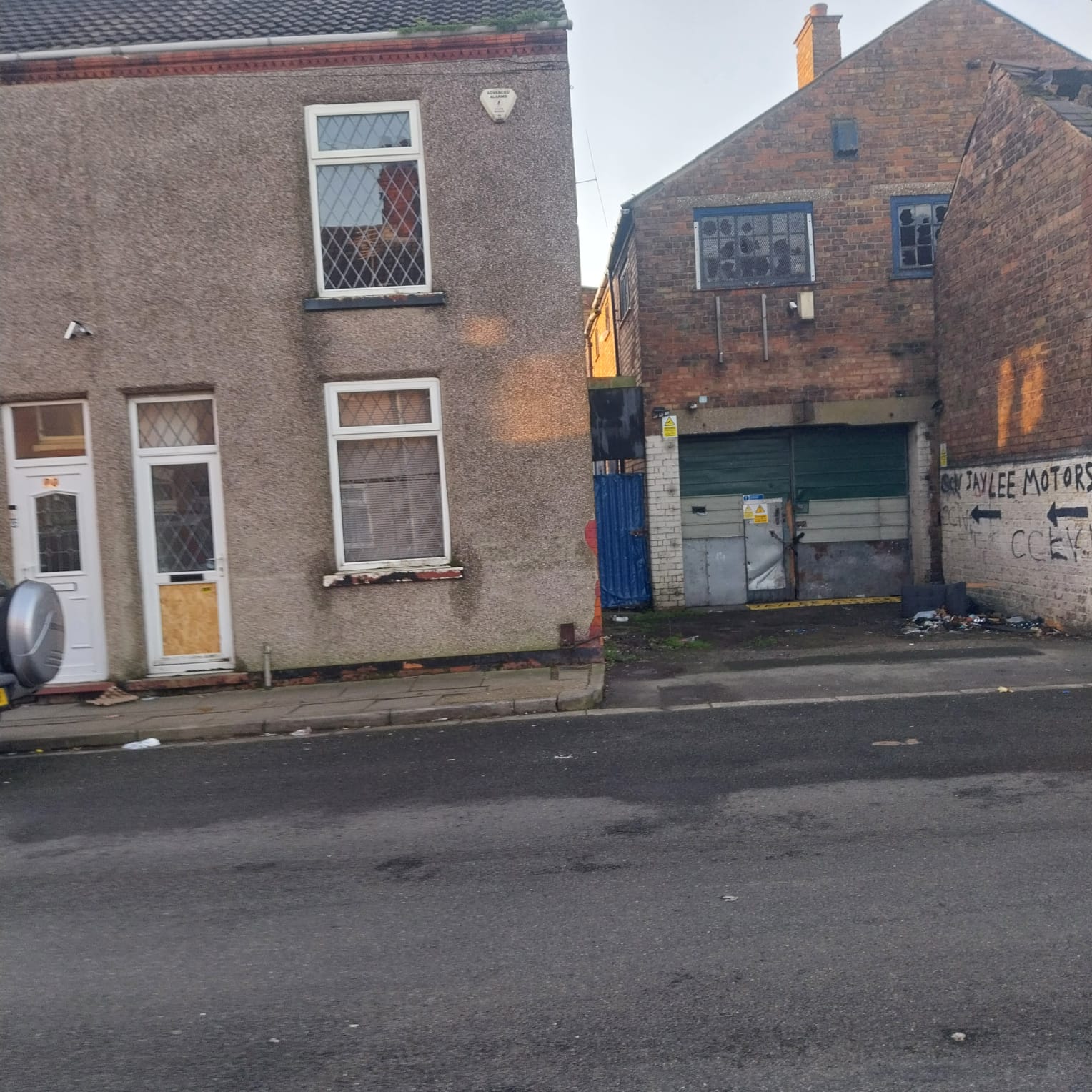
Figure 1.7 68 Harold street, recently burnt down internally and boarded up. Unoccupied for over 10 years.
Any family that moves into the area does so because of low rent which still meets the payments for social welfare.
To working professionals, this area is only attractive due to the low rental payments. Most working households which reside in this area state that they will move into a better area at the first given opportunity. Therefore, this is a transitional area for working families.
This area is currently long-term residents for those who are on long-term benefits.
This area is currently long-term residents for those who are on long-term benefits.
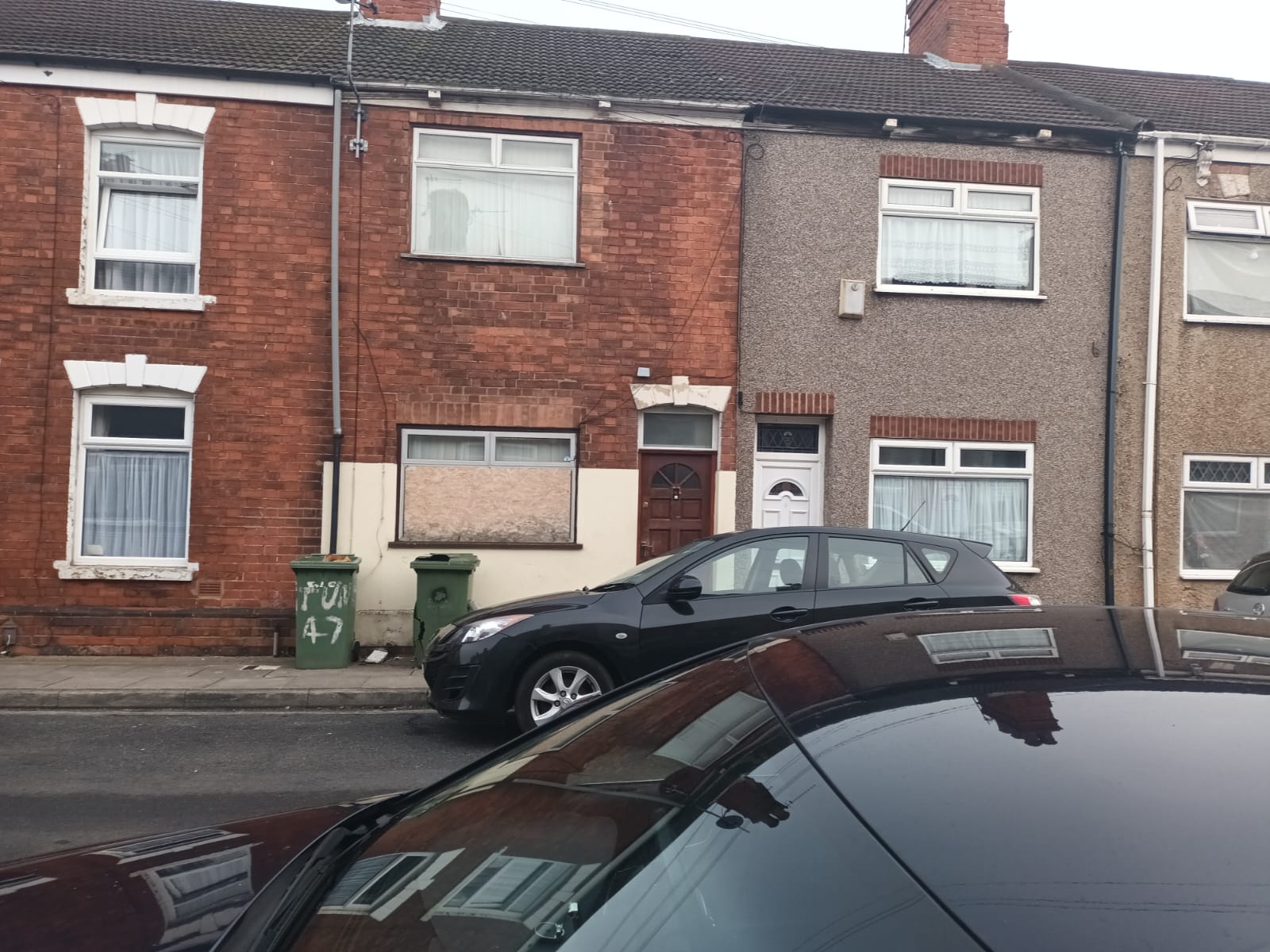
Figure 1.8 115 Rutland Street
Although our minor development is allowable from a strict legislative and policy viewpoint, it is good practice to be as lenient as possible with planning applicants in order to secure as much private investment in this area as possible. This will encourage the much-needed regeneration of the area.
1.8: The need for public and private investment.
In order to resolve all these issues, investment is required from the private sector. There is already a beginning of private investment, which will bring significant benefit to the area. This is the residential development at the rear of 110 Harold Street. However, this is not sufficient to break the systemic lack of investment in this area. Further investment is required to reach the tipping point when private investment will flow in unencumbered and systematically. At that point, the area will regenerate itself by default simply due to private investment.
Additionally, this building is a pivotal part of the area and its regeneration will strongly contribute to the regeneration of the area. The planning approval of our minor development will provide us with the permission needed to invest private capital in a financially viable project.
Our minor development will allow key private investment into this key commercial building, which is very likely to reach the tipping point required to attract a further cascade of private investment. This is due to the increased business investment in the area in employment and skill development by the future occupying business/es. Our minor development will generate highly skilled employment in the area, therefore increasing the local demand for high-quality housing close to the area of employment. In turn, this will encourage private capital to invest in further local business development and derelict housing regeneration due to the increased demand in this area (as we will see this is completely in line with the local planning policy, where the planners need to prioritise approval of those developments that will lead to the reoccupation of derelict uninhabitable houses).
As this minor development will allow us to revive the building, the whole area will experience an economic uplift as well as a new uplift to the look and feel of the area. In fact, the approval of our planning applications will allow us to initiate a viable project of regeneration of the building and the areas. This is because this building is pivotal to the area.
The immediate short as well as long-term consequence of our minor development is a significant contribution to the start of the regeneration of the area.
1.8.1: How the approval of this minor development is likely to spark a chain reaction of further private investment and area self-regeneration.
It is acknowledged that the impact the public sector can make in a meaningful investment in regeneration is limited. Help is required by the private sector.
The benefits brought by this minor development which will regenerate this commercial building are disproportionate. It is very likely that this minor development could be the ignition of the spark required to in turn attract further investment in the area, not only from the future businesses occupying the building. Also, other businesses in the area will find the increased business opportunities created by our private investment an attractive factor to make further safe investment in this area.
As a consequence, with the approval of this minor development, local high-skilled employment will increase in the area. Therefore, the housing demand and desirability of the area as a place to live close to the employing business/es will increase. The desirability of the area as a place to work and live will increase, therefore allowing an increased housing demand which will in turn encourage private investment to restore uninhabitable, derelict, boarded-up empty homes in the area (this is a stated local planning policy).
1.9: Derelict state of the premises and its restoration.
The state of part of the premises, although it is structurally secure, is partly derelict. The definition of derelict when referring to a building is “in a very poor condition as a result of long-term lack of maintenance and neglect”. This building currently meets this definition. It can still be used, but in a limited fashion and by taking certain precautions. The building requires restoration. However, this restoration needs to be done using a “sustainable” design and sustainable construction. As we will see, the deterioration of the extension is mainly due to the design choice made at the time of construction. This present design and mode of construction renders the extension not sustainable in the long term, and it is recommended to adopt a sustainable design to allow a sustainable use of the building for several decades to come.
The same does not apply to the main building, where the whole construction and design is highly durable and sustainable.
1.10: Design choice
An in-depth study has been carried out to find a sustainable design solution for the long term outlook of the building and the area. The word “Sustainable” in this case fits the definition made by the government in the national planning policy. More on this in the section where we examine the compliance of our minor development/alteration with the stated national planning policy framework.
A number of design solutions have been considered. This was done with sustainability in mind and also with what is allowable from a planning perspective. Therefore, our final design solution is both desirable, sustainable and favoured from a planning perspective but also a viable project that will attract private investment in the area.
Therefore, our proposal for the regeneration of this commercial building is considered to be the best possible “sustainable” solution for this building.
1.10.1: Summary of why selecting the flat roof matches the height of the current roof ridges.
The flat roof height does not exceed the height of the current ridges. Therefore, the top height of the extension is not increased . This makes the planning proposal non-intrusive and a very minor development.
This height offers much greater security for the building. This is because for intruders to attempt entry through the roof equipment like ladders is required and this type of effort is too high a risk, especially at night. Therefore, the likelihood of intrusion through the flat roof is dramatically reduced. This makes this development much more sustainable than any other possible configuration.
The higher height of the flat roof allows a higher degree of security for any solar panel installation. This is because the roof can only be accessed using ladders.
The higher height also allows the capture of less turbulent and higher-speed winds by any possible roof-mounted wind turbine producing more energy. The higher fleet roof height makes the wind turbine less subject to possible vandalism and theft.
For these and other reasons, the higher flat roof design is the most sustainable solution while not increasing the top height of the extension. Therefore, keeping our proposal clearly classed as a minor development because it seeks to modify slightly the envelope of the existing extension without increasing the top height of the roof.
From a planning perspective, because we are not increasing the top height of the extension and the extension is in an area not easily visible from any main road, this is generally considered a very low invasive planning proposition which is comparable to the household permitted development rights. The household permitted development rights allow the development of a dormer window of any shape, including a flat roof, under the condition that the height of the roof or the flat roof has not increased and other minor conditions. This is because the height of the top height of the building is not increased.
1.11: The current design is unsustainable.
The current design is not sustainable in the area due to the high security risks caused by the low double-pitched roof of the extension. The low height of the side walls has historically allowed easy, undetected and safe access into the building through the lower part of the roof’s extension.
It is clear how the current double-pitched roof configuration is not a sustainable design and structure. This is additionally due to the middle valley maintenance requirement.
On both sides of the extension (facing Harold Street and Castle Street), windows and entrance doors have been bricked up to prevent access to intruders. After the side windows and entrance doors were bricked up, the easiest point of entry to the intruders was through the extension’s roof.
The method of entry was and is simply through taking off a few roof tiles and making your way into the building, both safely and undetected. This has caused this building not to be financially sustainable throughout recent years, leading to the present degree of disrepair.
The possibility of restoring the current double roof configuration is unsustainable because this design presents intrinsic security risks. The inherent security risks of the extension’s current design render the building not only unsustainable, but it is also not possible to invest in its regeneration due to these intrusive design flaws. In order to overcome those inherent high security risks, a sustainable design has to be implemented.
Therefore, repairing this building using this current design is not a financially viable proposition, because any investment may not have a return on capital deployed , due to the inherent security risks and high maintenance requirements.
For these reasons, the current extension design is unsuitable for a regeneration project, keeping the extension’s design unchanged.
The unsustainability of the extension’s current design is also demonstrated by the constant, costly maintenance requirement to maintain the middle valley of the double-pitched roof.
Lack of this essential maintenance will cause roof deterioration, which then causes roof damage which becomes prohibitively expensive to repair.
Also, the current roof configuration does not allow the installation of renewable energy sources in a way that can guarantee any return on capital invested. The reasons for it are amply discussed in the appropriate section.
For these reasons, the current roof configuration is not sustainable and a sustainable design is required for the restoration of the building. Our proposed flat roof configuration, although there are minor alterations, at the same time, is a “sustainable” solution for the restoration of this building.
1.11.1: Sustainable extension design and construction; the consequences for the area.
Given the unfeasibility of the current extension design, our objective is to select the most “sustainable” building design for the extension. The word “sustainable” has to be interpreted as defined in the national planning policy.
The “sustainability” of the extension in terms of design and construction, as a consequence, will decrease the carbon footprint of the whole building itself because it will require less ongoing maintenance and lower running costs.
The potential of carbon footprint reduction will be exacerbated by the possibility to install effective renewable energy sources on the rooftop.
The building will be capable of sustaining long-term occupiers. The longer businesses are going to occupy the building unsustainably, the more the chances for businesses to grow and create new jobs and invest in the area itself.
The area will benefit by the increased prosperity generated by the businesses that will be able to occupy this building sustainably. It is a very well-known fact that in order for an area to be prosperous, the prosperity of local businesses is what brings prosperity through investments in the local area, job creation and general uplift of the local community.
1.12: The design optimisation process.
The design choice was made with sustainability in mind. Because the current double-pitched tiled roof is clearly an unsustainable design, we have examined a number of possible solutions. Several alternative options have been considered, and we have selected the best possible design, considering both what is considered a minor development (which is generally permissible) and the most “sustainable” option.
The implementation of the most sustainable design option is the government’s priority to promote “sustainable development” as defined in the national planning framework.
The proposed higher side walls, which will match the current roof ridges height, will grammatically reduce the risk of intruders making their way in easily through the roof because
- It is a flat roof at a higher height which will require the use of ladders or other equipment to reach it,
- The flat roof will not have tiles, Therefore, it is much more difficult to break into. Noisy battery-powered specialised tools would be required to break in through the new flat roof. This would attract attention.
1.12.1: The cost of vandalism. The un-sustainability of the current extension design/configuration.
One of the main issues that makes this extension unsustainable is the cost of burglaries and vandalism.
The present extension design presents several challenges. One of the major challenges is the general un-sustainability of its current double-pitched roof design. This renders the building non-sustainable to the businesses that occupy it.
Historically, this building had been burgled and vandalised several times.
The vandalism and burglaries have accounted for the following damages over recent years:
- Electrical wiring stripped out, replaced and stripped out again. The main motivation for this type of act is reselling the copper in the wires stripped out from the building. While the copper stripped from the wires can be resold for a few hundreds pounds, the repairs cost amounts to thousands of pounds every time. The cost of repair is very high mainly due to the costs of the employment of electrical contractors who also required to certify the new installation every time such large repair is carried out. Therefore the cost of repair is several times higher than the cost of copper, mainly because of the high costs of the specialised highly skilled labour required to perform the fault-finding to identify the wires to reinstall, how and where. Then carrying out the new wiring installation, testing and certifying the new installation every time. This type of costs are devastating to small businesses.
- Copper pipes are stripped out a number of times causing floods, damage to goods and downtime to the businesses occupying the premises. Once again, the motivation for stealing live copper pipes inside the building is the small gain for copper conversion into cash. Therefore, not only the cost of repair had to be borne by the occupiers, but also the cost of repairing the damage caused by the floods. Additionally, the costs of replacing the goods damaged by the internal floods are significant. Again, every time the copper pipes are stripped form the building the copper can be converted into 3 or 4 hundred pounds every time while the copper pipes replacement cost alone amounts to thousands of pounds every time. This is because not only of the costs of acquisition of the new pipes but the high costs of skilled labour to install it again. The cost of the damage caused to goods can also be estimated to be in the region of thousands of pounds depending on the goods present in the building at the time of the floods.
- Cost of replacing stolen merchandise. This cost varies depending on the value of the goods stolen each time.
- Cost of roof repair since the intruders preferred entry point is through the extension’s roof, this is because the extension an a hidden access and it is easily accessible due to its low height.
- Downtime to the businesses caused by these burglaries and acts of vandalism.
Historically, an act of theft in the building while it provided gains of less than 200 pounds to the thieves, it cost several thousands of pounds in rewiring, roof repair, lost goods, downtime etc not including the increased costs of adding extra security to the building. These are crippling costs to small-medium-sized businesses, and this security issue which is inherent to the building requires a definitive long-term solution.
Once the businesses occupying the building face these issues, they are required to look for a more sustainable building that offers more inherent sustainable security. This inherent security issue has made this building not viable throughout recent years to several small-medium-sized businesses that occupied it. In fact the recent occupation history of the building shows that businesses only managed to occupy the building for a relative short period of time for then preferring other more sustainable buildings to conduct their business in . In turn they moved their businesses elsewhere where they could grow their businesses sustainably. Therefore, this area has missed out in crucial growth opportunities due to the unsustainability of the current extension design.
1.13: The intrinsic security issue of the current extension design.
The cost of preserving security with the present extension’s double-pitched roof configuration is very high and therefore unsustainable to the occupying businesses. As we will see here this is mainly due to its design and construction.
The preferred entry point for intruders or buglers into the building is the extension. The extension is not easily visible to the public therefore this offers protected, safe and easy access to intruders especially at night.
The extension is the easiest point of entry into the building because the path surrounding is not illuminated at night. The alleyways that lead to the extension are not illuminated and hidden from public view therefore, intruders feel safe taking this route to access the building. Furthermore the mode of entry through the roof does not require noise to be generated during the breaking ins.
Additionally the low height of the extension side walls allows intruders to make their way into the building through the roof. The side walls of the extension are low enough for intruders to access the roof without using ladders. There is no requirement for ladders to access the roof of the extension from the two lower walls facing Harold Street and Castle Street. Historically once reached the side of the roof without the help of ladders, intruders lifted a few roof tiles to make their way into the building (this does not generate any significant noise level that could wake up neighbours at night who might in turn alert the authorities). Hence the lifting of roof tiles, which does not cause any high noise level, and the non requirement of ladders, make this entry very easy and low risk to intruders. In this way intruders enter the building, at night, relatively safely and without being detected.
Therefore, the high costs of maintaining the extension secure is mainly due to the low height of the side walls facing Harold Street and Castle Street and the method of construction of the roof.
A different design is required for the extension to make it inherently secure in the long term and therefore sustainable to the occupying businesses.
If the walls facing Harold Street and Castle Street were the same height as the roof ridges, a ladder would be required to access the roof and the extension would not be the preferred access point rendering the building inherently secure. This is because it is a risky and difficult endeavour for intruders to carry a ladder and other equipment to climb a high wall safely, especially at night. This high risk would deter most intruders from attempting to access the building through the extension. This alone will make the whole building inherently (by design and construction) secure and hence “sustainable” to the occupying businesses.
The term sustainability, here, is also referred to in the sense of the government’s stated definition in the national planning policy framework as “sustainability” goals .
Also the flat roof will require the use of power tools to make a hole in it to gain access. These power tools would need to be specialised and battery-powered, which would require considerable prior extensive preparation and investment by the intruders. Additionally the noise generated by the power tools will inevitably attract attention. This would make the building even further inherently secure and therefore “sustainable”.
This is because by choosing the correct design for the extension, any means of entry will require the use of equipment and noise will be generated to gain entry into the building. Hence, the increased risks connected to the unlawful entry into the building will deter most intruders.
1.13.1: The high ongoing maintenance costs imposed by the double roof configuration with a valley in between.
The middle valley requires ongoing maintenance due to its construction. Failing to carry out contact yearly maintenance can result in severe building structural deterioration, which can be extremely costly to repair. This is the case when the construction, like in the case of this building, is made partially of wood and structural steel.
If the whole structure is in steel, then the failure to carry out maintenance of the middle valley will have minor adverse effects. However, when the building is mixed steel and structural wood, the damage from failing to carry out maintenance could be devastating to the building.
Therefore, either a different construction method is required to keep this design, which will render the lack of maintenance not such a devastating event in the long run or the design is changed to an overall better solution . As we have seen and co0ntinue to see, there are instructing design disadvantages in keeping the present design and simply changing the construction to a steel frame. This will still pose inherent security challenges as we have seen int he section where we explain the ease of access by intruders with the current design.
As we have seen, the cost of replacing the structure from hybrid structural wood and structural steed to pure structural steel is not worthwhile due to the relatively high replacement cost and the inherent risks of introduction plus the inability of a proper feasible installation of renewable energy sources on the building.
Whereas a slight building alteration will make at almost the same replacement/building costs a much more “sustainable” building. As we have seen, the sustainable term fits into the definition of the government objective for sustainable building in the national planning policy.
1.13.2: Summary of the main causes from a building design perspective that allows ease of access to intruders and the basic design solutions.
Therefore, the building design has to be changed in order to make this building intrinsically secure, hence a competitive and unsustainable choice for the occupying businesses.
The ease of access is provided by
The low height of the side walls. This allows the intruders to access the roof safely without the use of ladders. Therefore, our design requires a height which will require the use of ladders and other heavy equipment to access the roof safely. In this way, access to the roof is more difficult and, therefore, it will be deterred.
The ease of access into the building through the roof by simply lifting some roof tiles and creating a hole in the roof through which the intruders access the building. The design solution therefore needs to have a roof which is higher and more impervious to intruders. A roof that requires power tools to allow access through it. If power tools are required, then the burglars and intruders are deterred because of the high noise levels generated during break-ins, attracting the attention of the neighbours.
Therefore, a higher roof and more impervious roof construction are required to achieve a sustainable security level.
1.14: The alternatives are explored to resolve this inherent security issue.
Changing the roof from tile to other materials, like resin or metal sheet.
This could improve the building’s security slightly because intruders would very likely require power tools to open up the roof therefore causing noise which would attract attention.
However, access is still very easy due to the accessibility of the roof from the two low walls facing Harold Street and Castle Street. Access to the roof will still not require ladders and other safety equipment. Therefore, the extension will remain the most vulnerable access point to intruders and burglars.
1.15: Single-storey flat roof
The intruders will still easily reach the roof and break into the flat roof to make their way in, especially at night. This configuration will still allow easy access to the flat roof without the use of ladders, therefore rendering the building intrinsically not secure.
A single-storey flat roof would present the same inherent high risk of break-ins and vandalisation as currently with the double-pitched configuration.
A single-storey flat roof makes the installation of wind turbines on the roof less energy efficient (due to lower energy capture due to higher wind turbulence at lower heights). Consequently, this will further increase the payback of any future wind turbine installation on the roof. This does not take into account the high risk of theft and vandalisation due to this low height. These risks and disadvantages make the investment in roof-mounted wind turbines not a viable investment for this building configuration.
The same high risk would apply to any solar panel installation. A single-storey installation of a flat roof would make the investment not viable, mainly due to the risk that the installation would be easily vandalised or stolen.
Therefore, any possible future solar panels and/or wind turbine installations on the single-storey flat roof will be highly vulnerable to theft and vandalism due to the low height. This will discourage private investment in renewable energy sources on this building. Renewable energy installations do increase the EPC rating of the building. Increasing the EPC rating of buildings throughout England and wales is a priority of the central government.
For these reasons a single storey flat roof is a comparatively unsustainable development, similar to the current single-storey double-pitched roof configuration.
|
1.16: Match the new flat roof level with the height of the previous top ridges of the double-pitched roofs.
The building security risks are dramatically reduced if the height of the flat roof is the same or even slightly lower than the ridges of the current roof height.
Matching the flat roof height to the same height of the current ridges would present several advantages, while at the same time not increasing the top height of the extension.
The main advantage is the increased security of the building. Therefore, a more sustainable development due to the decreased running costs of keeping the building secure. These are substantial savings that can be allocated to business development instead of incurring constant high security costs.
1.17: Double Storey and Double-pitched roof configuration.
A two-storey-high extension with pitched roof matching the height of the main building.
This design is intrinsically secure, but requires costly construction. The installation and payback of future renewable energy solutions on this type of roof configuration do not produce optimal payback compared to the two-storey-high flat roof configuration.
As we have seen from a planning perspective, it is allowable to match the height of the extension with the height of the main building and the surrounding houses. This is because the top height of the roof extension would match the height of the surrounding houses. Although it is admissible from a planning policy perspective (because it is consistent with the look and feel of the area), this arrangement has the following disadvantages:
- High maintenance of the middle valley’s double-pitched roof.
- Unfeasibility of the installation of solar panels in a way that renders investment in renewable energy a financially unviable proposition using private funds. This is due to the relatively low efficiency of the panels if installed on the pitched roof and also the high maintenance of the solar panels due to the height of the roof.
A two-storey building’s pitched roof is relatively more challenging for solar panels and wind turbine maintenance (versus a flat roof) because it requires special training and expensive health and safety preparations to work on a high slope. Any roof repair enquires the uninstallation of the solar panels and their reinstallation to carry out simple repairs which would otherwise be simple and inexpensive therefore the installation of solar panels in such a configuration increases the normal roof maintenance cots.
The installation of wind turbines would be much more challenging on a two storey double pitched roof. Also the same applies to the maintenance of the wind turbines. Additionally, the double pitched roof brings about a much higher degree of turbulence than a flat roof therefore decreasing the efficiency and therefore making the payback far longer and uncertain.
Also this roof arrangement requires a mush higher installation costs of the wind turbine/s.
All the above renders the investment into solar and wind too uncertain for the appetite of private investors.
1.18: Single-storey flat roof configuration
Low height means that the installation of solar panels becomes a high risk investment since it is too easily reachable by intruders and thieves/vandals theretofore making the investment in solar renewable power not viable on a single flat storey roof.
The same applies to the installation of wind power.
The construction costs of this type of configuration are slightly lower than placing a flat roof matching the current roof ridges of the extension. While an elevated flat roof is a much more sustainable design.
1.19: Why is this development classed as a minor building alteration?
This is a minor building alteration because
1. the footprint of the building is unchanged
2. the top height of the extension remains the same
3 it is an alteration which only seeks to change the roof from double pitched to flat.
It will only increase the height of the side walls facing Harold Street and Castle Street to match the height of the current roof ridges.
The flat roof will be at the same height or lower than the current roof ridges and still one storey lower than the main building and one storey lower than the surrounding houses.
It does not seek to change the full extent of what is architecturally allowable from a planning point of view. What is architecturally allowable from a planning perspective is matching the extension height with the height of the main building keeping the roof as a double pitched.
1.19.1: How this small development/building alteration will have a disproportionate positive impact on the area.
This minor building alteration has no negative impact on any neighbouring properties as amply demonstrated in our studies presented in this document.
As we have demonstrated, this minor development (alteration) will not cause any loss of privacy, no loss of light to the neighbouring properties and it passes all the tests to be approved throughout the planning process.
- This minor development will have a disproportionate positive impact on the area because, despite being a minor alteration to an existing building (which will not have any negative impact on any neighbouring properties), it will:
- Allow the restoration of this much-needed commercial building. Without this minor building alteration, a sustainable restoration of this building is unfeasible.
- All the alleyways used to access the rear of the building will be restored, kept clean and secure once again. These alleyways are currently unused, in disrepair and subject to fly tipping.
- This minor building alteration will deploy private investment in the area
- The building will become sustainable for normal business occupation.
- The occupying businesses will be capable to expand and hire locally
- The type of businesses occupying this building after the completion of this minor development will be very likely to invest in employees skill development, apprenticeships, attract talent from other areas of the country and employ people living locally.
- The area look and feel in the immediate vicinity will improve dramatically.
- The local demand for housing will be boosted by the presence of highly skilled employees working at the premises. Therefore encouraging other private capital investment into the renovation of boarded up uninhabitable houses (as stated in the local planning policy)
- The presence of highly skilled employees will in turn boost the housing demand encouraging more private investment into the regeneration of the area.
- Further investment will be encouraged into commercial buildings given the outlook betterment of the area.
- The area will be reinvigorated by the fact that people will once again, after several years of area degeneration, may decide again to make this area a long term place to live of their choice.
1.20: The extension and most of the main buildings are not visible from any main road.
We have demonstrated how our design represents a drastic improvement compared to the minimalist existing design. However, any possible argument that the design is not a clear improvement is easily defeated. It is important to emphasise the positioning of these minor developments. It does not face any main road and is hardly visible from any main road. Also since the top height of th ebuilding is not increased, it is not any mor visible than it may have been previously. Therefore, although an objective improvement of the design has been made, any objection in connection with the way the building will look with this new improved extension is easily defeated because
- The design is a drastic improvement to the existing configuration.
- The material used is the same as the existing
- Its location is as such that it is hardly visible from any main road, therefore minimally intrusive.
- The top height of the extension remains unchanged.
Although the overall look of the building will improve dramatically as a result of our development. It is important atto realise the the building is not visible form any main road. This is characteristic of the type of development that is subject to permitted development rights in dwelling houses, for example. The permitted development right in the dwelling house allows the household to add extensions (wining limits) and dormers which extend the scope of the part of the roof which is not facing the main road . The reason for allowing these types of permitted development rights to share holders, it became there is little if no impact at all on the effect that the development visually does to the back of the properties, which is not easily visible form the main roads. Hence the relaxation in planning law of any part of developments that are not easily visible form the main roads.
- This is the case with our development.
- Our development is minor.
- Placed in a part of land where it is not easily visible from any main roads.
1.21: Drawback of rejecting planning approval for this minor building alteration.
Resistance to this minor building alteration is not expected by the council because, as amply demonstrated, this minor development meets all the criteria for approval. This development is a minor building alteration that complies with all planning policies, both national and local as amply demonstrated in this document.
However, if the council attempted to reject this minor development proposal, this will be a major contributing factor in keeping the are in the present deprived state. This area is in need of investment, especially through private capital.
This minor building alteration will disproportionately improves the outlook of the area. Therefore, rejecting the approval will be seen by the public as a failure of the public sector to simply facilitate a minor development that has disproportionate positive consequences to the area and no negative impact. This would grow a sentiment of distrust in the competency of the council to resolve the entrenched deprivation of the area. This is especially true when part of the solution to the issues of this deprived area could be resolved by private investment.
The council is expected to facilitate private capital investment in an area which desperately needs it. Especially when this is deployed in a minor building alteration that will have disproportionate positive impact in the area while meeting all the criteria for approval. In case private capital deployment is not going to be facilitated by the council, this will be negatively viewed by the residents and the public.
In case the planning department will take a stand against this minor building alteration, the building’s unsustainability will continue for longer than required. The building’s full rehabilitation is dependent on the approval of this minor development. This is because the building restoration utilising the the current extension design is not “sustainable” and is not feasible with private capital.
In the current configuration the building will remain incapable of offering full sustainable accommodation to any local business in the long term. As it has occurred until recent years and it is unlikely that most businesses will be able to occupy the building in the long term unless the extension design is improved.
Keeping the current design, the building will be unsuitable, as it is today, to accommodate the viable installation of renewable energy sources. Therefore the building will be incapable of contributing to the government’s “sustainable” goals.
We examined and proved extensively how this minor development meets all the criteria for approval therefore in the unlikely case this minor development application would be refused, we believe there would be very high chances of approval at appeal. In case of approval at appeal the public would be confronted again with the bureaucratic stranglehold on the area, which will only delay the inevitable investment required to improve the area’s conditions.
1.22: Advantages of granting planning permission.
Not with standing that this minor development meets all the criteria for full approval as amply demonstrated in this document, the following are true:
- Our minor development will deliver a better-looking and pleasant design than what the present design offers. As amply demonstrated, the proposed design blends really well with the area and the building is concealed by the surrounding houses. This will improve the area outlook in general and boost economic development locally.
- Our minor development helps regenerate the area using private capital. At present, this area is widely considered deprived/underdeveloped. As we have seen this area has uninhabitable boarded-up houses and has several major challenges.
- Our minor development will increase local highly skilled employment both in the short term and long term.
- Our minor development will deliver a more durable and improved “sustainable” building construction and design.
- The inherent sustainability of our design will require much lower maintenance therefore the occupying businesses can allocate their resources into business development and the development of the local job market.
- This minor development will allow the provision for sustainable energy production on the building, both solar and wind. The flat new roof, which matches the height of the current roofs ridges, will be capable to accommodate the installation of renewable energy sources.This provision is hardly viable keeping the present design.
- While our development is minor, it does have a disproportionate positive impact on the entire area as amply demonstrated in this document.
- As part of the works we will incorporate full thermal insulation of the extension.
1.23: The back unused and not maintained alleyway is shared with the properties in Harold Street.
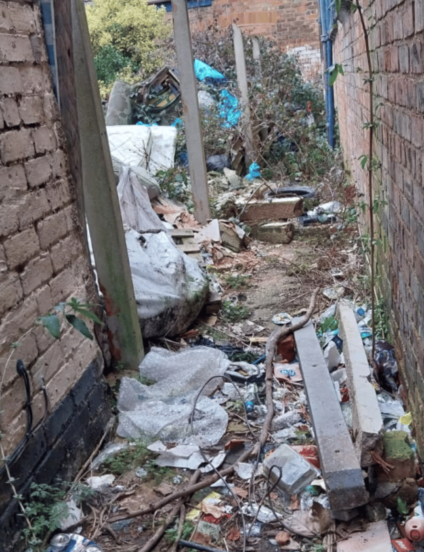
Figure 1.9: Derelict State Of One Back Alleway
This alleyway has not been maintained for several years, since one of the back entrances to the entrances to the building has been blocked up for security reasons. This minor development will make the maintenance of the alleyway necessary for the occupier/s of the building, since these entrances will be safe and required again. Also this will improve the safety and monitoring of the alleyway with CCTV cameras and make the surrounding houses and building much safer. For example the arson of 68 Harold Street would have been much less likely to happen if this alleyway were monitred and maintained. This another example of the many benefits brought by this minor development.
1.24: Sustainability of this proposed minor development (minor building alteration).
According ro the “International Institute for Sustainable Development”, the definition of sustainable development is :
“A development that meets the needs of the present without compromising the ability of future generations to meet their own needs.”
See https://www.iisd.org/mission-and-goals/sustainable-development
This is the definition adopted for “word by word” in the National Planning Framework.
Therefore, our proposed minor building alteration (minor development) meets this definition because:
It makes the installation of renewable energy sources possible . Hence increase the ability of “future generations to meet their own needs” by promoting a cleaner environment.
Additionally the need for lower maintenance reduces the inherent carbon footprint making this development a further substantial improvement compared to the present alternative (without the approval of our minor building alteration). Therefore the improvement of the building performance constitutes the accomplishment of the “sustainable” objective per se.
Because the new design will resolve the present issues of high maintenance, low security, vandalism and theft the lower running costs of the improved building will lead to the businesses occupying these building to have freed up resources, Those resources can be invested in apprenticeships, high skilled employment and business development in the area. This, therefore by definition, increase the ability “of future generations to meet their own needs”.
This minor building alteration will improve the overall outlook of the area hence “meets the needs of the present without compromising the ability of future generations to meet their own needs”.
This minor building alteration will bring to life a design witch is an improvement compared to the existing alternative and it will blend in a better fashion with the area. Therefore it “meets the needs of the present without compromising the ability of future generations to meet their own needs”
As a result of this minor development we will be thermally insulating the whole extension. This is a feasible investment because it will not add significant extra costs at the building stage and this will be integral part of the government requirement for sustainable development. At present the extension and the main building does not have any thermal insulation. We are under no legal obligation to incorporate any thermal insulation within any part of the building. However if planning permission is granted we will voluntarily integrate full thermal insulation to the extension.
To summarise, our minor developments ensure high levels of sustainability due to
- Low maintenance
- Making this extension suitable for the installation of renewable energy devices.
- High energy efficiency. Lower heating requirements due to the new thermal insulation. Lower carbon emissions.
- Increased inherent security
- Better overall design and construction
Therefore, this minor building alteration meets the definition of sustainable development as the definition adopted in the national planning policy. While at the same time, not only preserving the rights of the neighbouring properties but also meeting all other planning policies both local and national.
1.25: Unlocking the potential of green energy generation.
Our minor development unlocks the possibility, which is not currently achievable, of the green generation of electricity and heat. This is because the current roof configuration renders the installation of green energy sources a unviable investment.
1.26: The proposed use is suitable for the area
This application is not in connection with the use of the building. However given the local planning policy (as discussed at length) this use is perfectly in line with the stated local planning policy.
1.27: The appearance and size of this alteration is in keeping with its neighbours and the surrounding area.
The part of the building that our minor development is targeting is the rear of the building. The only part of the building easily visible from any main road is the front of the main building. This part of the building (the front) is not going to be affected by our minor development. The rest of the building is not visible from any main road. It is only visible from the back of the properties that surrounds it. A small potion is visible from the car park.
It said that, notwithstanding the fact that the building is concealed by the surrounding houses the design is considerable an improvement and perfectly in character with the surrounding area and the existing building. This is because the same or similar bricks will be used for the development.
The appearance of our minor development blends in with the surrounding properties.
1.28 These external alterations to the existing building is in character
The part of the building that will be altered is mostly concealed from public view. Therefore, whether in character or not should be a major concern from a planning perspective. However, even if it is a major concern, which is should not be, this alteration will be carried out using the same or similar external bricks as the original construction. Therefore, it is completely in character.
1.29 Potential increase in noise and disturbance, for example from the comings and goings of extra traffic
The minor development is a minor alteration to the building envelope only. No change of use is made under this application.
For these reasons, there is not going to be any increase in noise , disturbance or any increase in traffic.
1.30: Public footpaths remain unaffected
This minor development consists in a minor alteration only in the building envelope and does not affect any public footpaths or roads.
1.31: Visual effect on the landscape, i.e. loss of trees and
This minor development consists in a minor alteration only in the building envelope, and it is concealed from view from any public road. It clearly does not have any impact on any landscape, trees or hedgerows.
Overlooking
2.1: Overlooking.
Overlooking is one of the policy matters that needs to be taken into consideration in a general full planning application.
As we will see, this minor development causes no “material harm” to the existing houses in terms of privacy and overlooking. In some cases, not only does it not cause any material harm, but the new window openings are well over 20 metres away from any habitable room window, not causing overlooking in the first place.
2.2: Duplicating Existing Overlooking.
If other windows in the building or nearby already overlook the same area (e.g., a garden or window), adding another similar window doesn’t cause harm in a legally significant way. In such cases the impact is considered neutral or minimal, and therefore non-material.
To summarise, the windows on the extension are allowable because:
- There are already existing windows in the extension directly overlooking both properties facing Harold Street and Castle Street. Therefore, the addition of further windows on the upper levels facing the same direction will not cause loss of privacy.
- In the case of the properties facing Castle Street, the distance between the extension and the back windows of the uninhabitable rooms on the ground floor is over 20 meters. Therefore, even if no existing windows were present in the existing extension, the long distance allows brand-new windows to be placed on this side of the extension because when the distance is over 20 metres, as we will see below, directly-facing windows are not considered to cause loss of privacy due to the distance alone.
- Even in the case of the absence of existing windows in the extension, there is ample pre-existing loss of privacy from the other windows of neighbouring properties.
- Any new window openings on our extension both at ground floor and first floor level do not cause any loss of privacy due to the distance exceeding the minimum requirement of 15 meters in highly dense areas (where the site is located ) but even 20 and 24 meters, respectively.
- Any new windows on both ground and first floor extension are a simple addition to previously pre-existing windows.
- Even if these openings in the extension caused any loss of privacy (which they do not). There is an already established loss of privacy caused by another existing property due to the first windows overlooking into the rear of all the properties facing castle street. This will be examined in detail shortly.
- Even without the existing rights to the window openings in the extension, as we will see any new window opening on either side of the extension does not cause material harm to any neighbouring property. This is because the overlooking already exists from the main building and other properties. This exciting overlooking is a normal feature of city centre areas where this type of overlooking is also acceptable nowadays from a planning perspective.
2.7: The existing view into the back of the properties facing Castle Street from adjacent properties.
As we have seen above, the extension has pre-existing windows and door openings which look directly into the back of the properties facing Castle Street. However, given the distance from the extension to the back of the properties facing castle street, no addition to the windows in the extension, both on the ground floor and first floor can cause any loss of privacy.
However, the loss of privacy has already been caused, not by the windows in the extension, but by the adjacent property overlooking into the backyards and back windows of the properties facing castle street. These windows are at a distance well below the 20 meters and in some instances even less than the 15 metres threshold in city centres. However this level of overlooking , as we mentioned erier, is allowable because the rules for overlooking are relaxed due to the site location in a dense popu;ated city centre area.
To summarise, even if the windows and door in the extension were not previously present, any new windows both at ground and first floor levels of the extension would be allowable because:
- The distance from the extension to the closest window on the ground floor (non-habitable) of any property facing Castle Street is over 20 metres. The distance to the nearest habitable room window on the first floor is over 24 metres. As we can see in our development, the windows are 20.2 metre away from the closest ground floor window and approximately 24 metres away from the first floor windows, which are considered habitable. This clearly passes the standard test for overlooking. This is especially due to the fact that the allowable distance in the city centre can be relaxed down to 15 metres. Therefore, any new window openings on the extension are allowable.
- More importantly, there is a much more invasive overlooking issue from the first floor windows of the nearby property. This is the cause of the established loss of privacy of the properties facing castle street.
In essence, the proposed windows are duplicates of existing ones and face an elevation where overlooking is already established. A separation distance of over 20 metres from any habitable room window is maintained, in line with established privacy standards. Therefore, the proposal does not result in material harm to residential amenity.
2.8: Loss of privacy objections/overlooking. Where the loss of privacy has already occurred.
In case the existing windows of preexisting buildings have already caused a loss of privacy, the residents are already in loss of privacy and are assumed to have taken all possible measures to prevent the neighbours from overlooking, like using of blinds, curtains etc.
Where there has already been a previous loss of privacy, any additions of windows that are overlooking the same existing estates will not cause a further loss in privacy. This is because the affected residents will be required to take the exact same measures to prevent overlooking into their private dwellings. The test is, with or without development, will the residents reasonably need to take the same or similar measures to preserve their privacy?
Therefore, where a loss of privacy is already established, the addition of overlooking windows clearly do not constitute any “material harm”. If, before and after the development, the residents have to take the same measures as before to avoid being seen through the windows, then there is clearly “no material harm” caused by the development. On the contrary, if after the development, the residents require curtains and blinds to avoid overlooking which was not previously required, then “material harm” from the new development can be argued.
2.8.1: What is the minimum distance between directly facing windows?
Usually, the allowable distance between habitable room windows that are facing directly one another is 20 meters for suburbs. This is a very common standard used in planning for several years, and therefore this minimum distance has long been considered acceptable from a planning perspective.
The overlooking issue is more stringent into sleeping quarters. Sleeping quarters are usually located on the first floor. However, the minimum distance requirement is not as stringent when new windows look into kitchens and diners. There are even less stringent the overlooking issue into backyards.
The same privilege of right to privacy is not afforded in the same way to non-habitable room windows, like kitchens and sometimes dining and living rooms. Therefore, in suburbs the minimum distance can be less than 20 meters if the window is to a habitable space.
It has to be borne in mind first of all that it is customary for habitable rooms to be located on the first floor . The ground floor is rarely dedicated in single family homes to habitable rooms. These are usually , dining rooms kitchens etc. The areas of concern are the first floor rooms, which are the ones to be habitable.
These non-habitable spaces are usually, with some exceptions, located on the ground floor in detached and terraced houses. Therefore, the distance to neighbouring ground floor windows can also be less than 20 meters in suburbs.
As a general rule, any directly facing windows placed at a distance higher than 20 metres is not considered to cause loss of privacy from a planning perspective. Therefore, in a suburban area, any directly facing windows at a distance greater than 20 meters is considered allowable.
This 20-metre rule is often relaxed and reduced to 15 meters in city centre areas. This therefore becomes the minimum distance requirement for new directly facing windows in order not to cause loss of privacy in city centre areas. This is where our development is located. This reduction to 15 meters is considered necessary because, otherwise, no new developments would be possible where it is mostly needed. This is the reason for the relaxation of the minimum distance requirement in city centre areas.
2.9: Views at an angle
The above is true for planning standards for directly facing windows. However, even if the windows are not facing directly each other there is still a loss of privacy. Windows that provide views into other properties at an angles different to 90 degrees (direct facing view) also do cause a material loss of privacy. This is because even if the view is not as good as the direct facing windows, views into the internal space of a dwelling house is still possible at an angle.
Because of this the presence of these windows cause the affected household to require curtains and other obscuring measures to maintain their internal privacy. The closer the view is to 90 degrees the better the view into the window. Conversely, the smaller the angle the less the view. See the figure below for reference.
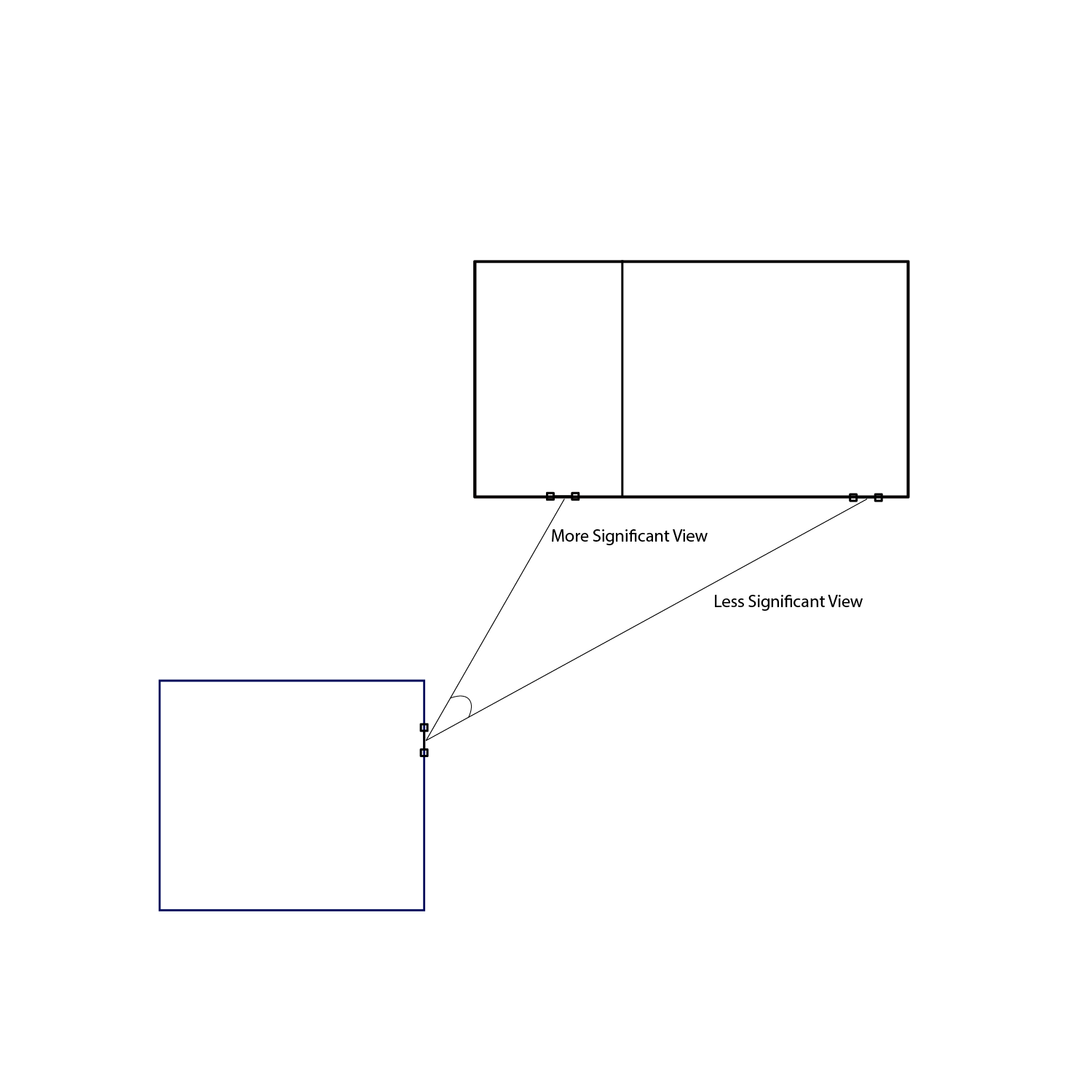
Figure 2.1. Even non-directly facing windows do provide a certain degree of overlooking (loss of privacy).
At an angle, a new window can be considered to cause a loss of privacy if:
- It allows a view into neighbouring habitable rooms, especially into Bedrooms
- It is within a certain distance.
- The angle of view allows enough view inside the dwelling house.
While there is no fixed national distance, many local authorities use a 20-metre rule for directly facing habitable windows.
The acid test for views at an angle is: does this view at an angle reasonably cause the neighbour to require taking measures to preserve their privacy by using curtains or blinds etc. As discussed at length in case where privacy is already lost then additional windows (duplicating windows) do not cause any material loos of privacy.
Parameters for establishing a “Material loss Of Privacy” for views into a habitable space in terms of distance and angle of view.
Distance from any habitable window to establish loss of privacy:
Less than 20 meters causes loss of privacy in suburban areas. This is a standard used in planning for several years and very well accepted for testing overlooking into habitable rooms. The distance can be shortened considerably to even half 10 metres in certain cases if the view is into an uninhabitable space like kitchen, dining areas etc.
Less than 15 meters causes loss of privacy in city centre areas. The distance can be shortened considerably to even half 5 to 6 metres in certain cases if the view is into an uninhabitable space like kitchen and dining areas.
Provided that the distance between windows are below the above stated thresholds, angle of views to establish loss of privacy maybe as follows:
- Less than 15 degrees angle, no material loss of privacy
- 20 to 15 degree angle could be cause of concern of loss of privacy. This mean that people especially prone to preserve their privacy could subjectively believe that the privacy have been lost.
- More than 20 degree angle, loss of privacy as the angle of view is sufficient to have enough internal view of the premises is that it is objectively required to use means of privacy preservation like curtains, blinds etc.
Therefore:
- Any view into a habitable window at a distance less than 20 meters and an angle greater than 20 degrees may constitute a potential loss of privacy in a suburban area.
- Any view into a habitable window at a distance less than 15 meters and an angle greater than 20 degrees may constitute a potential loss of privacy in a city centre area.
2.10: Established loss of privacy of the properties facing Castle Street.
Because there are established existing windows and an entrance door on the side of the extension facing the properties in Castle Street, placing windows on this side of the extension does not require planning permission due to established rights.
However, as we have seen, even if there are no pre-existing windows on this side of the extension, the extension is 20.2 meters from the nearest ground floor window (kitchens, non-habitable) and 24 meters from the first floor habitable windows of the properties facing castle street.
Therefore, the windows on this side of the extension are considered not to cause any overlooking even by suburban standards. Therefore, any window opening on both ground and upper levels are allowable from a planning perspective.
Given the above, there is no need to examine any existing loss of privacy from any properties. However, we have done this as part of our due diligence to show how existing properties already cause a material loss of privacy to these properties.
Here we are going to examine the views of the neighbouring property’s first floor windows. Specifically, we are going to examine the existing areas overlooking the properties’ back windows facing Castle Street.
Ground floor window
[vc_single_image image=”11256″ img_size=”full” onclick=”custom_link” link=”https://areton-ltd.com/Aretonoldbackup/wp-content/uploads/2024/11/visulization-1.4.pdf”]
Visualisation 1.1
This analysis assesses privacy implications based on distances and viewing angles, using the standard thresholds:
-
Suburban threshold: 20 meters
-
City center threshold: 15 meters
-
Viewing angle concern threshold: 20° and above
-
General rule: If the space being viewed is non-habitable on the ground floor, there is no material loss of privacy, even if the distance is under 20m.
🔹 1. 17816 – 59° – Distance: 17.81 meters
-
Distance: Below both suburban and city thresholds.
-
Angle: 59° (wide view).
-
Assessment: The wide angle and close distance typically suggest a strong visibility concern.
-
Conclusión:
⚠️ Potential privacy intrusion, but 🛑 Likely material loss of privacy since the space is habitable.
🔹 2. 19015 – 54° – Distance: 19.01 meters
-
Distance: Slightly below suburban threshold.
-
Angle: 54° (moderate to wide).
-
Assessment: Could potentially view into private areas, but depends on space usage.
-
Conclusión:
⚠️ Privacy concern exists, but 🛑 Likely material loss space is habitable.
🔹 3. 23211 – 42° – Distance: 23.21 meters
-
Distance: Well above all thresholds.
-
Angle: 42° (very wide).
-
Assessment: The wide view is mitigated by the long distance.
-
Conclusión:
✅ No loss of privacy.
🔹 4. 24824 – 38° – Distance: 24.82 meters
-
Distance: Substantially above all thresholds.
-
Angle: 38° (extremely wide).
-
Assessment: Though the angle is high, the distance is safe.
-
Conclusión:
✅ No loss of privacy.
Summary Table Visualisation 1.1
| Label | Distancia | Angle | Privacy Risk | Conclusión |
|---|---|---|---|---|
| 17816 | 17.81m | 59° | High | ⚠️Likely material loss of privacy (Habitable) |
| 19015 | 19.01m | 54° | Moderate/High | ⚠️Likely material loss of privacy ( Habitable) |
| 23211 | 23.21m | 42° | Baja | ✅ Likely No Material Lose of Privacy |
| 24824 | 24.82m | 38° | Very Low | ✅ Likely No Material Lose of Privacy |
[vc_single_image image=”11254″ img_size=”full” onclick=”custom_link” link=”https://areton-ltd.com/Aretonoldbackup/wp-content/uploads/2024/11/visulization-1.2.pdf”]
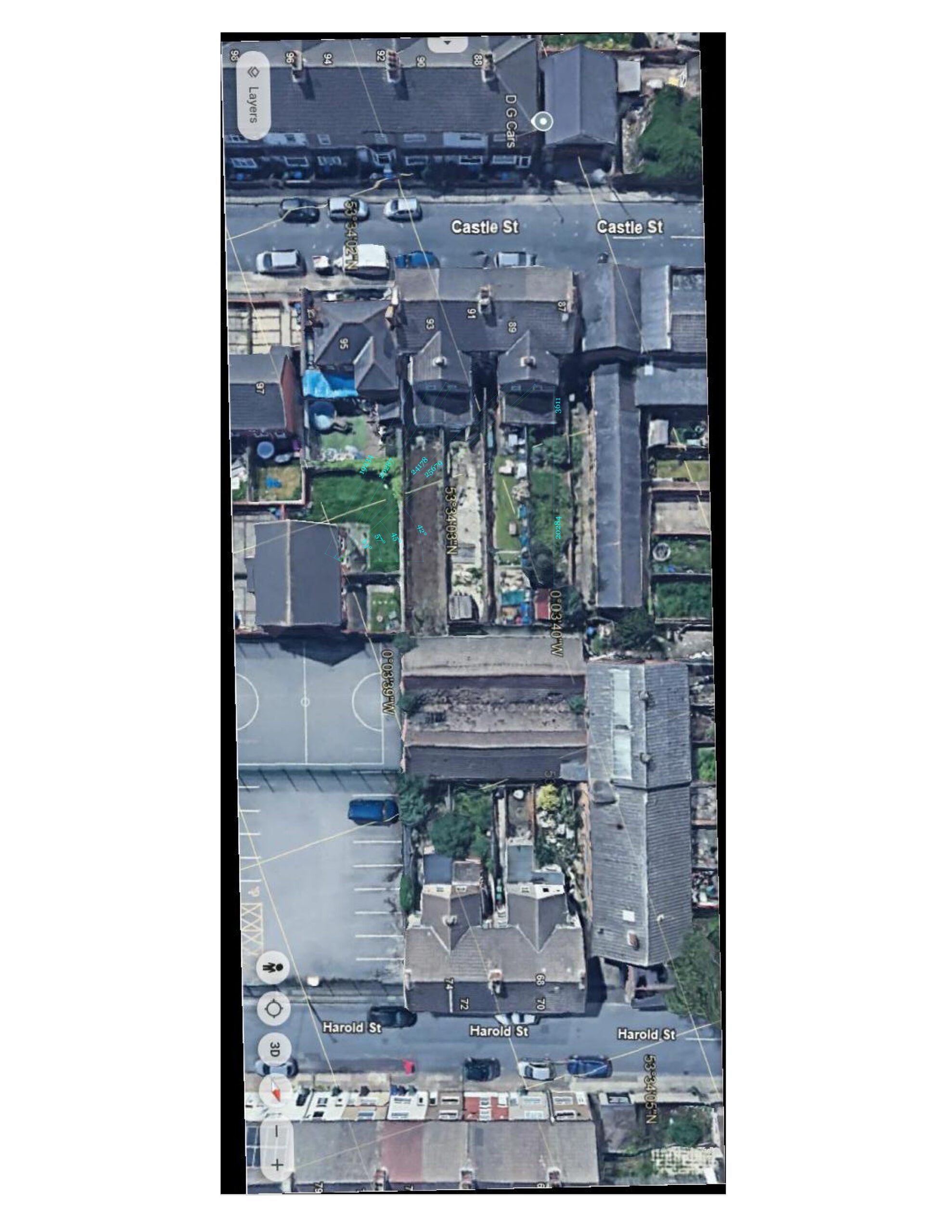
Visualisation 1.2
Analysis Based on Parameters:
This analysis evaluates potential privacy loss based on two main parameters:
-
Distance threshold (Suburban context):
Less than 20 meters → Possible privacy loss
Greater than or equal to 20 meters → No privacy concern -
Angle threshold:
Greater than 20° → Potential for visibility into private areas
🔹 1. 19234 – 63° – Distance: 19.234 meters
-
Distance: Just below suburban threshold.
-
Angle: 63°, which is very wide.
-
Assessment: This is the only combination that qualifies as a potential privacy concern, since both the distance is below 20m y el angle is wide.
-
Conclusión:
⚠️ Loss of privacy can be argued, depending on the use of the space. If the view is into non-habitable ground floor, 🛑 no material privacy loss occurs.
🔹 2. 20287 – 57° – Distance: 20.297 meters
-
Distance: Slightly above suburban threshold.
-
Angle: 57°, wide view.
-
Conclusión:
✅ No loss of privacy — Distance exceeds threshold, mitigating the wide viewing angle.
🔹 3. 24178 – 45° – Distance: 24.178 meters
-
Distance: Significantly above threshold.
-
Angle: 45°, wide angle.
-
Conclusión:
✅ No loss of privacy — Safe distance outweighs the wide field of view.
🔹 4. 25679 – 42° – Distance: 25.679 meters
-
Distance: Far above threshold.
-
Angle: 42°, moderately wide.
-
Conclusión:
✅ No privacy concern — Excellent distance.
Summary Table Visualisation 1.2
| Label | Distancia | Angle | Privacy Risk | Conclusión |
|---|---|---|---|---|
| 19234 | 19.234m | 63° | High | ⚠️Likely material loss of privacy (Habitable) |
| 20297 | 20.297m | 57° | Baja | ✅Likely No Material Lose of Privacy |
| 24178 | 24.178m | 45° | Very Low | ✅ Likely No Material Lose of Privacy |
| 25679 | 25.679m | 42° | Very Low | ✅ Likely No Material Lose of Privacy |
[vc_single_image image=”11255″ img_size=”full” onclick=”custom_link” link=”https://areton-ltd.com/Aretonoldbackup/wp-content/uploads/2024/11/visulization-1.3.pdf”]
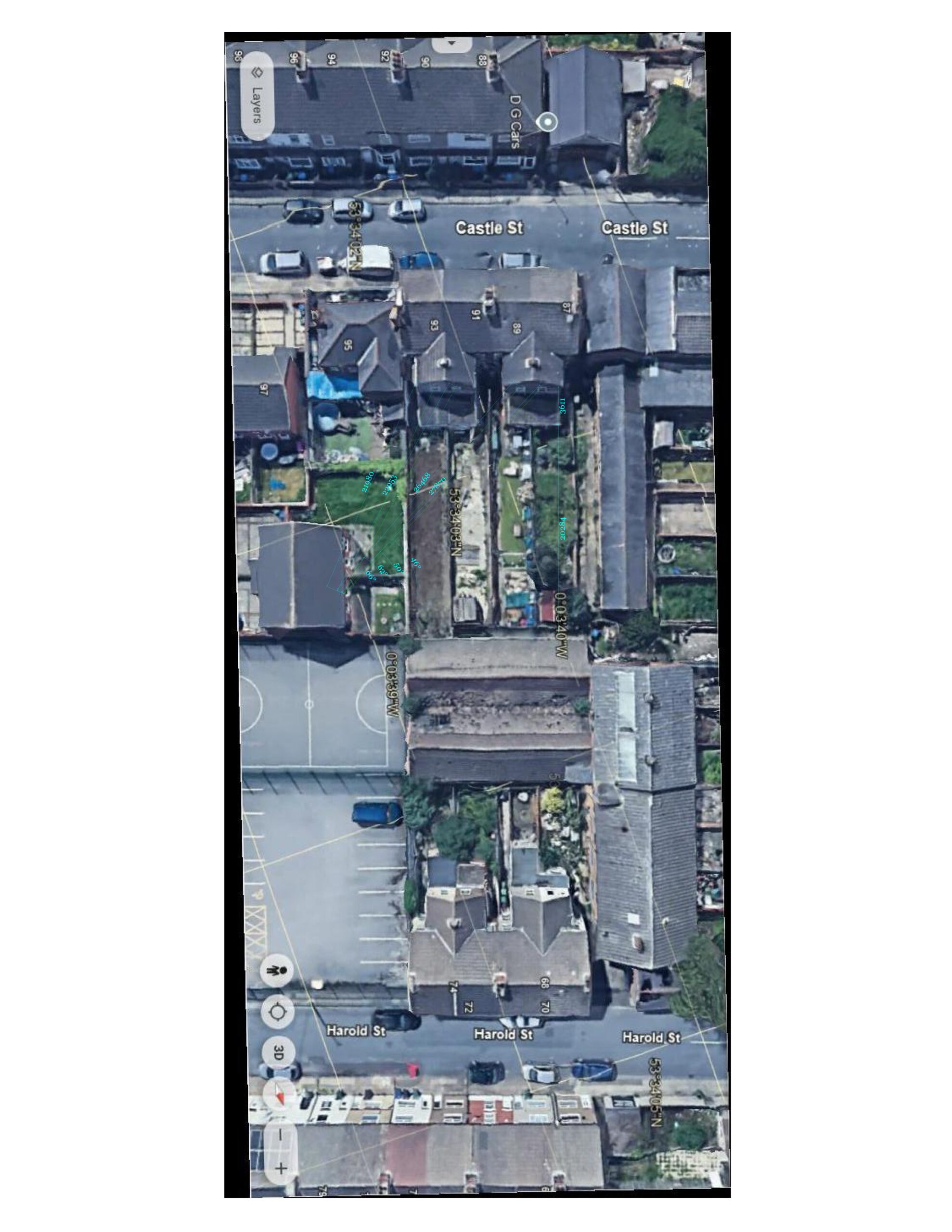
Visualisation 1.3
[vc_single_image image=”11256″ img_size=”full” onclick=”custom_link” link=”https://areton-ltd.com/Aretonoldbackup/wp-content/uploads/2024/11/visulization-1.4.pdf”]
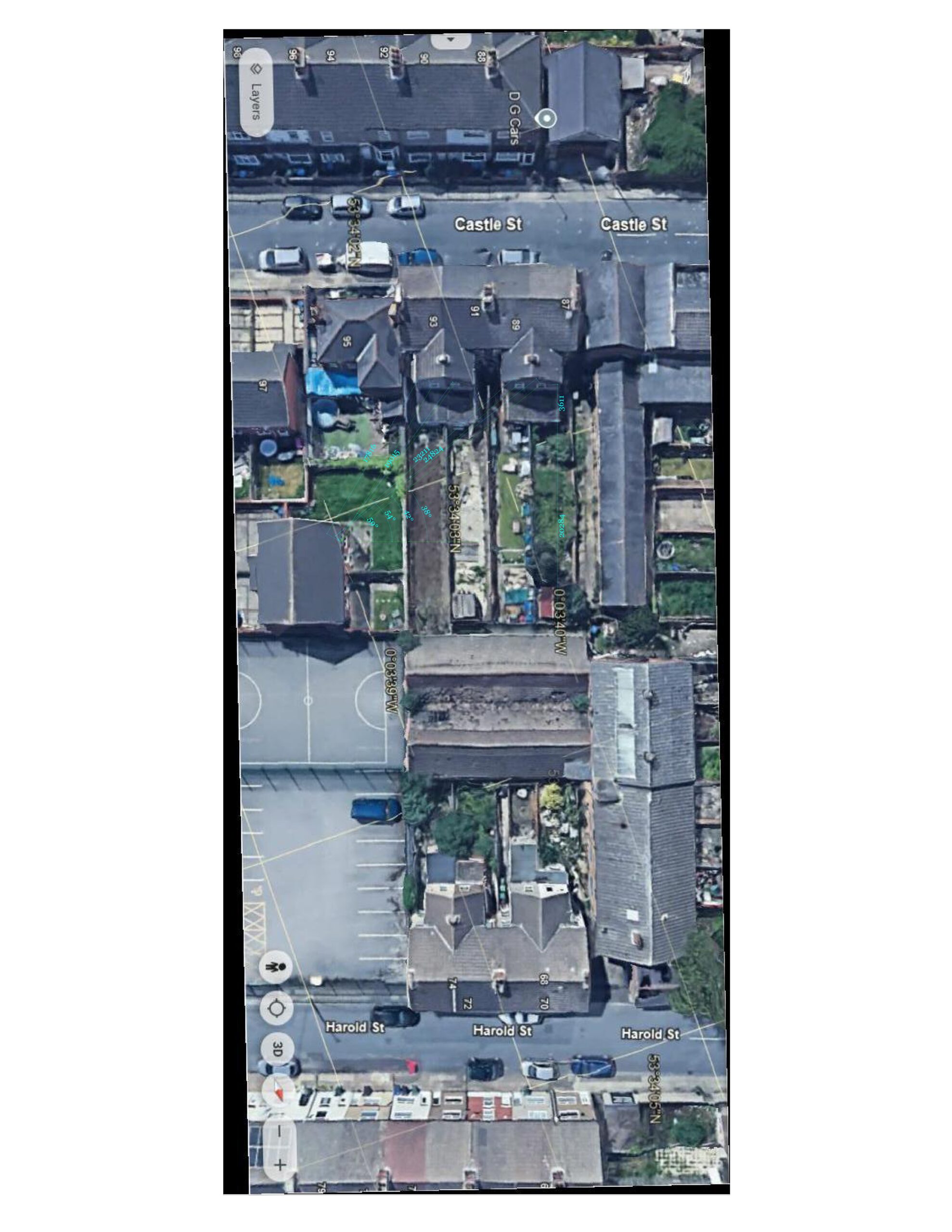
Visualisation 1.4
We see the direct distance between the existing windows on the extension and the ground floor windows for the non habitable rooms being over 20 meters.
The direct distance between the existing windows and the first floor habitable rooms of the properties facing castle street is approximately 24 metres which is well the acceptable threshold. Hence, even if no existing windows were present in this side of the extension, new windows would be permissible due to the distance being over the threshold.
Hence no legitimate claim of overlooking or loss of privacy can be made due to any of the windows facing the properties on Castle Street, even if not window openings were previously present.
However, we continue this study to highlight how existing developments already cause a degree of overlooking and potential loss of privacy..
This analysis evaluates privacy implications based on direct distances and viewing angles from the windows of a proposed extension to surrounding properties. It uses the following thresholds:
-
Suburban threshold: 20 meters
-
City centre threshold: 15 meters
-
Viewing angle concerning threshold: 20° or greater
-
Privacy rule: No material loss of privacy is considered if a non-habitable ground floor space is being viewed—even when within 20 meters.
🔹 Viewpoint 1: 23388 – 23.38 meters – 68°
Distance: Above threshold.
Angle: Wide view, though not intrusive due to sufficient distance.
Conclusión: ✅ No privacy loss.
🔹 Viewpoint 2: 24332 – 24.33 meters – 63°
Distancia: Well above both suburban and city center thresholds.
Angle: Extremely wide view, but mitigated by long distance.
Conclusión: ✅ No privacy loss.
🔹 Viewpoint 3: 27646 – 27.64 meters – 52°
Distancia: Far above the minimum threshold.
Conclusión: ✅ No privacy loss.
🔹 Viewpoint 4: 28945 – 28.94 meters – 48°
Distancia: Substantial distance from neighbouring properties.
Angle: Extremely wide viewing angle.
Conclusión: ✅ No privacy loss.
Summary Table Visualisation 1.4
| Viewpoint | Distancia | Angle | Privacy Risk | Conclusión |
|---|---|---|---|---|
| 23388 | 23.38 m | 68° | Very Low | ✅ Likely No Material Lose of Privacy |
| 24332 | 24.33 m | 63° | Very Low | ✅ Likely No Material Lose of Privacy |
| 27646 | 27.64 m | 52° | Very Low | ✅Likely No Material Lose of Privacy |
| 28945 | 28.94 m | 48° | Extremely Low | ✅ Likely No Material Lose of Privacy |
[/vc_column_text][/vc_column][/vc_row][vc_row][vc_column][vc_single_image image=”11245″ img_size=”full” onclick=”custom_link” link=”https://areton-ltd.com/Aretonoldbackup/wp-content/uploads/2024/11/2.1.pdf”]

Visualisation 2.1
Views into non habitable space on the ground floor.
1. 14585 – 52° – Distance: 14.58 meters
Distance (14.58m): Well below thresholds.
Check: Again, ground floor is non-habitable.
Conclusión: ⚠️ High privacy risk, but 🛑 Likely no material loss of privacy if non-habitable.
2. 16128 – 44° – Distance: 16.12 meters
Distance (16.12m): Below both suburban and city thresholds.
Angle (52°): Moderate, but wide enough to see into private areas.
Check: the view is into non-habitable space on the ground floor,
🛑 No material loss of privacy.
Conclusión: ⚠️ Potential privacy concern, but ❌ Likely no material loss due to space usage.
3. 21089 – 33° – Distance: 21.0 meters
Distance (21.0m): Slightly over suburban threshold.
Angle (44°): Very wide viewing angle.
Conclusión:
✅ No loss of privacy — Angle is wide, but distance keeps it safe.
4. 23153 – 30° – Distance: 23.1 meters
Distance (23.1m): Above suburban (20m) and city center (15m) thresholds → safe zone.
Angle (33°): Wide, above 20° threshold.
Conclusión:
✅ No loss of privacy — Distance mitigates any potential visual intrusion despite the wide angle.
Summary Table Visualisation 2.1
| Label | Distancia | Angle | Privacy Risk | Conclusión |
|---|---|---|---|---|
| 14585 | 14.58m | 52° | High | ⚠️Likely no material loss of privacy (ground floor non-habitable) |
| 16128 | 16.12m | 44° | Moderate | ⚠️Likely no material loss of privacy (ground floor non-habitable) |
| 21089 | 21.0m | 33° | Low/Moderate | ✅ Likely No Material Lose of Privacy |
| 23153 | 23.1m | 30° | Baja | ✅ Likely No Material Lose of Privacy |
[vc_single_image image=”11248″ img_size=”full” onclick=”custom_link” link=”https://areton-ltd.com/Aretonoldbackup/wp-content/uploads/2024/11/2.2.pdf”]
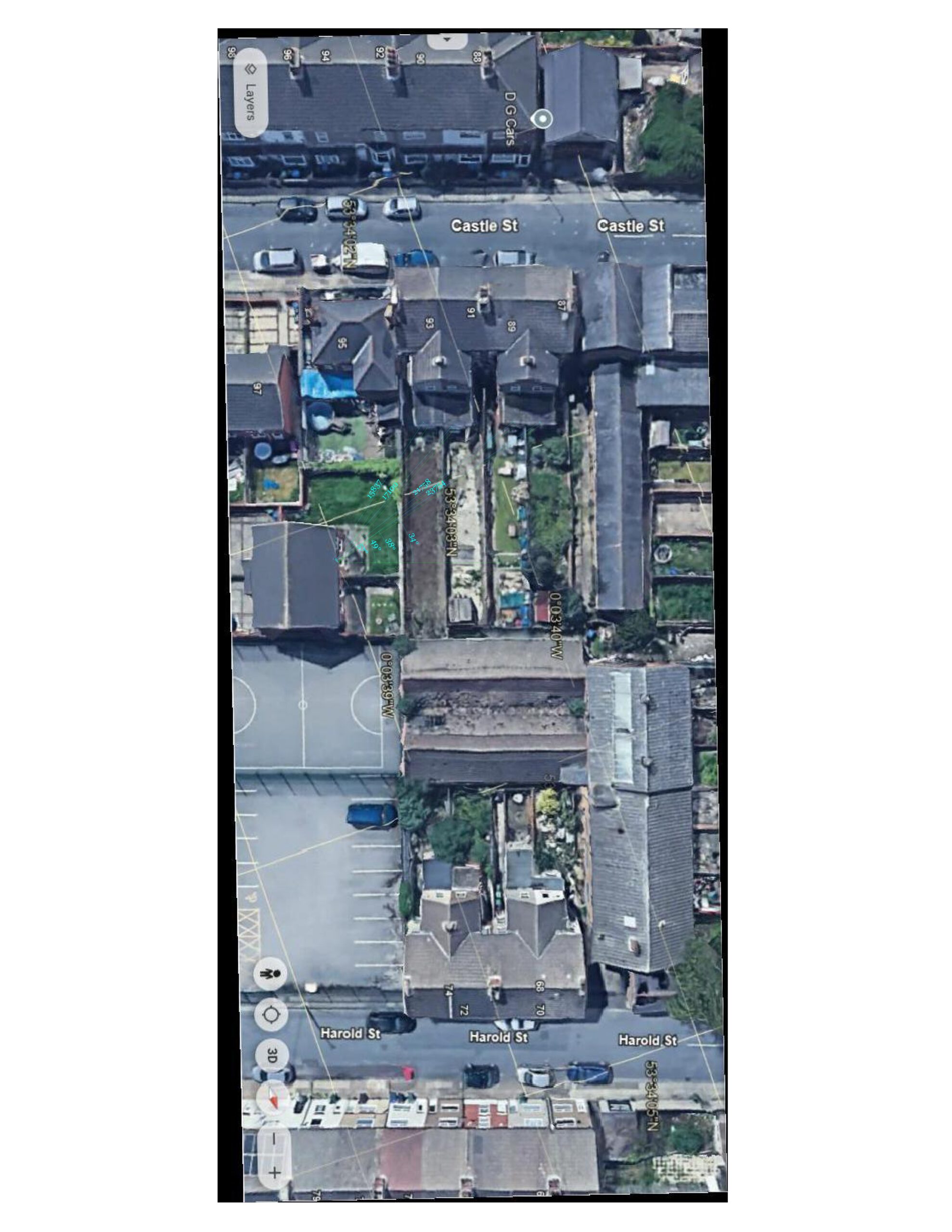
Visualisation 2.2
Another view into the first floor windows of the properties facing Castle Street. These are non habitable windows.
1. 15837 – 57° – Distance: 15.83 meters
Distance (15.83m): Below both thresholds → high concern for habitable spaces.
Angle (57°): Very wide field of view → strong potential for intrusion.
Check: If this is a ground floor view into non-habitable space,
❌ Still no material privacy loss. Conclusión: ⚠️ Privacy concern, but Likely No material loss of privacy because the space is non-habitable.
2. 17100 – 49° – Distance: 17.10 meters
Distance (17.1m): Below both suburban and city thresholds → normally a concern.
Angle (49°): Wide viewing angle; potential intrusion.
BUT: If the view is into ground floor, non-habitable space,
❌ Like No material privacy loss applies.
Conclusión:⚠️ Significant privacy concerns can be argued, Likely No material loss of privacy because the space is non-habitable ground floor.
3. 21758 – 38° – Distance: 21.7 meters
Distance (21.7m): Slightly above suburban threshold, well above city center’s.
Angle (38°): Moderate to wide angle.
Conclusión: ✅ No privacy loss — Sufficient distance offsets angle.
4. 23754 – 34° – Distance: 23.7 meters
Distance (23.7m): Well beyond both suburban (20m) and city center (15m) thresholds.
Angle (34°): Above 20°, allowing a moderate view.
Conclusión: ✅ No privacy loss — Distance sufficiently mitigates any visibility concerns, despite the angle.
Summary Table Visualisation 2.2
| Label | Distancia | Angle | Privacy Risk | Conclusión |
|---|---|---|---|---|
| 15837 | 15.83m | 57° | Very High | ⚠️Likely no material loss of privacy (ground floor non-habitable) |
| 17100 | 17.1m | 49° | High | ⚠️Likely no material loss of privacy (ground floor non-habitable) |
| 21758 | 21.7m | 38° | Moderate | ✅ Likely No Material Lose of Privacy |
| 23754 | 23.7m | 34° | Baja | ✅ Likely No Material Lose of Privacy |
[vc_single_image image=”11250″ img_size=”full” onclick=”custom_link” link=”https://areton-ltd.com/Aretonoldbackup/wp-content/uploads/2024/11/2.3.pdf”]
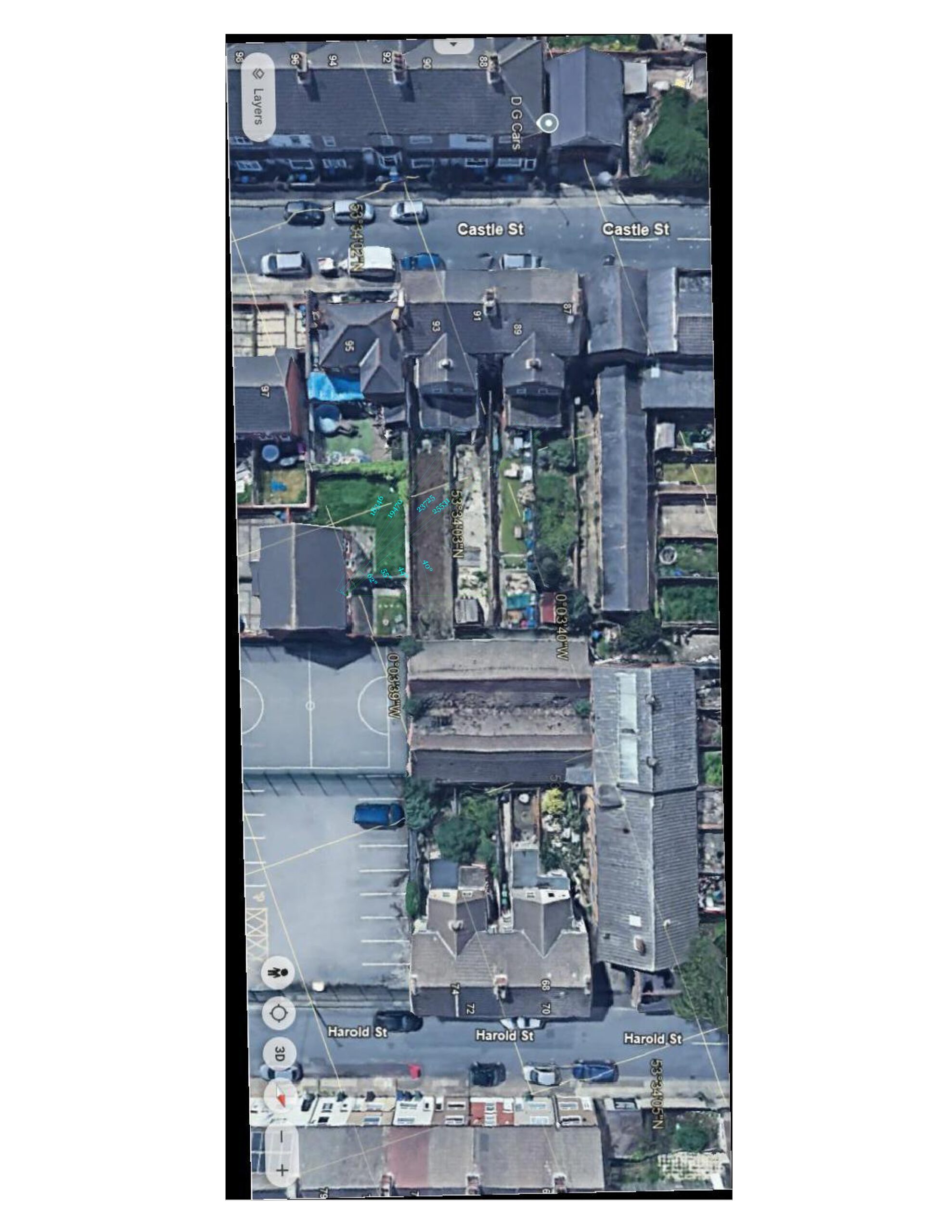
Visualisation 2.3
1. 18346 – 62° – Distance: 18.34 meters
Distance (18.34m): Below both thresholds.
Angle (62°): Wide and may allow private views.
Check: If this is ground floor, non-habitable — still okay.
Conclusión: ⚠️ Potential privacy intrusion, Likely No material loss of privacy because the space is non-habitable.
2. 19470 – 55° – Distance: 19.47 meters
Distance (19.47m): Just under suburban threshold, below both technically.
Angle (55°): Very wide and potentially intrusive.
Check: If the view is into ground floor non-habitable space,
🛑 Likely No material loss of privacy.
Conclusión:⚠️ Privacy concern, Likely No material loss of privacy because the space is non-habitable.
3. 23725 – 44° – Distance: 23.72 meters
Distance (23.72m): Exceeds both suburban (20m) and city center (15m) thresholds.
Angle (44°): Wide field of view.
Conclusión: ✅ No loss of privacy — Distance ensures that even with a wider angle, there is no intrusion.
4. 25531 – 40° – Distance: 25.53 meters
Distance (25.53m): Well above all thresholds.
Angle (40°): Very wide field of view.
Conclusión: ✅ No loss of privacy — Distance completely eliminates any risk of intrusion, even with a very wide angle.
Summary Table Visualisation 2.3
| Label | Distancia | Angle | Privacy Risk | Conclusión |
|---|---|---|---|---|
| 18346 | 18.34m | 62° | Moderate/High | ⚠️Likely no material loss of privacy (ground floor non-habitable) |
| 19470 | 19.47m | 55° | High | ⚠️Likely no material loss of privacy (ground floor non-habitable) |
| 23725 | 23.72m | 44° | Baja | ✅ Likely No Material Lose of Privacy |
| 25531 | 25.53m | 40° | Very Low | ✅ Likely No Material Lose of Privacy |
[vc_single_image image=”11252″ img_size=”full” onclick=”custom_link” link=”https://areton-ltd.com/Aretonoldbackup/wp-content/uploads/2024/11/2.4.pdf”]
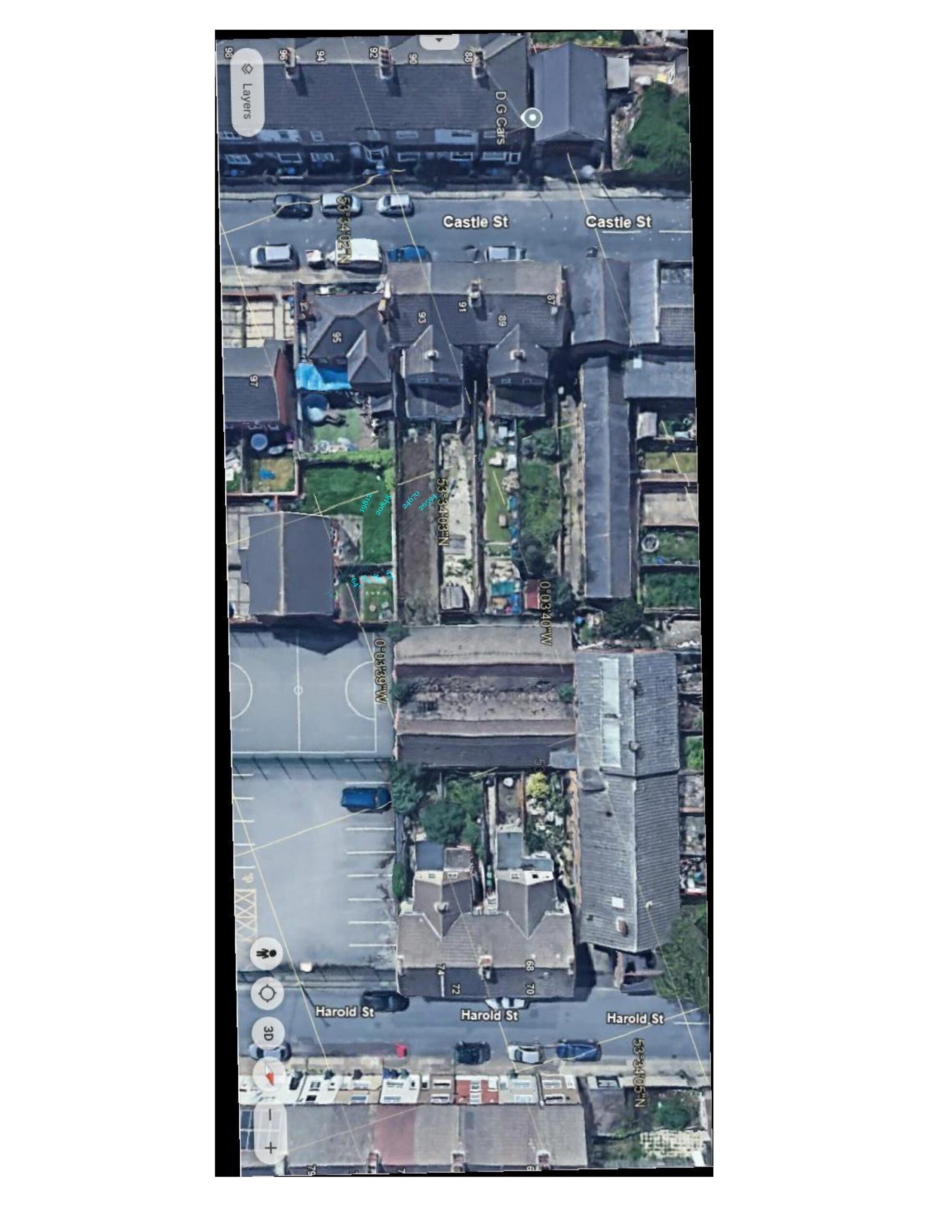
Visualisation 2.4
1. 19812 – 64° – Distance: 19.81 meters
Distance (19.81m): Slightly below suburban threshold.
Angle (64°): Very wide, potentially intrusive.
Check: If viewing ground floor non-habitable space,
🛑 Likely No material loss of privacy.
Conclusión: ⚠️ Privacy concern due to short distance and wide angle, but Likely No material loss of privacy because the space is non-habitable.
2. 20848 – 57° – Distance: 20.84 meters
Distance (20.84m): Slightly above suburban threshold.
Angle (57°): Very wide and intrusive.
Check: View is into ground floor non-habitable space,
🛑 Likely No material loss of privacy.
Conclusión:⚠️ Wide angle, but Likely No material loss of privacy because the space is non-habitable.
3. 24670 – 46° – Distance: 24.67 meters
Distance (24.67m): Above both suburban (20m) and city center (15m) thresholds.
Angle (46°): Wide field of view, over the 20° threshold.
Conclusión: ✅ No loss of privacy — Distance exceeds thresholds, so the wider angle does not result in intrusion.
4. 26594 – 43° – Distance: 26.59 meters
Distance (26.59m): Well above both thresholds.
Angle (43°): Very wide viewing angle.
Conclusión: ✅ No loss of privacy — Distance completely negates impact of wide angle.
Summary Table Visualisation 2.4
| Label | Distancia | Angle | Privacy Risk | Conclusión |
|---|---|---|---|---|
| 19812 | 19.81m | 64° | High | ⚠️Likely no material loss of privacy (ground floor non-habitable) |
| 20848 | 20.84m | 57° | Baja | ✅ Likely No Material Lose of Privacy |
| 24670 | 24.67m | 46° | Baja | ✅ Likely No Material Lose of Privacy |
| 26594 | 26.59m | 43° | Very Low | ✅ Likely No Material Lose of Privacy |
[vc_single_image image=”11257″ img_size=”full” onclick=”custom_link” link=”https://areton-ltd.com/Aretonoldbackup/wp-content/uploads/2024/11/3.1.pdf”]
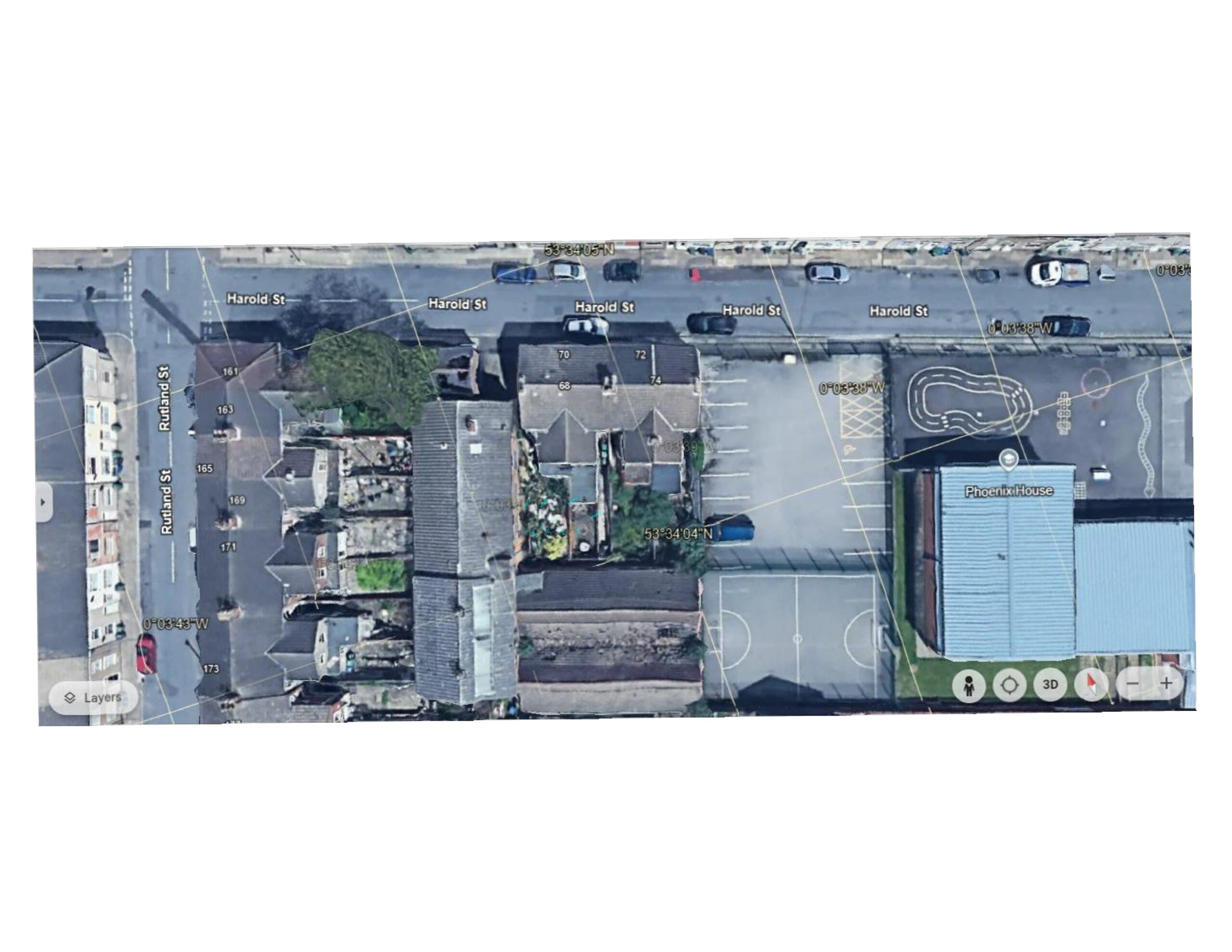
Visualisation 3.1
[vc_single_image image=”11258″ img_size=”full” onclick=”custom_link” link=”https://areton-ltd.com/Aretonoldbackup/wp-content/uploads/2024/11/3.2.pdf”]
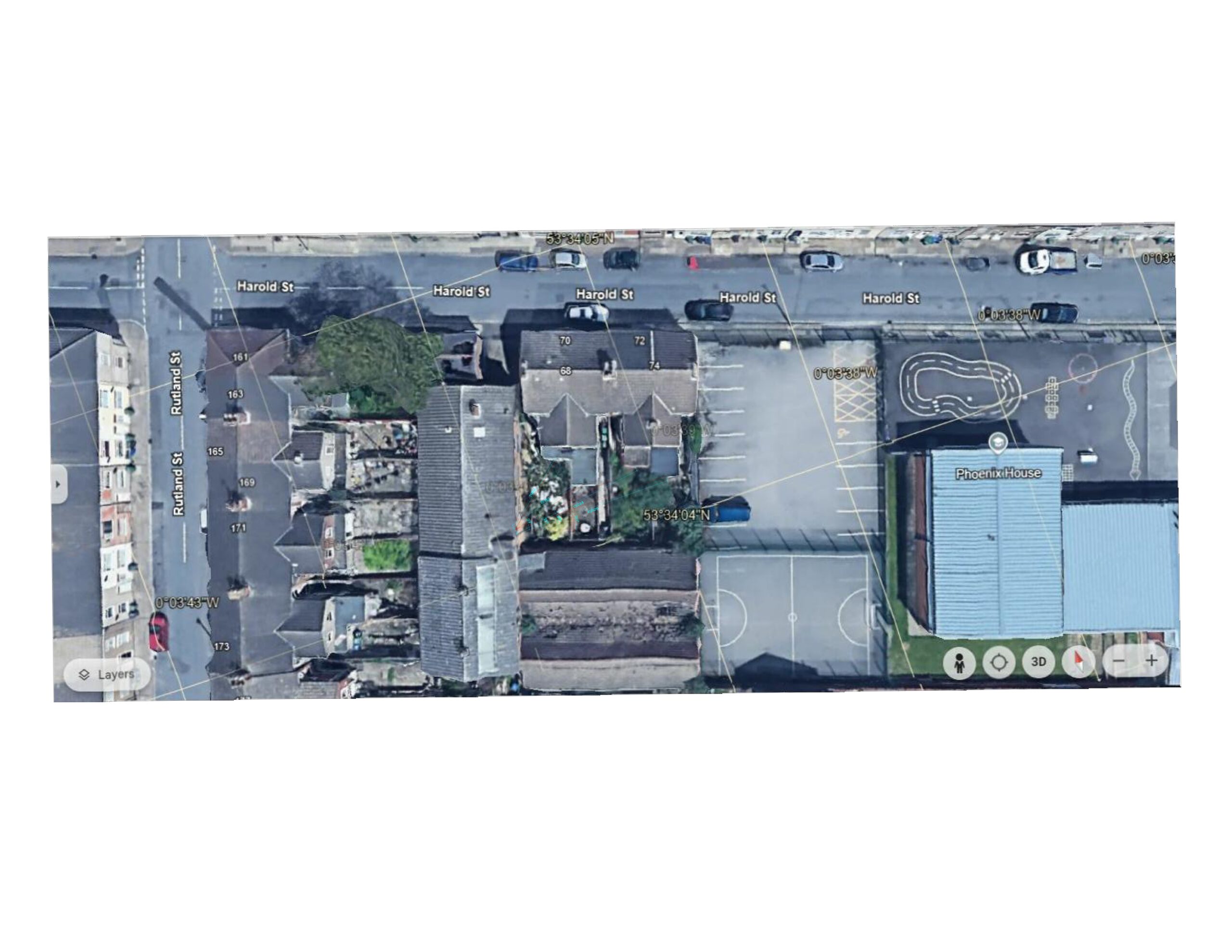
Visualisation 3.2
1. 7962 – 59° – Distance: 7.96 meters
-
🚨 Distance: Way below 20m suburban threshold.
-
✅ Angle: Very wide (59°).
Conclusión:
🛑 Significant loss of privacy — Extremely short distance and very wide angle enable deep visibility into private outdoor areas (gardens, patios, etc.).
2. 8053 – 33° – Distance: 8.05 meters
-
🚨 Distance: Far below threshold.
-
✅ Angle: Moderately wide (33°).
Conclusión:
⚠️ Privacy concern — Though less intrusive than 59°, this combo still presents clear risk due to close proximity and visibility into sensitive spaces.
3. 13244 – 28° – Distance: 13.24 meters
-
⚠️ Distance: Below 20m, but moderately placed.
-
✅ Angle: Moderate (28°).
Conclusión:
⚠️ Moderate privacy concern — Focused visibility into neighboring zones. Not severe, but residents may still feel observed.
4. 15629 – 20° – Distance: 15.62 meters
-
✅ Distance: Closer to the 20m threshold, but still under.
-
⚠️ Angle: Right at 20°, threshold limit.
Conclusión:
✅ Minimal privacy concern — Narrow view and greater distance reduce risk, but may still feel intrusive to privacy-conscious residents.
Summary Table Visualisation 3.2
| Label | Distancia | Angle | Privacy Risk | Conclusión |
|---|---|---|---|---|
| 7962 | 7.96m | 59° | High | ⚠️Likely no material loss of privacy (ground floor non-habitable) |
| 8053 | 8.05m | 33° | High | ⚠️Likely no material loss of privacy (ground floor non-habitable) |
| 13244 | 13.24m | 28° | Moderate | ⚠️Likely no material loss of privacy (ground floor non-habitable) |
| 15629 | 15.62m | 20° | Low–Moderate | ✅ Likely No Material Lose of Privacy |
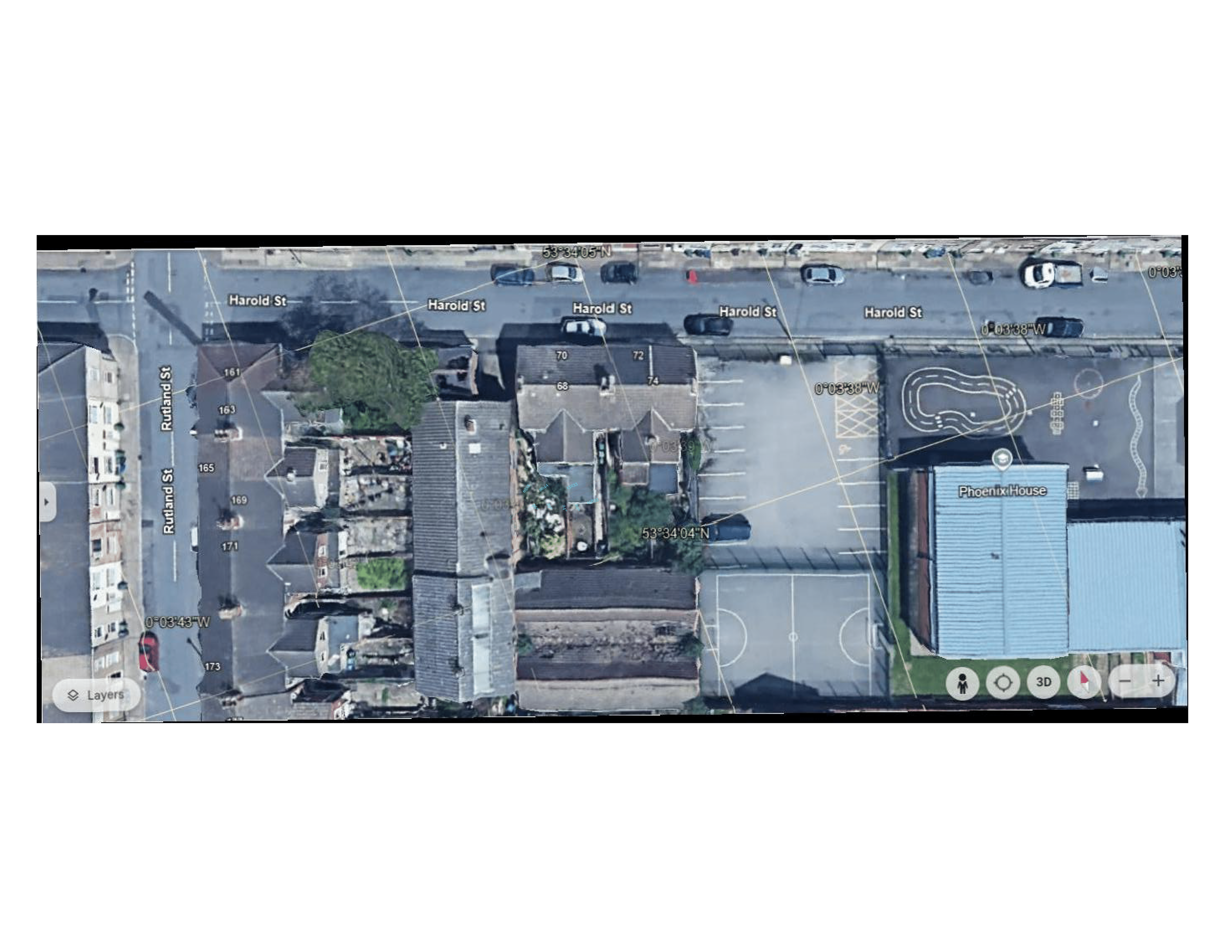
Visualization 3.3
This particular view not only causes a material loss of privacy to the backyard of all the properties facing hard street. But due to its angle of view and distance to the first floor windows, it starts to provide an almost direct clear view through the first floor windows. This causes a CLEAR material loss of privacy directly into the first floor sleeping charters of the dwelling house. This constitutes a clear loss of privacy not only due to the short distance that starts at just above 6 meters in to first floor window of 68 Harold Street, but also to a maximum of 10 meters into the first floor window of 72 Harold Street. The angles of view offer a clear view inside the dwelling house through the first floor windows directly inside the sleeping quarters.
1. 6513 – 56° – Distance: 6.51 meters (First-floor windows)
-
🚨 Distance: Way below the 20m threshold.
-
🚨 Angle: Very wide (56°), offering a direct view inside.
Conclusión:
🛑 Material loss of privacy — Direct intrusion into habitable first-floor rooms. Strongest privacy breach in the file.
2. 8644 – 39° – Distance: 8.64 meters
-
✅ Distance: Very far — no intrusion from proximity.
-
⚠️ Angle: Wide enough to raise concerns if pointed at specific zones.
Conclusión:
✅ Generally no loss of privacy — But placement-sensitive. Only intrusive if view is directed at private windows.
3. 13233 – 24° – Distance: 13.233 meters
-
✅ Distance: Extremely long.
-
⚠️ Angle: Same as above (24°).
Conclusión:
✅ No loss of privacy — Long distance reduces any risk. Only becomes a concern if overlooking vulnerable residential zones.
4. 15833 – 20° – Distance: 15.833 meters
-
✅ Distance: Longest in the dataset.
-
⚠️ Angle: At privacy threshold (20°), wide view possible.
Conclusión:
✅ No loss of privacy — Wide field of view, but distance fully mitigates potential intrusion.
Summary Table Visualisation 3.3
| Label | Distancia | Angle | Privacy Risk | Conclusión |
|---|---|---|---|---|
| 6513 | 6.51m | 56° | Very High | 🛑 Clear material loss of privacy first-floor rooms |
| 8644 | 8.64m | 39° | High | 🛑Material Lose of Privacy ( Habitable ) |
| 13233 | 13.233m | 24° | High | ✅ Likely No Material Lose of Privacy ( Habitable ) |
| 15833 | 15.833m | 20° | Baja | ✅ Likely No Material Lose of Privacy ( Habitable ) |
[vc_single_image image=”11260″ img_size=”full” onclick=”custom_link” link=”https://areton-ltd.com/Aretonoldbackup/wp-content/uploads/2024/11/3.4.pdf”]

Visualisation 3.4
This particular view not only cause a material loss of privacy to the back yard of all the properties facing harold Street. But due to its angle of view and distance to the ground floor windows it starts to provide an internal view through the ground floor windows. Hence, the material loss of privacy implication is not only to the back yard but it is also to the internal areas of the dwelling houses on the ground floor.
📌 Critical Privacy Concern: Ground Floor Intrusion – Harold Street
This particular configuration causes material loss of privacy in two key ways:
-
✅ Backyard visibility for all properties facing Harold Street.
-
✅ Internal visibility into ground floor rooms — not just external observation.
This is not a minor or abstract issue — it directly impacts internal, potentially habitable areas.
Analysis – Visualisation 3.4
1. 5852 – 45° – Distance: 5.85 meters
-
🚨 Distance: Very short, far below suburban (20m) threshold.
-
✅ Angle: Wide (45°), offers direct interior views.
Conclusión:
🛑 Material loss of privacy — Combination of wide angle + short distance leads to clear visibility into internal ground floor rooms (likely habitable). The strongest breach in this set.
2. 7022 – 14° – Distance: 7.02 meters
-
🚨 Distance: Very short.
-
⚠️ Angle: Narrow, but still above 10°, enabling focused visibility.
Conclusión:
⚠️ Privacy concern — Narrow field, but short range enables internal ground floor views. If space is non-habitable, risk may be lower.
3. 12307 – 16° – Distance: 12.30 meters
-
⚠️ Distance: Below 20m, but more moderate.
-
✅ Angle: Narrow and precise.
Conclusión:
⚠️ Moderate privacy concern — Focused view may still reveal private details depending on internal layout. Acceptable if targeting non-sensitive areas.
4. 15023 – 10° – Distance: 15.02 meters
-
⚠️ Distance: Below threshold.
-
✅ Angle: Narrow but detailed.
Conclusión:
⚠️ Slight privacy concern — Risk is reduced compared to wider angles, but proximity means some privacy impact remains.
Summary Table Visualisation 3.4
| Label | Distancia | Angle | Privacy Risk | Conclusión |
|---|---|---|---|---|
| 5852 | 5.85m | 45° | High | ⚠️Likely Possible material loss of privacy (non-habitable) |
| 7022 | 7.02m | 14° | Baja | ⚠️Likely no material loss of privacy (non-habitable) |
| 12307 | 12.31m | 16° | Baja | ⚠️Likely no material loss of privacy ( non-habitable) |
| 15023 | 15.02m | 10° | Baja | ⚠️Likely no material loss of privacy (non-habitable) |
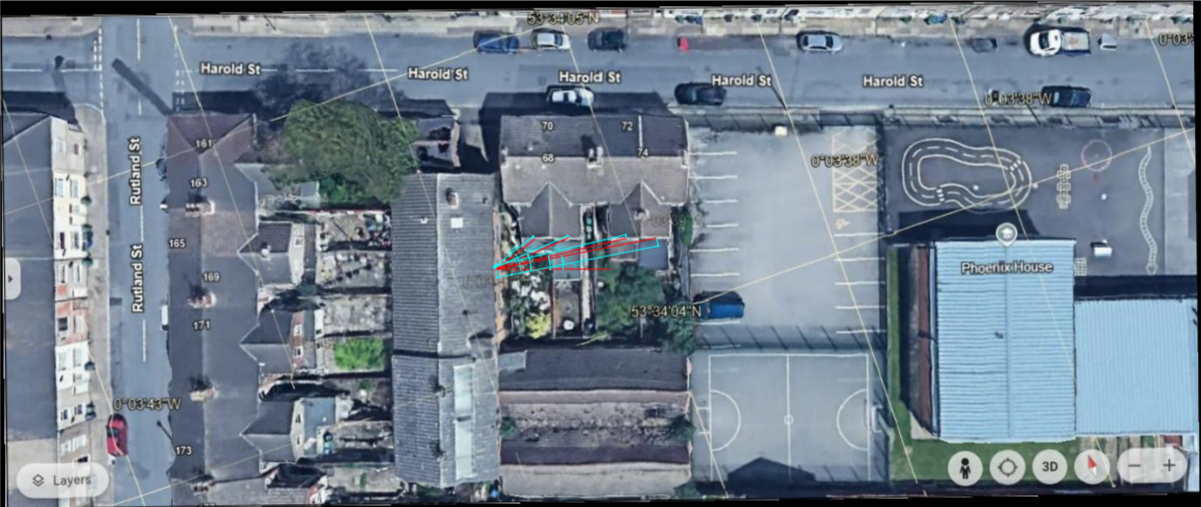
Visualisation 3.5
This particular view not only causes a material loss of privacy to the backyard of all the properties facing Harold Street. But due to its angle of view and distance to the first floor windows, it starts to provide an internal view through the first floor windows. Hence, the material loss of privacy implication is not only to the backyard, but it is also to the internal areas of the dwelling houses.
Primary Privacy Concern: Harold Street – First-Floor Intrusion
This view causes a material loss of privacy due to:
-
Visibility into backyards
-
Direct views into first-floor windows
-
The line of sight allows access into internal habitable spaces (likely bedrooms or lounges).
Conclusión:
Material loss of privacy — This is a serious issue because the observer can see through first-floor windows into living spaces. It goes beyond just outdoor visibility.
Detailed Privacy Analysis
1. 4606 – 38° – Distance: 4.606 meters
-
✅ Distance: Very far — well beyond 20m suburban threshold.
-
⚠️ Angle: 38° — wide, but impact mitigated by distance.
Conclusión:
🛑 Material loss of privacy (habitable space)
2. 7290 – 24° – Distance: 7.29 meters
-
🚨 Distance: Extremely close — serious privacy concern.
-
⚠️ Angle: 24° — above intrusion threshold.
Conclusión:
⚠️ Strong privacy concern — first-floor habitable space is in view, this is a material loss.
🛑 If the view is only into non-habitable space (e.g. storage, hallway) → no material loss.
3. 12401 – 13° – Distance: 12.40 meters
-
⚠️ Distance: Below 20m — close enough to raise privacy issues.
-
⚠️ Angle: 13° — wide view, allows detailed observation.
Conclusión:
⚠️ Privacy concern — space is habitable and on first floor, this may be a material loss.
🛑 If it’s non-habitable, no material loss.
4. 15137 – 11° – Distance: 15.13 meters
-
⚠️ Distance: Slightly below suburban threshold, just above city center (15m).
-
✅ Angle: Narrow — focused view.
Conclusión:
⚠️ Mild privacy concern — Only intrusive if directly facing private windows.
🛑 No material loss if space viewed is non-habitable.
Summary Table Visualisation 3.5
| Label | Distancia | Angle | Privacy Risk | Conclusión |
|---|---|---|---|---|
| 4606 | 4.60m | 38° | Very High | 🛑 Material loss of privacy (habitable space) |
| 7290 | 7.29m | 24° | High | 🛑 Material loss of privacy (habitable space) |
| 12401 | 12.40m | 13° | High | ⚠️Likely material loss Of Privacy (habitable space) |
| 15137 | 15.14m | 11° | Baja | ⚠️Likely no material loss Of Privacy (habitable space) |
[vc_single_image image=”11262″ img_size=”full” onclick=”custom_link” link=”https://areton-ltd.com/Aretonoldbackup/wp-content/uploads/2024/11/3.6.pdf”][/vc_column][/vc_row]
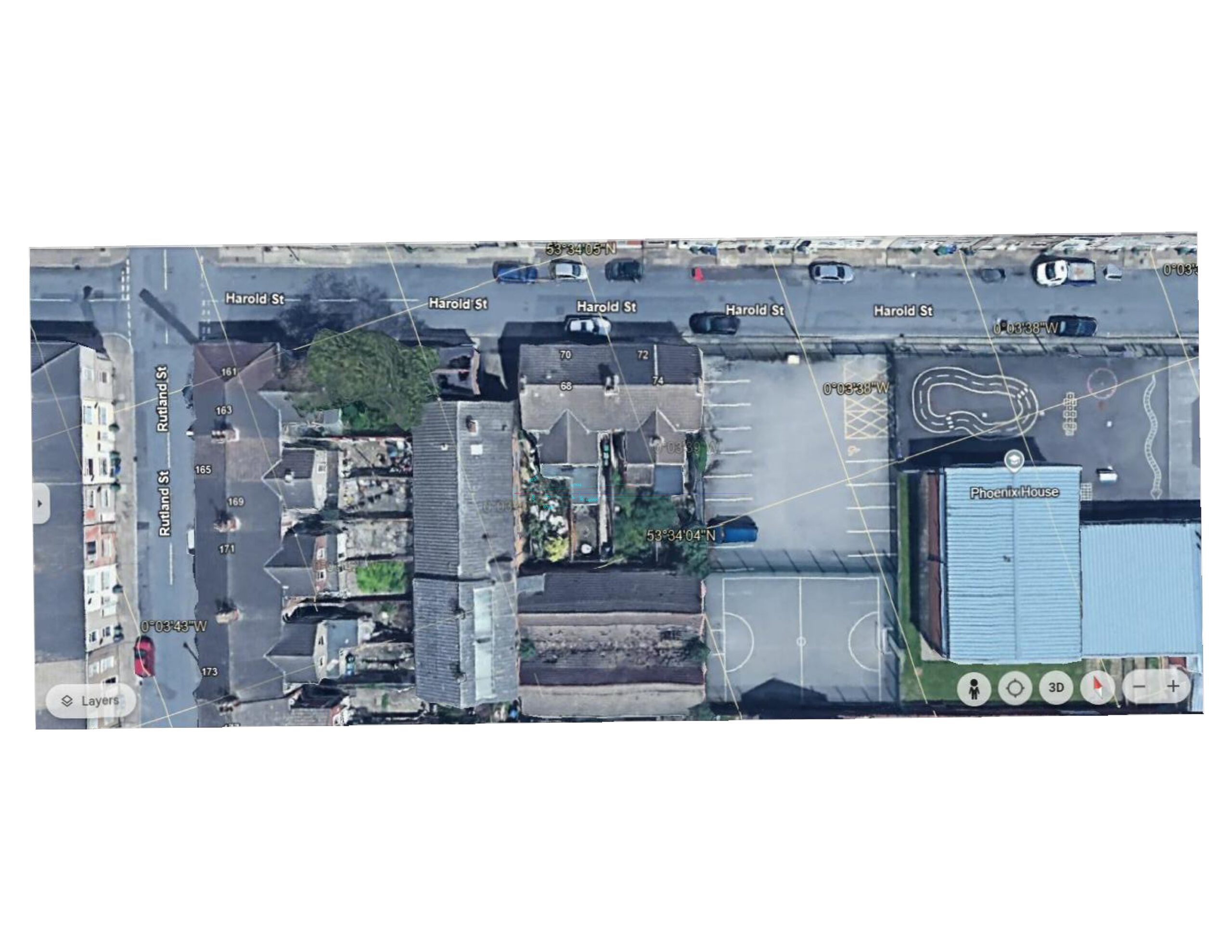
Visualisation 3.6
This diagram includes short to moderate distances y extremely narrow viewing angles (well under the 20° threshold). Here’s the breakdown:
🔹 1. 4257 – 20° – Distance: 4.257 meters
-
Distance: Very close — far below the 20m suburban and 15m city center thresholds.
-
Angle: Exactly at the 20° threshold.
-
Conclusión:
⚠️ Potential privacy concern, but 🛑 no material loss of privacy occurs if this view is into ground floor non-habitable space.
🔹 2. 11704 – 4° – Distance: 11.704 meters
-
Distance: Below both thresholds.
-
Angle: Very narrow (4°) — well below concern level.
-
Conclusión:
✅ No privacy loss — While the distance is close, the extremely narrow view makes it non-intrusive.
🔹 3. 14668 – 1° – Distance: 14.668 meters
-
Distance: Below suburban but above city center threshold.
-
Angle: 1° — minimal visibility.
-
Conclusión:
✅ No privacy loss — View is nearly perpendicular, very narrow.
🔹 4. 6736 – 8° – Distance: 6.736 meters
-
Distance: Very close.
-
Angle: 8° — still quite narrow.
-
Conclusión:
⚠️ Distance suggests potential concern, but 🛑 no material loss applies due to the narrow angle and assuming non-habitable space.
Summary Table Visualisation 3.6
| Label | Distancia | Angle | Privacy Risk | Conclusión |
|---|---|---|---|---|
| 4257 | 4.257m | 20° | Moderate | ⚠️Likely No material loss Of Privacy (non-habitable) |
| 11704 | 11.704m | 4° | Ninguna | ✅ Likely No Material Lose of Privacy |
| 14668 | 14.668m | 1° | Ninguna | ✅ Likely No Material Lose of Privacy |
| 6736 | 6.736m | 8° | Baja | ⚠️Likely No material loss Of Privacy (non-habitable) |
2.11: Final Conclusions
Properties Facing Harold Street
All the above extensively proves that this minor development does not cause any material harm to any of the properties facing Harold Street. Because:
-
The existing windows and entrance door of the extension already offer a direct view into all the properties of Harold Street.
-
The windows on the first floor of the main building already have plenty of established views into all the back windows of the properties facing Harold Street.
Because of the above, any extra window openings both on the main building and the extension do not cause any material harm to the properties of Harold Street, therefore allowable.
Additional Privacy Finding – First-Floor Windows
However, based on the detailed visibility analysis conducted across multiple views, it is concluded that the following first-floor properties on Harold Street have lost privacy:
-
No. 68A
-
No. 70
-
No. 72
These properties experienced at least one direct or angled view from the proposed development that:
-
Occurred at a distance below 20 meters, and/or
-
Involved a viewing angle greater than 20°,
Resulting in a clear line of sight into private, habitable spaces.
Conclusión: These first-floor properties on Harold Street are considered to have lost privacy due to the proposed development and are no longer protected from overlooking.
Properties Facing Castle Street
All the above extensively proves that this minor development does not cause any material harm to any of the properties facing Castle Street. Because:
-
The existing windows and entrance door of the extension already offer a direct view into the back of all the properties facing Castle Street.
-
The windows in the extension are at a distance which is widely considered not to cause overlooking and acceptable from a privacy perspective in planning. Hence, even in case of non-pre-existing windows in the extension and no door openings on this side of the extension, the windows on this side of the extension are over 20 meters from the ground floor windows and approximately 24 metres from the Castle Street first floor windows of the habitable rooms. As we have seen, the standard minimum distance from directly facing windows in a city centre area can be reduced to 15 meters, but in our case, it is also over the standard 20 meters distance applied in suburban areas.
-
It has been amply demonstrated how the view from the adjacent property is far more intrusive than any existing or future window in the extension. As discussed above, the existing view from the adjacent residential building is far more intrusive than the view from our minor development.
Therefore, it has been clearly demonstrated that there is no material harm caused by the minor development to the properties facing Castle Street. Hence, any extra window openings do not cause material harm and are therefore allowable.
Additional Privacy Finding – First-Floor Windows
Despite the above, the detailed privacy analysis shows that the following first-floor properties on Castle Street have lost privacy:
-
No. 93
-
No. 91
-
No. 89
-
No. 87
These properties were exposed to at least one view that breached privacy thresholds (distance under 20m and angle over 20°), leading to unobstructed visibility into first-floor rooms.
Conclusión: These Castle Street properties are considered to have no remaining privacy in planning terms due to the nature of the views from the proposed development.
====================================================================================
Conclusions
Properties facing Harold Street
All the above extensively proves that this minor development does not cause any material harm to any of the properties facing Harold Street. Because:.
1 The existing windows and entrance door of the extension already offer a direct view into the back windows of all the properties facing Harold Street.
2 The windows on the first floor of the main building already have plenty of established views into all the back windows of the properties facing Harold Street.
Because of the above, any extra window openings both on the main building and the extension do not cause any material harm to the properties of Harold Street, therefore allowable.
Properties facing Castle Street.
All the above extensively proves that this minor development does not cause any material harm to any of the properties facing Castle Street. Because:
- The existing windows and entrance door of the extension already offer a direct view into the back of all the properties facing Castle Street.
- The windows in the extension are at a distance which is widely considered not to cause overlooking and acceptable from a privacy perspective in planning. Hence, even in case of non-PRE-existing windows in the extension and no door openings on this side of this extension, the windows on this side of the extension are over 20 meters from the ground floor windows (non habitable) and approximately 24 metres from the castle street first floor windows of the habitable rooms. As we have seen, the standard minimum distance from directly facing windows in city centre area can be reduced to 15 meters but in our case it is also over the standard 20 meters applied in suburban areas. In other words, even if there were no existing windows and doors opening in the Extension facing the back of the terraced houses facing Castle Street, any new window is at a distance higher than 20 meters from a non-habitable window on the ground floor and 24 meters away form the window of a habitable room on the first floor. These distances are widely considered acceptable and therefore allowable from a planning perspective.
- It had been amply demonstrated how the view from the adjacent property is far more intrusive that any existing window in the extension and any future window in the extension. As we have studied above the existing view from the existing residential building is far more intrusive than the view from our minor development.
Therefore, it has been amply demonstrated how there is clearly “no material harm” caused by the minor development into the properties facing castle street. Hence, it is amply demonstrated that any extra window openings do not cause any material harm to the properties of Castle Street, therefore allowable.
Properties facing Rutland Street
The existing windows on both the ground floor and first floor of the main building all provide a direct view into all the properties’ back windows. We think this is straightforward and requires no studies or explanation.
Explaination Of Loss Of Light Study
Light Loss and Overshadowing Assessment for Proposed Development
This study evaluates the potential impact of our minor building alteration on light levels to surrounding buildings, ensuring no loss of light or overshadowing occurs.
The proposed minor building alteration involves modifying the existing extension by replacing the current double-pitched roof with a flat roof configuration, maintaining the overall height of the extension at the same level as the top ridge of the existing pitched roof.
Specifically, the extension will be converted from a double-pitched roof to a flat roof. The height of the flat roof will align with the existing top ridge height. While this adjustment raises the edges of the extension, it remains essential to confirm that no overshadowing is caused to neighbouring properties.
The study is conducted using computer-generated images (CGIs) of the existing building and the proposed flat roof extension. Dormer windows are shown in the CGIs as part of a broader possible modifications of the building, but this assessment focusses exclusively on the flat roof extension. Previous loss-of-light studies have already been completed for the dormer windows and confirmed that no loss of light and overshadowing are caused by any possible dormer window on the main roof too; however, this is not the scopes of this particular study.
The properties along Harold Street are identified as the primary area of concern. As such, the verification process is limited to these properties. If the 45-degree rule is satisfied for all windows of the buildings facing Harold Street, it can be concluded that no overshadowing will affect other surrounding properties, which are further away.
The most critical aspect of this study is the assessment of ground-floor extension windows at 70 Harold Street and 74 Harold Street. If these windows meet the 45-degree angle rule and do not intersect the extension, no loss of light or overshadowing will result from the proposed development.
Explanation: 3.1
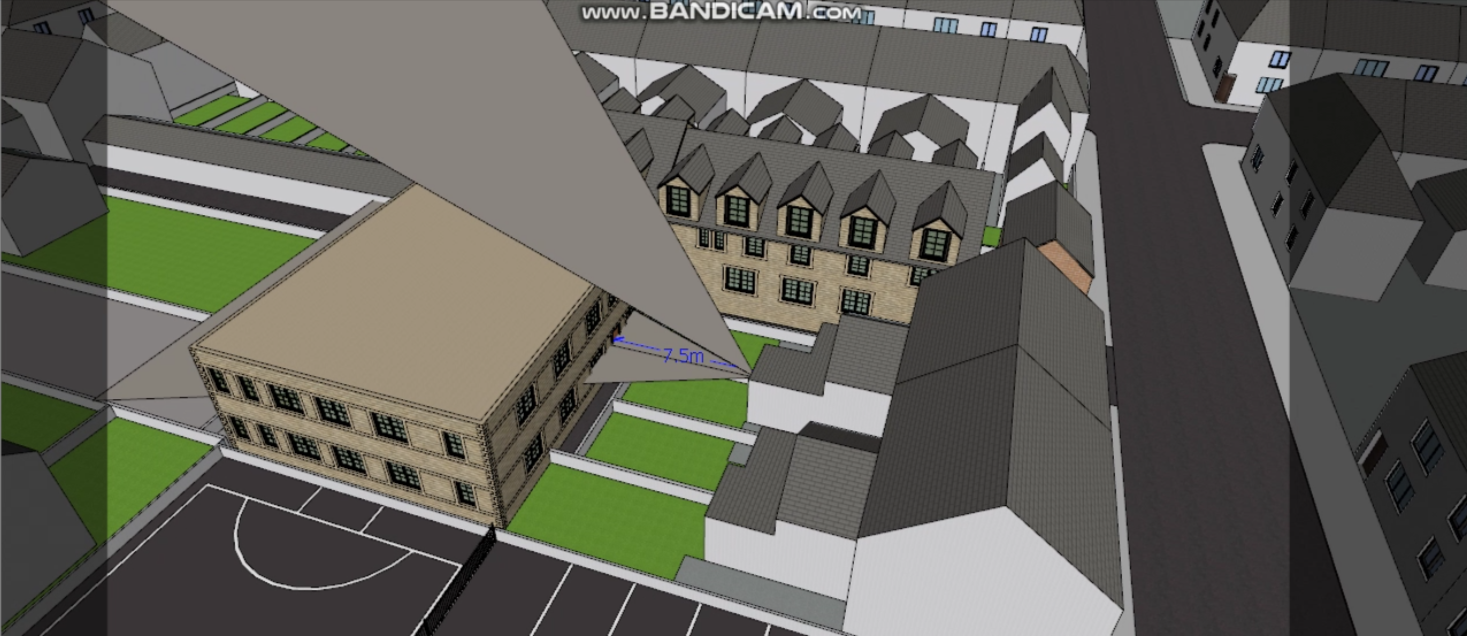
Figure 3.1
This 3D visualization demonstrates a shadow analysis for a proposed flat roof extension, focusing on its impact on neighbouring properties. The beige building represents the modified structure. The “7.5m” measurement highlights the distance between the extension and the nearest structure, ensuring compliance with light regulations such as the 45-degree rule. The angled projection line assess whether the shadow affects the windows or critical areas of nearby properties, particularly those on Harold Street, confirming that the development does not cause any loss of light or overshadowing. the 45-degree test conducted from the ground-floor extension window of 70 Harold Street, representing one of the worst-case scenarios for potential overshadowing. As this window passes the test, it is anticipated and confirmed by other studies that all first-floor windows also meet the required standard, ensuring no overshadowing implications for the neighbouring properties.
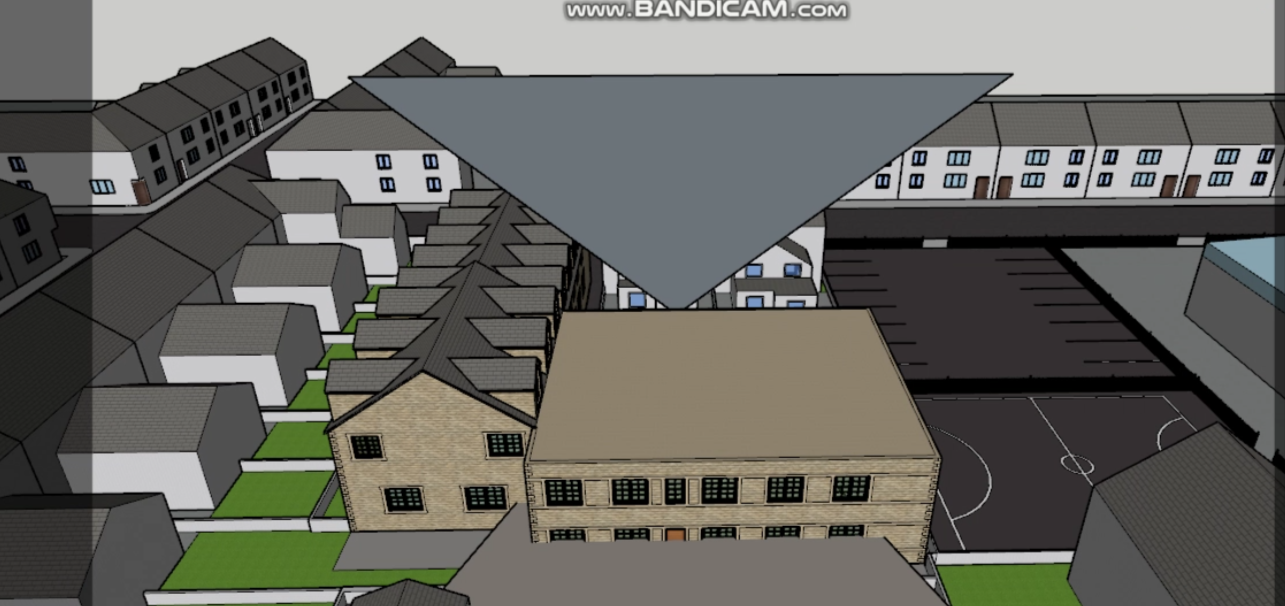
Figure 3.1.1
This image shows another angle of a shadow analysis for a proposed development. The triangular projection from the window is at 45 degree angle, and it goes past the building, therefore ensuring no loss of light is caused to the particular window that could potentially be affected most by it.
Explanation: 3.2
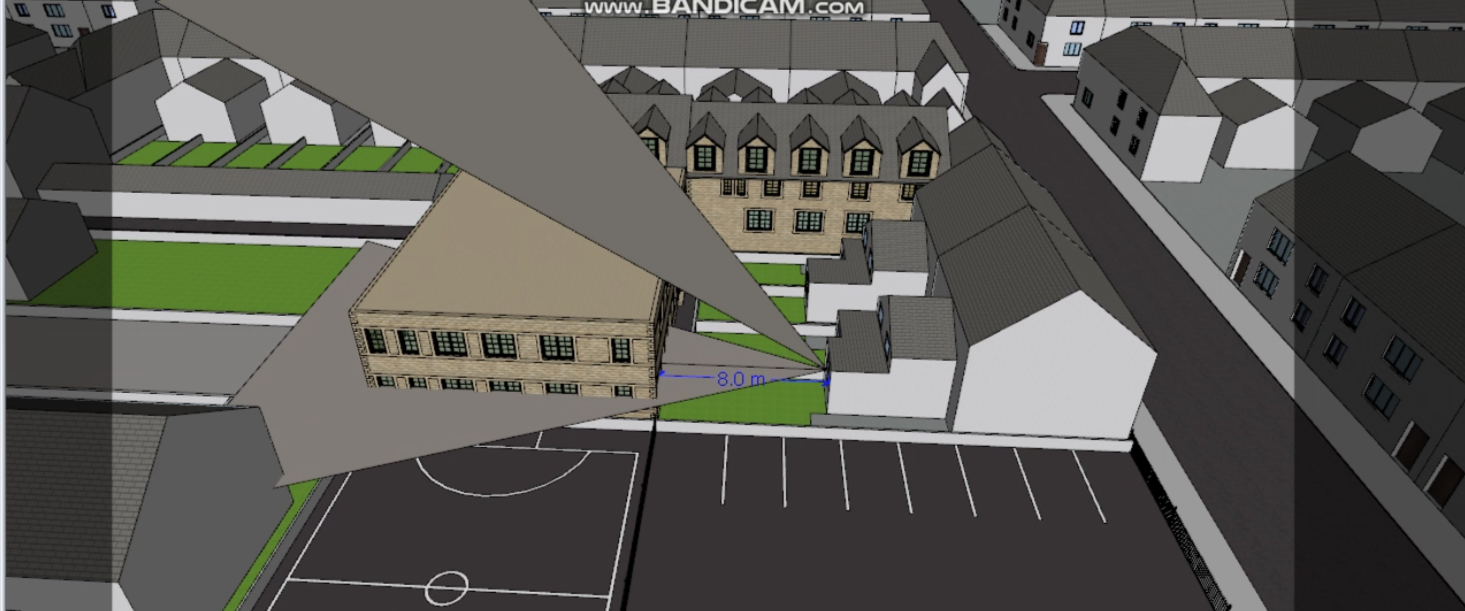
Figure 3.2
This image illustrates one of the most critical windows that could be considered at risk of failing the 45-degree angle test (overshadowing/loss of light). However, upon analysis, it is evident that this window comfortably passes the test. Based on this result, it is reasonable to conclude that all other windows on both the ground floor and the first floor of the surrounding properties will also pass this assessment without issue (this has also been verified).
Therefore, it is demonstrated how all the windows of the properties facing Harold Street successfully meet the 45-degree angle test with a considerable margin. This confirms that the proposed roof alteration to the extension does not cause any overshadowing or loss of light to the nearby properties. The results provide clear evidence that the modification has been carefully assessed to preserve the natural light to neighbouring buildings, thereby ensuring compliance with overshadowing regulations and safeguarding the amenity of the local residents.
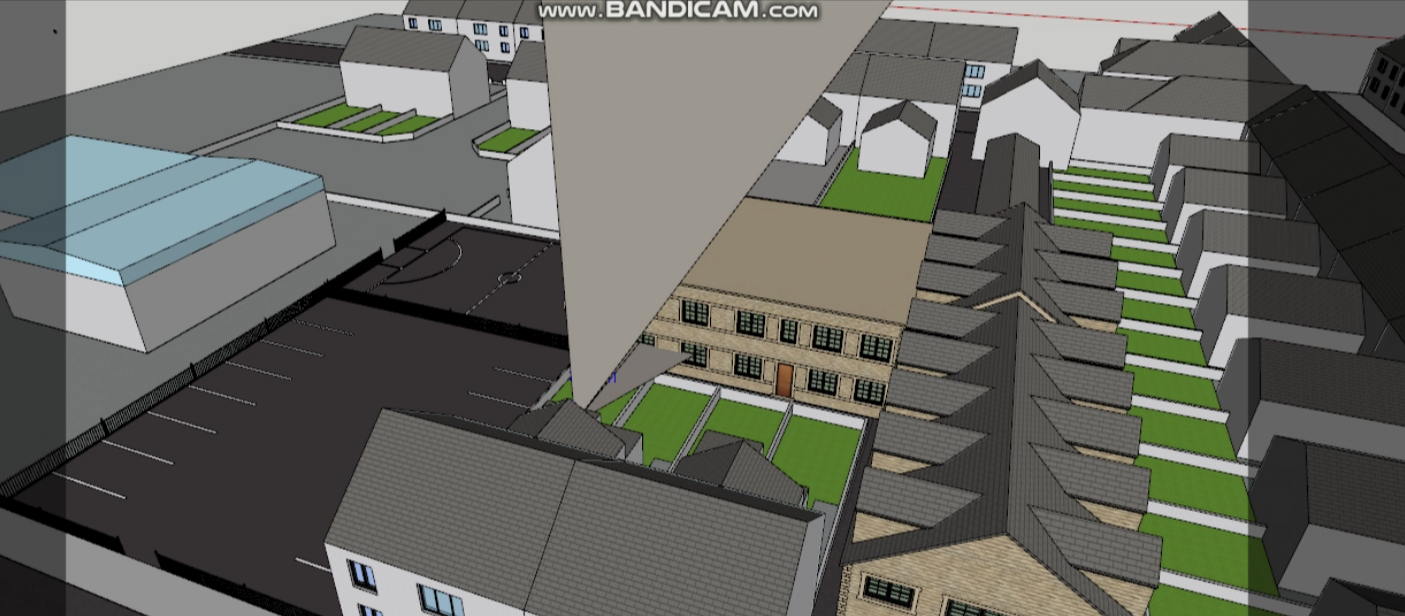
Figure 3.2.2
The above image shows how the second floor back window of 74 Harold Street as expected passes the 45 degree angle test as it comfortably passes the top of the building. The 45-degree angle test, ensures that no overshadowing occurs at rear of the properties facing Harold Street.
Therefore, this minor modification to the extension roof does not negatively impact the daylight access to any of the windows at the back of the properties facing Harold Street. As we will see all other windows pass the 45-degree angle test with ample margin, proving that the extension alteration does not cause any loss of light. Therefore, no claim of overshadowing could be a success.
Explanation: 3.3
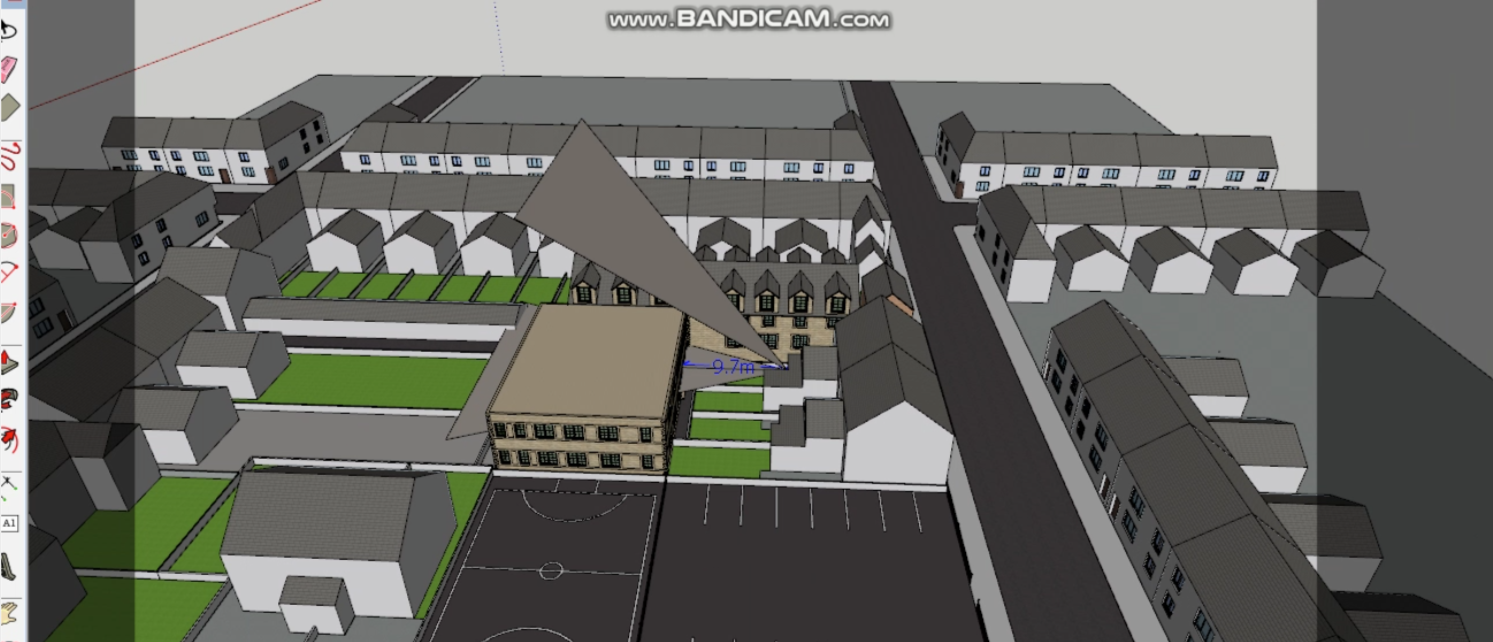
Figure 3.3
The above direct line measurement to the extension is (9.7 m). Once again, it is clear how the 45-degree test is amply passed. The line passes the roof of the building from a first floor window with ample margin.
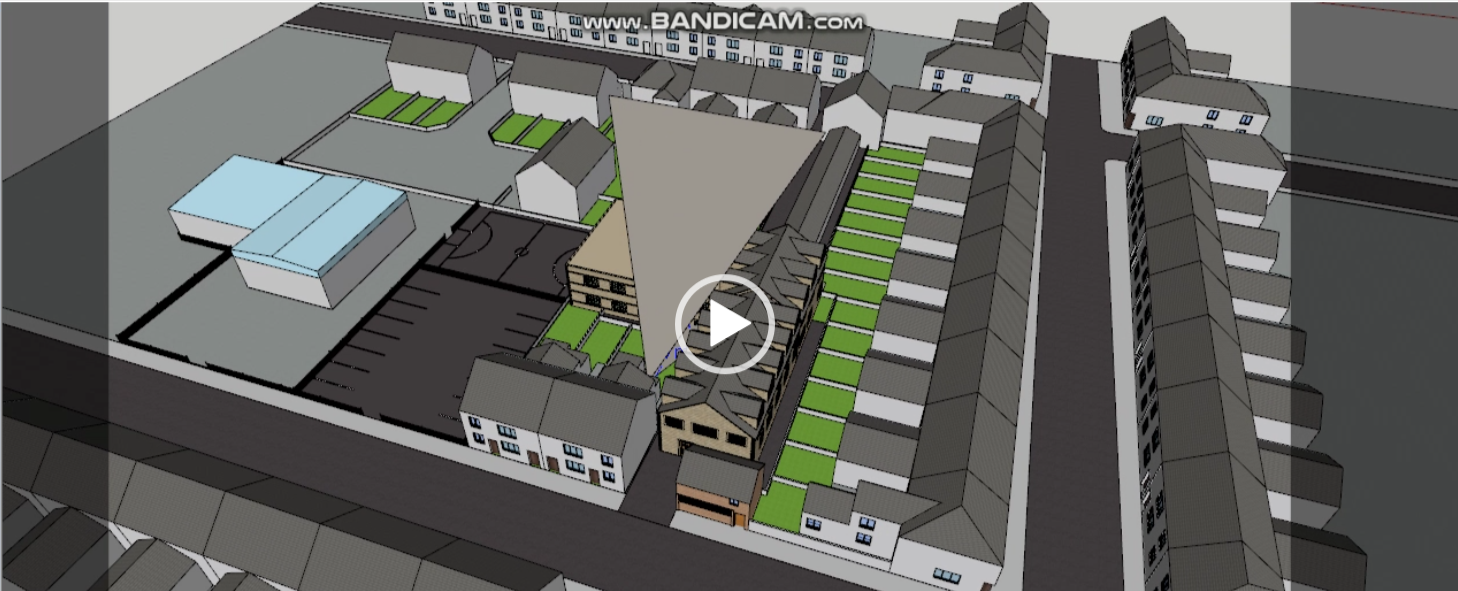
Figure 3.3.3
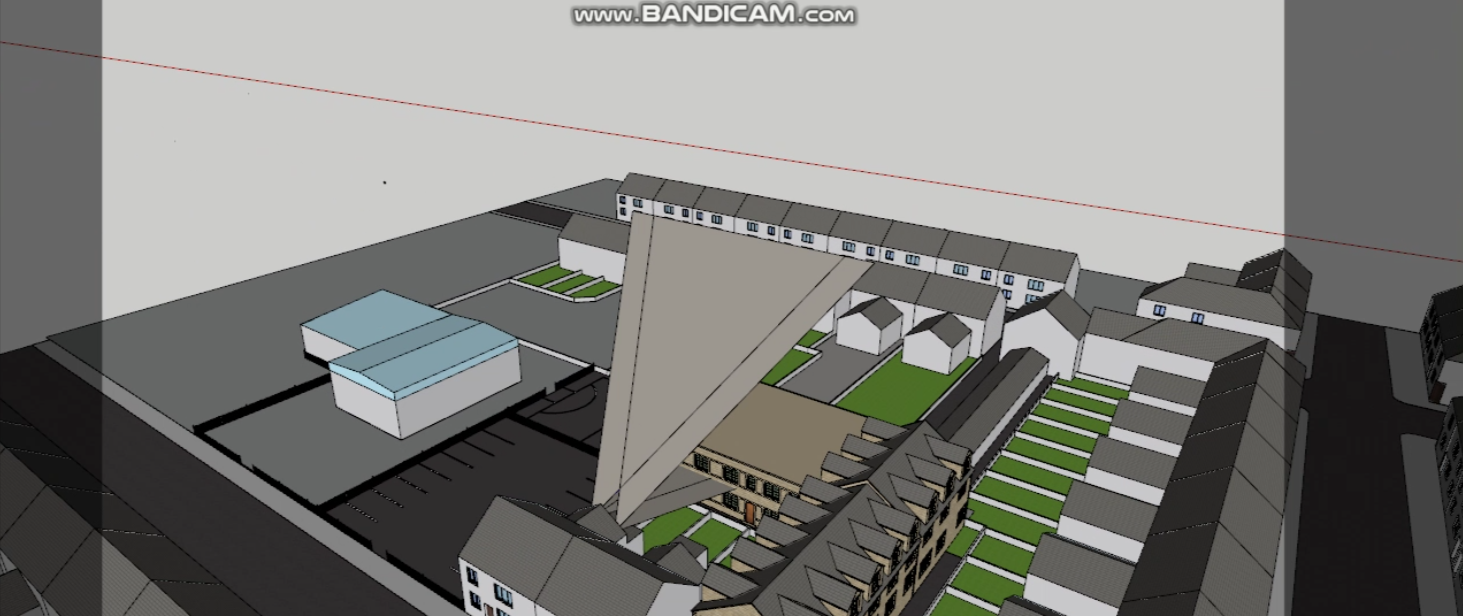
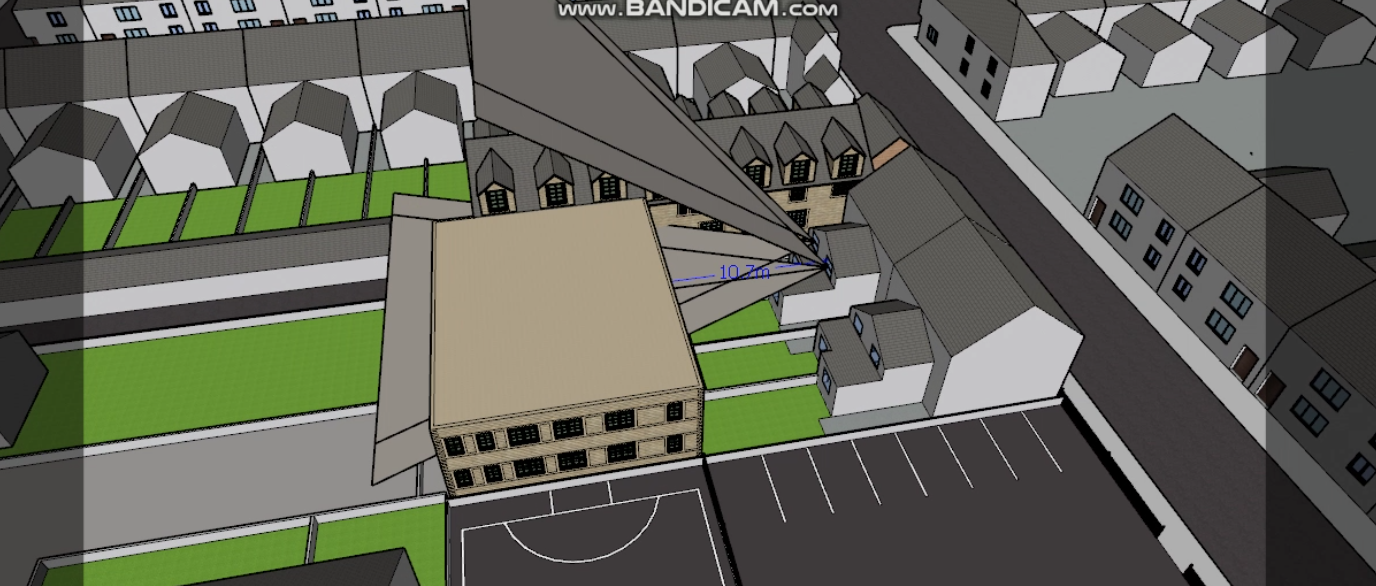
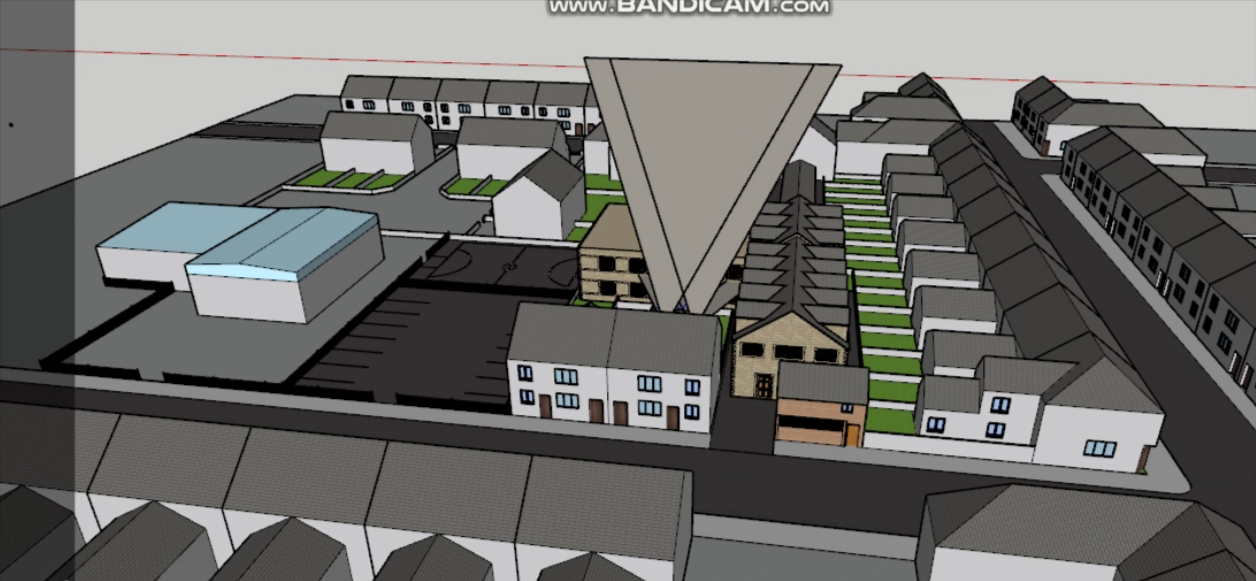
Explanation: 3.6
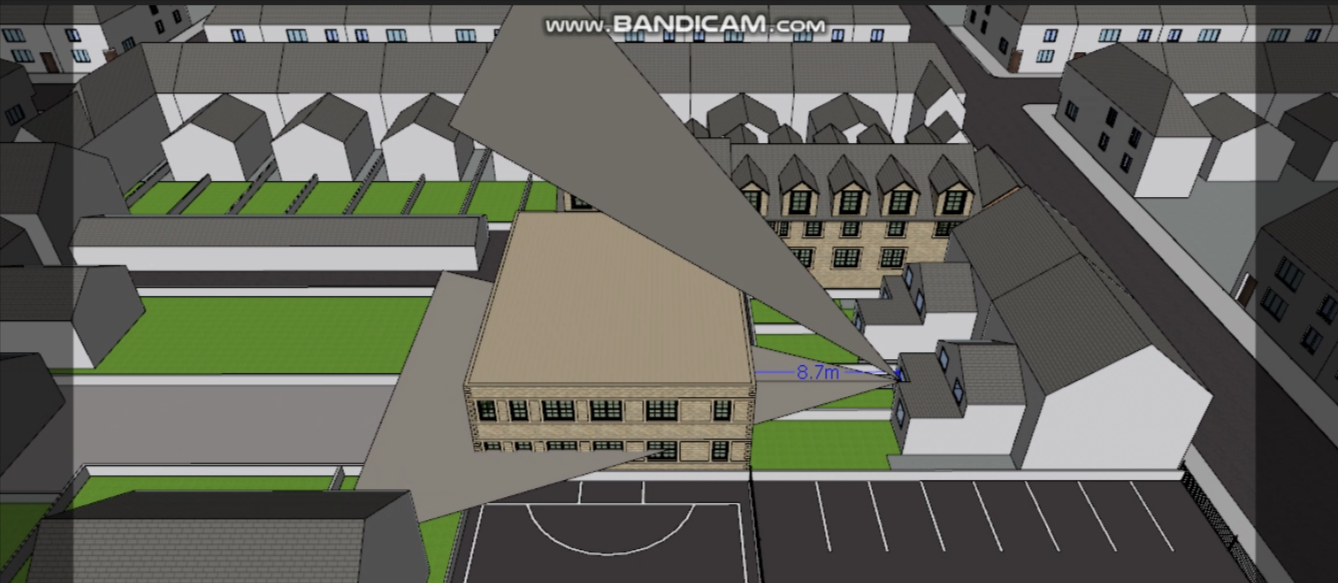
This comprehensive analysis, covering both the front (facing Harold Street) and the backside, confirms that the proposed extension has been carefully planned to minimize its impact on surrounding properties. The results demonstrate that the development respects the daylight and overshadowing requirements for the nearest properties, ensuring no detrimental effect on the living conditions of the local residents.
Compliance With National Planning Policy
In compliance with the “national planning policy framework ” December 2024 we demonstrate how our proposal meets the design expectations set out in local and national policy.
Click Here To Read: National Planning Policy Framework
4.1: Achieving sustainable development.
7. The purpose of the planning system is to contribute to the achievement of sustainable development, including the provision of homes, commercial development and supporting infrastructure in a sustainable manner.…….. meeting the needs of the present without compromising the ability of future generations to meet their own needs ………….. These address social progress, economic well-being and environmental protection.”
As seen in this document our minor development clearly “addresses social progress” by improving the outlook of the entire area, which requires a substantial private investment to attracts jobs and local housing demand. Our minor development has a disproportionate positive impact on the outlook of the entire area.
“The presumption in favour of sustainable development 11. Plans and decisions should apply a presumption in favour of sustainable
development.For plan-making this means that: a) all plans should promote a sustainable pattern of development that seeks to: meet the development needs of their area; align growth and infrastructure; improve the environment; mitigate climate change (including by making effective use of land in urban areas) and adapt to its effects.”
As amply demonstrated our minor development although does not impede the rights of any neighbouring property (and it is considered minor), it is clearly classed as sustainable. The low maintenance compared to the present configuration allows businesses occupying the premises to invest in business growth and high-skilled employment instead of allocating large budgets to maintenance . This minor development has been conceived to allow the installation renewable energy sources in a way not currently possible or feasible with the current double pitched roof configuration.
4.2: Plan-making
“16. Plans should:
a) be prepared with the objective of contributing to the achievement of sustainable development”
The above requirement is placed in a prominent place in the policy framework because it is considered of outmost importance.
The sustainability of our development is brought by
- More robust construction of the flat roof
- Far more long lasting construction of the extension.
- Far less maintenance required
- Our minor building alteration favours the installation of solar power, both electrical and hot water. As discussed below the payback due to our proposal would render the installation of solar power a much more secure investment than the current configuration.
- Our minor building alteration favours the installation of wind power. Any proposed wind turbine installation would be much more easily installed, much more easily maintained and much higher energy production due to the reduced turbulence of the flat roof versus the double-pitched roof.
4.3: Decision-making
“39. Local planning authorities should approach decisions on proposed development in a positive and creative way. They should use the full range of planning tools available,…………… and work proactively with applicants to secure developments that will improve the economic, social and environmental conditions of the area.”
This is a policy that clearly matches the criteria for planning approval of this minor building alteration. Not only is this minor development admissible in terms of right of light, overview, it does not increase the top height of the extension but it clearly matches the stated national decision making policies as it is very clear how this very minor development will ” improve the economic, social and environmental conditions of the area.” This is amply demonstrated in out supporting documentation.
“Decision-makers at every level should seek to approve applications for sustainable development where possible.” The term sustainable is often interpreted as net zero carbon emission or renewable energy, like solar and wind power. However in our case this development will allow to construct a more viable “sustainable” roof which not only require far less maintenance than the current double pitched roof, but also will make the accommodation of solar panels on to the flat roof a financially viable endeavour due to its very low maintenance. The current roof configuration due to its high maintenance requirement does not permit the sustainable installation of solar panels because the payback of solar installations are typically in excess of 15 years and sometimes even longer. Therefore the solar panel installations would need to be uninstalled for roof maintenance before their payback is complete hence making the installation of solar panels a non viable proposition keeping the current roof configuration.
Additionally the height of the new flat roof will make hard for the solar panels to be stolen or vandalised while at the same time allowing the confidence required to make suck a high cpital investment in a renewable source of power. In contrast if the roof is at a first storey level then the access to the solar panels would be too easy making it a non suitable proposition given the high risk of theft and vandalism at these very easy to reach heights.
Additionally, it is demonstrated that a flat roof is a much better commercially viable solution for the installation of solar panels and wind turbines in general rather than pitched roofs.
4.3.1: Why are flat roofs a better solution for solar and wind power installations?
1. The tilting of the solar panels can be adjusted as required on a flat roof to maximise the efficiency of the capture of solar rays to produce the maximum amount of electricity. On a pitched roof its slope and orientation of the roof may not be best suited for the most efficient capture of solar rays energy. On a pitched roof, it is not easily possible to adjust the pitch and the orientation of the solar panels to achieve the best possible energy capture efficiency, however this is possible on flat roofs.
Figure 4.1While on a pirtched roof the tilting of the solar panels are confined to the angle of the pitched toof, In a flat roof the solar panel titl can be optimised for theie maximum solar energy capture. Therefore this is a much more efficient configuration leading to faster and more secure investment payback
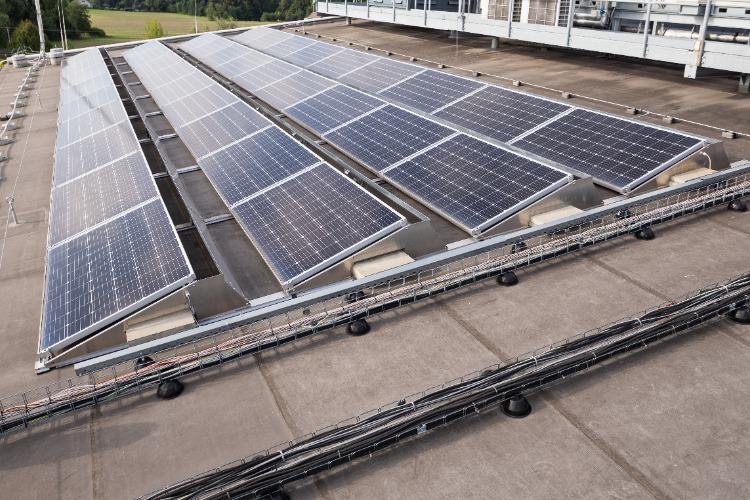
2. Ease of access of flat roofs for maintenance. The access for maintenance of solar panels installations on a flat roof is much less expensive than a pitched roof since the risk of falling from the flat roof is much lower than the pitched roof. Therefore also the maintenance burden of the solar panels is lower in a flat roof which in turn makes this solution a much better environmental and sustainable design from the stand point of renewable energy installations. In a double pitched roof there is the extra disadvantage of needing to pay more for maintenance due to the increase costs connected with working at a height on a pitched roof. What we discussed there is the costs of maintenance of solar panels on flat roof compared to pitched roofs, but the same applies to find turbines installations.
3. Also the pitched tiled roof requires much more maintenance than a modern flat roof. Every time maintenance is required on a tiled pitched roof (tiles cracked or slipped for example) the solar panels need to be uninstalled and reinstalled to allow for roof repair. The uninstallation and reinstallation of solar panels on pitched roof require two sets of skills: One set of skills dedicated to solar panels maintenance and installation and the other dedicated to pitched roof repair. Therefore the costs are several times higher in double pitched roof compared to a flat roof installation. On the contrary not only a modern flat roof requires much less maintenance than a tiled pitched roof but also the maintenance of the flat roof is several times easier and often does not only not require specific skills. Maintenance of flat roofs is very easy for most people to learn and master.
Additionally, this type of maintenance can be carried out by people not comfortable working at heights hence maintenance of a modern flat roof is much less expensive than a double-pitched tiled roof. This is because the pool of workforce willing to perform such jobs are larger than those willing to perform the same jobs on highly sloped roofs.
Additionally, the central part of the current double pitched configuration does not allow for a viable solar panel installation and the sun exposure is not optimal there. The central valley needs to be accessed every year making this more expensive and making the solar panel payback even less likely.
The maintenance of the central valley of the double pitched roof is very expensive and this need to be carried out at least once a year for the roof to function correctly and not develop structural issues of over time.
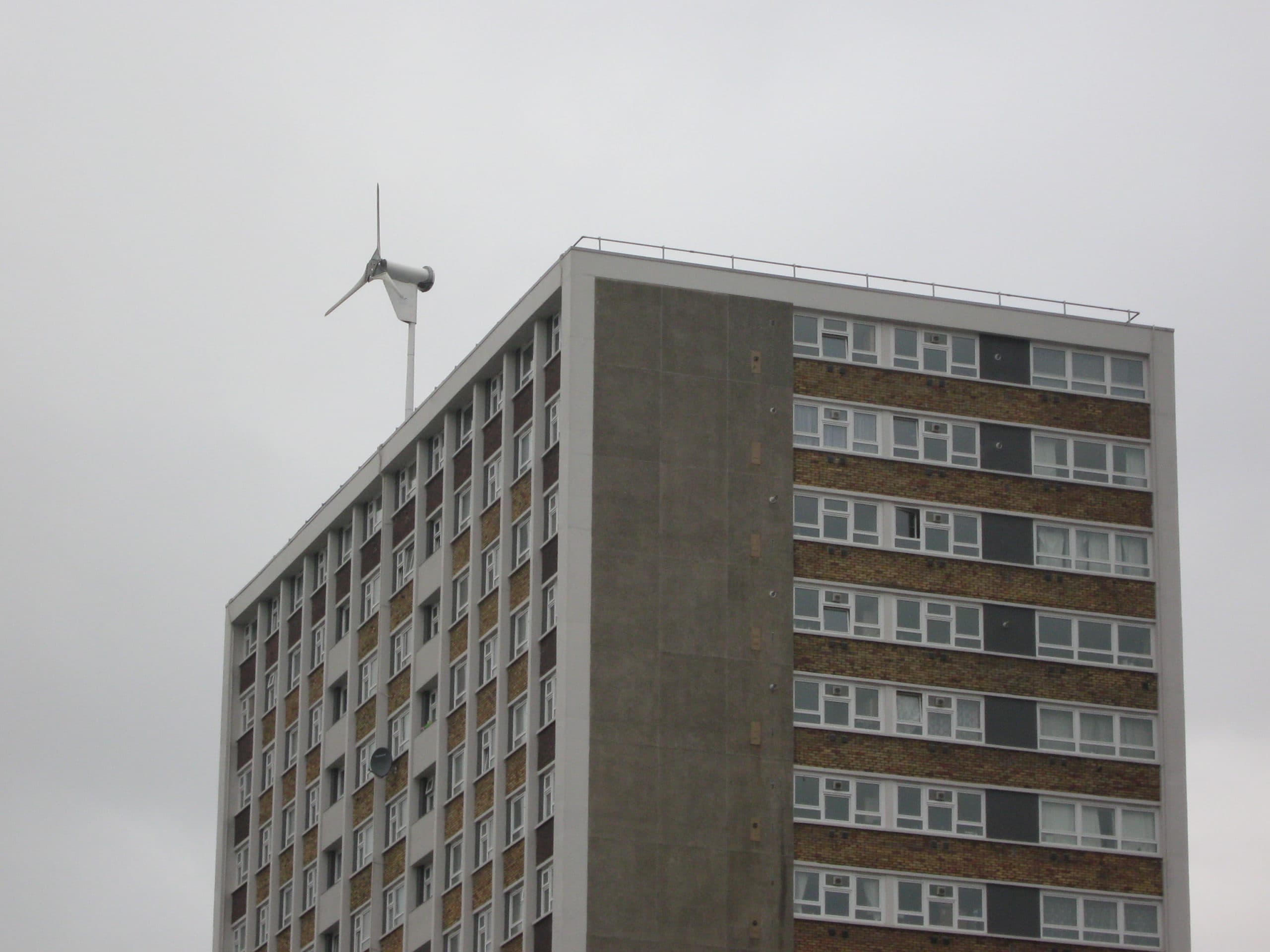
Figure 4.2 Installation of a downwind 6 KW wind turbine on a flat roof.
Wind turbines can be installed on a flat roof in conjunction with solar panels. Wind turbine installations are very challenging on a double-pitched roof, but the higher installation costs are also coupled with prohibitive maintenance costs not present in flat roofs. Wind turbine installation on flat roofs. The results showed that wind turbines mounted on flat roofs were likely to produce larger and more consistent power than that of the other roofs. In addition, flat roofs demonstrated lower turbulence intensity than the other roof shapes.
Therefore, this minor building alteration allows the installation and development of renewable energy sources not possible with the present double-pitched roof configuration.
The height of the flat roof is permissible from a planning point of view, because the top height of the extension of the building is not increased. It presents three further advantages.
- Higher wind at higher heights
- Lower turbulence
Ease of installation of the wind turbine/s at higher height.
Ease of installation on a flat roof also compatible with the installation of hre solar panels at the same time.
4.4.1: Conclusions:
A flat roof allows the possibility to install both solar panels and wind turbines in such a fashion that due to ease of installation, much cheaper maintenance and higher efficiency leads to much more secure investments in renewable energy sources as well as far faster return on investments compared to the present double-pitched roof configuration.
4.5: Delivering a sufficient supply of homes
Not applicable. Unrelated to our minor development. However, as a consequence of this minor development, local housing demand will increase, leading to a higher likelihood that the boarded and abandoned houses are going to to be refurbished and occupied again.
4.6: Building a strong, competitive economy.
Point 85 states “Planning policies and decisions should help create the conditions in which businesses can invest, expand and adapt.”
Our minor development will allow the extension to be repaired to a standard so that it will make it “sustainable” by design and construction. The existing configuration is high maintenance and the current building design does not allow the businesses that occupy the building to adequately invest in expansion and invest in adaptation to changing market conditions effectively. This is because a larger budget needs to be constantly allocated to substantial ongoing maintenance and building security because this is inherent;y required by the current double-pitched roof design . With a flat roof configuration and high ceilings, the building can be:
- Very low maintenance, which will allow more capital to be allocated business expansion.
- Inherently secure by both design and construction.
Therefore, this minor development will allow any occupier to have more confidence in the sustainability of the building hence allowing to boost confidence, so that investment will be targeted to business expansion and adaptation to future change in market conditions (as required by this planning policy).
“Significant weight should be placed on the need to support economic growth and productivity, taking into account both local business needs and wider opportunities for development.”
This minor building alteration will allow the sustainable employment of capital to regenerate the building. Therefore, this project will trigger economic growth not only due to the building regeneration, but also due to the economic growth that this building will generate within the area after the regeneration is complete. This will boost productivity by satisfying the business needs in the area. Granting planning permission for this minor building alteration will allow local small business development in the area, which in turn will attract further families to move in the area and more private capital will be invested in the generation of the local housing as demand for housing will increase. As a consequence, this will encourage private capital to regenerate the dilapidated houses in the area.
” The approach taken should allow each area to build on its strengths, counter any weaknesses and address the challenges of the future.
The weaknesses of the area is the local deprivation due to lack of of employment which produces lack of demand and in turn causes lack in investment. This minor development will allow the regeneration of a key commercial building in the area which, in the immediate future will boost employment due to the development itself. , but later on will it will increase employment in the area increasing demand and attracting further private investment. This new investment in the area will tackle the challenges of the future in the area.
“This is particularly important where Britain can be a global leader in driving innovation, and in areas with high levels of productivity, which should be able to capitalise on their performance and potential.”
The permitted use of the building as a light industrial building, which is within the crop of Class E, allows research and development-orientated businesses to invest in innovation. Therefore, this minor building alteration, not only better the future outlook of the area but also as this policy states, will increase the productivity levels of the area, unlocking the barriers to growth to this currently depressed area.
” 86 Planning policies should: d) seek to address potential barriers to investment, such as inadequate infrastructure, services or housing, or a poor environment;”
In this particular case the barrier to investment is a financially viable proposition which will allow to restore this key commercial building in the area. Our minor building alteration solves this problem, allowing a commercially viable investment into this particular building which is pivotal to the well-being of the area, both in the medium and long term. Therefore, the planning approval will remove a significant barrier to investment in an area which is currently considered deprived (“poor environment”) with dilapidated boarded-up houses (“inadequate housing”).
4.7: Ensuring the vitality of town centres
In particular, in point 90 a) “promote their (town centres) long-term vitality and viability”.
This minor building alteration will allow the promoted regeneration of the area and as a consequence, increasing the vitality and viability of the area. In particular, it will contribute to making the area into a desirable location for families to live in as a long term choice.
Point 90 d) “Meeting anticipated needs for retail, leisure, office and other main town centre uses over this period (at least the net 10 years)”.
This minor development allows the regeneration of an important Class E use building (retail, office etc) in a central location in need of regeneration.
4.8: Promoting healthy and safe communities
This commercial building is an important part of the local area. The approval of the planning application for this minor building alteration will allow us to work on a financially viable project. As a consequence of the approval of this building alteration, the building will be revitalised and, as a consequence, the whole area will benefit from this private investment. This will improve the outlook of the area and attract more working families into the area, therefore making the area safer, more appealing and sustainable.
In particular, point 96 c). Enables and supports healthy lives, ………..reduces health inequalities between the most and least deprived communities – for example, through the provision of …….. Local shops, …….
Granting planning permission for our minor development will allow better use of the building. Therefore, the use of this building could be to provide “local shops” in a “deprived area”. As this particular point suggests.
Particularly 98 d) “ensure that established shops, facilities and services are able to develop and
Modernise, and are retained for the benefit of the community;” this minor development allows us to “develp and modernise” a building which (due to its current class use ) allowed use also as a shop, group of shops or similar within the scope of use class E .
Point 99: Planning policies and decisions should consider the social, economic and environmental benefits of estate regeneration. Local planning authorities should use their planning powers to help deliver estate regeneration to a high standard”. This minor development will allow us to deliver “estate regeneration at a high standard” as needed in this particular area.
4.9: Promoting sustainable transport
Not applicable because it is not relatable to out minor development.
4.10: Supporting high-quality communications
Not applicable because it is not relatable to out minor development.
4.10.1: Compliance with the policy of “making use of the land”
In our case the use of the land remains the same because our minor development is confined on the exiting building footprint and it does not increase the top height of the original extension.
Compliance with point 137 of the “national planning policy framework ” December 2024 we demonstrate how outr proposal meet the design expectations set out in local and national policy
4.10.2: Better design and sustainable development.
According to national policy of “achieving well designed places”:
pint 135 “a) will function well and add to the overall quality of the area, not just for the short
term but over the lifetime of the development;” this minor development will make the extension low maintenance, far more durable than the current double pitched roof configuration, and the design also fits/bends very much better with the surrounding area
“b) are visually attractive as a result of good architecture, layout and appropriate and
effective landscaping;” Visually it will be improving the area since the design is much better fit with the area than the current double pitched roof design.
40″c) are sympathetic to local character and history, including the surrounding built
environment and landscape setting, while not preventing or discouraging
appropriate innovation or change (such as increased densities);” Any part of the building will be built using the original brickwork therefore blending and preserve the character of the area, whilst improving it at the same time.
“d) establish or maintain a strong sense of place, using the arrangement of streets,
spaces, building types and materials to create attractive, welcoming and
distinctive places to live, work and visit;” The building materials will be the same as exiting and the minor development will not fall outside its original footprint, hence complying with this point.
“e) optimise the potential of the site to accommodate and sustain an appropriate
amount and mix of development (including green and other public space) and
support local facilities and transport networks; and” this minor development will revitalise the area and the local business outlook, bringing the building to its full potential.
“f) create places that are safe, inclusive and accessible and which promote health
and well-being, with a high standard of amenity for existing and future users”
” The development will improve the outlook of the whole area which is in need of improvement. This will promote health and well-being in the local area.
and where crime and disorder, and the fear of crime, do not undermine the
quality of life or community cohesion and resilience.” This minor building alteration will enable private surveillance of the site which in turn will dis-incentivise crime and other similar activities in the area. This will promote not only well being in the area but also further cohesion of the local residents (which come from different parts of the world).
4.11: Protecting Green Belt land
Not applicable as this is a minor development and this policy does not apply to our planning application as it clearly is unrelated to the green belt.
4.12: Meeting the challenge of climate change, flooding and coastal change
This is all covered in our flood risk assessment.
4.13: Conserving and enhancing the natural environment
Not applicable because this is a minor development.Additionally, this policy does not apply to our planning application because our minor development does not impact the footprint of the building, and it does not alter the top height of the building.
4.14: Conserving and enhancing the historic environment
Not applicable as this is a building alteration made to improve a derelict part of a commercial building which is not located in a site of historical interest.
4.15: Facilitating the sustainable use of minerals
Not applicable
Compliance With Local Planning Policy
Click Here To Read: Local Planning Policy
5.1: Provision for class B uses on page 57
In the provision for class B uses it is clear that priority is given to Class B1a and Class B1c . This is because (according to the local planning policy) the vast majority pf new jobs created by the private sector fall within these use classes. Hence the prioritisation in the local planning policy to favour class use B. This building falls within this use class. In this section it is clear how the study presented shows that the majority of the jobs are generated by the class use B1a and B1c and the other classes that this building use fall on at the moment. Therefore, this building, from a local planning policy perspective, is of a high value to the community due to the emphasis to this type of building use class in this section of the local planning policy. Due to these complaints, it is clear that a strong bias to approval for this minor development should be clear. This is because this minor building alteration will be used to regenerate the building as a whole keeping a use favoured by the local planning policy.
As outlined in the planning policy at page 60 the highest density of job per square metre is provided by class use B1 (this is according to the table presented in the planning policy one job per 12 square metres). Hence the approval of this minor development will be directly inline with this section of current local planning policy.
5.2: Page 71 SO1 Population
The approval of this minor development due to the use of theis building will grammatically facilitate the accommodation and creation of the new 8800 job forecasted in the planning policy by 2032. According to the local planning policy (as stated in page 60) this building use class is the type of use that generates and accommodates the highest density of job per square metre. This is exactly what is it needed in the area where job deprivation is raging rampant and a major issue to this deprived area.
5.3: Page 71 SO2 Climate Change
“Promoting development that minimises natural resource and energy use” incorporates sustainable construction practices.” as we have seen, this minor building alteration represents the best solution to minimise the impact on natural resources and minimise energy consumption. This is due to the thermal insulation which will be incorporated in the regeneration of the extension. Additionally the impact on natural resources will be minimised also due to the fact that the building alteration will make the generation of renewable energy on the extension’s new roof possible, thorough the viability of the installation of solar panels and /or wind turbines.
The increase in security inherent in this design will allow a further lower carbon footprint of the building due to the lower ongoing maintenance which will be required, this is due to the lower risks of burglaries repairs to the building. Every time a repair is necessary further energy is expended by contractors to make the necessary repairs caused by the burglaries. the same energy can be used for constructive purposes in the development of the business that occupies the building, hence rendering this a clearly sustainable development.
“Promote the role of green infrastructure in mitigating aspects of flood risk” While the extension is not currently thermally insulated it will be thermally insulated due to the approval of this minor development. As mentioned this minor development will allow the provision for renewable energy sources installation on the flat roof. Due to the decreased carbon emissions because of the lower energy needed to heat up the extension and the energy generation using renewable energy sources of this minor building alteration will significantly contribute to the reduction in increase of sea levels and therefore it will clearly contribute to the mitigation of future flood risk, due to global warming.
“Recognise the increased stress on habitats and species that climate change causes.” This minor development will reduce carbon emissions dramatically therefore reducing “climate change” or “global warming” and their effects.
“Promote the role of green infrastructure in mitigating aspects of flood risk” While the extension is not currently thermally insulated it will be thermally insulated due to the approval of this minor development. As mentioned this minor development will allow the provision for renewable energy sources installation on the flat roof. Due to the decreased carbon emissions due to the lower energy needed to heat up the extension and the energy generation using renewable energy sources this minor development will significalty contribute to the reduction in increase of sea levels and therefore it will clearly contribute to the mitogation of future flood risk, due to global warming.
“Recognise the increased stress on habitats and species that climate change causes.” This minor building alteration will reduce carbon emissions dramatically therefore reducing “climate change” or “global warming” and their effects.
5.3.1: Critical success factors:
1. Reduced the waste generated and increased waste recycling;
2. Reduced the overall proportion of dwellings at risk from flooding. The lower carbon emissions due to the SUSTAINABILITY of our minor building alterations will lower the risks of flooding due to climate change or global warming.
3. Addressed the issue of poor air quality; The lower carbon emissions due to the SUSTAINABILITY of our minor development will IMPROVE AIR QUALITY.
5.4: SO3 Economy
Support environmentally responsive local economic growth by promoting conditions that sustain an increase in the number of better paid jobs.
This minor building alteration is Environmentally friendly and it clearly directly tangibly contributes to the local economic growth in the short term due to this minor development itself, in the medium and long term due to the sustainability of the development . This minor development will clearly sustain and increase the number of better-paid jobs ” because
1 Resources which were previously allocated to maintain security and high ongoing maintenance costs will be reallocated to e business economic growth which will clearly involve the employment of better skilled employees.
Only highly productive and highly skilled employees can provide the best chances of business growth.
Additionally, the Scope of use of the building as a B1(b) Research and development will be possible due to the better building overall quality which will be offered by this minor development. Research and development companies require a very cosy building environment for their highly skilled employees and the approval of this minor development will render the building suitable for this scope of use. This use class brings about highly skilled and highly paid employment and this is yet another of the several advantages of allowing this minor building alteration which is making this building suitable for the use class B1(b).
removing barriers to investment and access to jobs; and, raising skills.
Currently the double pitched construction of the extension imposes a strong barrier to investment. This is because of the unsustainability of the current configuration/design as amply explained.
The extension with this current roof arrangement is non-investable. This is because restoring the double roof arrangement not only is costly but will present the same unsustainable features of the current arrangement therefore it does not attract private investment, which is desperately required in the area.
This current double roof pitched configuration is also a barrier to highly skilled jobs creation and the possibility of “raising skills” in this particular challenged area due to the unsustainability of the extension design and construction. This is because due the challenges of this current extension design it is not feasible to restore the building to its full potential using the same design due to its intrusive un-sustainability. This in turn form a barrier to the creation of jobs and “raising skill” within this area.
Therefore granting permission for our minor building alteration, would remove these barrier to investment and access to jobs; and, raising skills will be easier as required by this particular policy.
5.4.1: Reduced unemployment, through job creation and development of skills to support sector growth;
The use B1b is the most promising for the reduction of “unemployment and the development of skills to support sector growth”. B1(b) use is one of the permissible uses of this building and allowing the this minor building alteration this will help restore in a sustainable way a building with this use class.
5.4.2: Reduced the proportion of population subject to social deprivation;
This minor building alteration will render the building sustainable and competitive in the long term. Therefore businesses will occupy the premises sustainably and hence will be able to expand and invest in local employment. This minotr development will be tangibly and directly create new long term employment and investment by the occupying businesses which in turn will significantly “reduce social deprivation” as required by this policy.
5.4.3: Delivered infrastructure to support economic development;
This building is integral part of the Rutland street and Harold street infrastructure and a key asset, therefore this minor development will directly “support economic development” to the area as required by this policy.
SO5 Social and health inequality
Narrow the gap in terms of social and health inequality by addressing issues of housing choice, providing accessible employment and training opportunities, facilities.
5.5: Critical success factors:
Reduced deprivation, narrowing the gap in terms of social and health inequality; and
Our minor building alteration will allow both short term and long term investment into the area. Especially the long term investment that the businesses that will occupy the building after it regeneration will bring about are job opportunities and business investments in the area that will directly achieve “reduced deprivation,” and as a consequence will “narrow the gap in terms of social and health inequality”
5.6: SO8 Town centres and local facilities
Strengthen the vitality and viability of town centres, meeting the needs for retail, commercial and leisure uses, focusing appropriated uses on town centre sites, promote regeneration where appropriate and support the retention of local community and service facilities.
Our minor development will strengthen the vitality of this local central hub that had slowly deteriorated over the years. It will satisfy the retail and commercial needs of the local area. This minor development will significantly promote the regeneration desperately needed in this depressed area.
Critical success factors:
Delivered town centre growth and regeneration, improving vitality and viability and widening choice. It will revitalise this local central hub which is currently in a depressed state and in need of major investment.
“and offer; and, sustained a network of local centres providing local day to day service needs”
This minor development will be integral part day to day service needs to this area.
5.7: SO9 Design
Raise the quality of developments by applying the principles of good sustainable and inclusive design; promote safe, secure and accessible streets and places; and, recognise the importance of supporting and strengthening local character and distinctiveness.
The sustainability of our design has been well proven. Due to its strong beneficial impart on the regeneration of the local area it will clearly promote safe and secure streets and places, due to the long term investment in the area which will be made by the occupying businesses as required by this planning policy.
Critical success factors:
Lifted the quality of development, reducing crime and fear of crime issues.
Our minor development will lift the quality of development, reducing crime and fear of crime issues. The quality of the extension design is not only aesthetically more pleasing than the current arrangement but undoubtedly sustainable, and due to the sustainability of our design it will significantly reduce crime and fear of crime issues in the area because it will have a strong long term effect in increasing the jobs opportunity and bringing about long term prosperity to the area.
5.8: The table on page 74
This table shows how the “Presumption in favour of sustainable development” is a prerequisite ALL throughout the local planning policies and this is in line with the central government planning framework’s main policy requirement. The sustainability of our minor development has been amply demonstrated.
5.9: Page 80
10.1 The Plan as a whole sets out the spatial development strategy for the Borough, providing the basis for future planning decisions. It promotes sustainable development which seeks to improve the quality of life, bring forward quality development to meet identified needs and which delivers economic, social and environmental benefits.
Our minor building alterations, as amply demonstrated, is classed as sustainable development as per the definition of the central government planning policy. Our minor development will bring about disproportionate improvement in the local quality of life. It brings forward a high-quality restored building which meets the clearly identified needs of the local area (which is in need of regeneration). Our minor development will bring tangible economic, social and environmental benefits as stated by this planning policy. The economic benefits are both in the short term but especially in the long term. In short term as the regeneration project will bring about employment demand for minor developments. The highest benefit will arise from the regeneration of a key sustainable building in the area where businesses can safely invest and expand therefore bringing about long term economic development and create new job opportunities in the area. The environmental benefits are delivered by the thermal insulation incorporated in the development and also by the viability of the installation of renewable energy sources on the roof top not currently feasible in the present situation.
5.10: Page 82
Shows how this area is classed and urban area where over 60% of housing growth is accounted for.
Therefore, this minor sustainable development will serve an ever-increased housing stock in the area in the medium/ long term.
5.11:Page 83
Shows how the area where the building is located is marked with the star sign is classed as a regional and regional town centre.
Therefore, not only are major commercial developments favoured by the local planning policy, but of course, this is minor development is seen very favourably by the planning policy. The fact that the area is in a depressed state exacerbates the already strong bias for approval of this minor development, which will bring about far disproportionate benefits to the local area, as proven extensively.
5.12: Page 92
F. The Council will in addition support:
i. Proposals that deliver health infrastructure, including doctor’s surgeries and pharmacies, which offers improved services for their users; and….
The use class of the building can accommodate doctor’s surgeries and pharmacies under the current use class of the building. Therefore this stated policy in yet another reinforcing element which strengthens even further the bias towards approval.
5.13: Page 96
The land and premises – The industrial accommodation within North East Lincolnshire includes a significant proportion of second hand, poor quality stock. Much of which is nearing the end of its useful economic life and is in some cases fails to meet the requirements of modern-day businesses.
It is also stated that there is a lack of suitable commercial buildings suitable for the current needs of businesses. It is emphasised that there is a mismatch between available sizes and the businesses requirements. Additionally it is stated how, like in our case, some building are simply obsolete. The challenge is to render these obsolete buildings commercially viable for the private sector. This minor development will allow us to bring to life a building, which its currently uncompetitive within the market place, and make it viable and “sustainable” (sustainable is to be interpreted as within the meaning of the Sustainability definition of the central government national planning policy). Aa it is clear this simple building alteration will render the entire building competitive within the market place. As we demonstrated extensively, this is only a minor development but it will bring about disproportionate benefits to this challenged area. Hence this is yet another further point which is clearly in favour of the approval of our minor development.
12.2 To overcome this issue, the Council has, developed a South Humber Industrial Investment Programme (SHIIP), which seeks to provide public sector support specifically to deliver land and premises.
With the a approval of a minor building alteration (which does not impact negativelly on any neighbouring proerties as amply demonstyrated) the council will secure private sector investment without the need to spend public funds. The private sector always seeks to invest in secure and financially viable investments and this is what this minor development project will be securing.
5.14: Page 97
The low wage and low skill economy – The skill base has traditionally been around relatively low skill process operations. As a result, wages remain significantly lower than the regional or national averages. The North East Lincolnshire Sector Study (2014) specifically identifies skills shortages as an issue for various sectors, particularly ports and logistics, renewables and energy and chemical and process industries.
One of the allowed uses of this building is B1(b) research and development therefore once revitalised, thank to the approval of this minor development, the building will have the capabilities to attract businesses which invest in research and development. R and D businesses do require and need to attract highly skilled employees, therefore this is only yet another added benefit which this minor building alteration will bring about. Therefore this minor development is very likely to improve the wage levels in the entire area, especially where it is needed the most given the challenges of the area.
12.6 The Policies of the Plan specifically seek to ensure that investment opportunities are capitalised, and that the constraints to development, are addressed and where possible overcome.
This particular investment opportunity is capitalised by the approval of a minor building alteration proposal which will enable the employment of private capital in this depressed area. In our case we have amply demonstrated how there are no impediments to the approval of this minor development because all possible legal challenges to the approval have already amply been examined in detail and proven extensively that this minor building alteration does not impact negatively on any neighbouring property. This minor building alteration only has an overwhelming disproportionately positive impact on this currently depressed area. This building regeneration will be accomplished only by using private investment.
12.7 Section 8’Future development requirements’ establishes a requirement to identify a minimum of 123ha of employment land (Use Classes B1, B2 and B8). In meeting this requirement, site-specific allocations need to reflect the needs of modern day businesses.
This minor development meets this requirement. This is done by revitalising an existing building for a B1 use and other uses which provide a high density employment level as recognised by the local planning policy itself.
5.15: Page 112
Office development is a stated priority of the local planning policy. This is due to the general lack of supply (according to the data referred in the planning policy). One of the allowable uses of this building is office use. Therefore, this planning policy is in favour of the approval of this minor building alteration which will bring about the regeneration of a key building which has the potential of office use.
12.59 The Economic Futures Report (2014) indicates that there is likely to be growing demand for office accommodation (Use Class B1) in North East Lincolnshire, particularly for business-to-business services. However, the range and choice of office accommodation is currently somewhat limited, and is concentrated mostly in Grimsby town centre, at Laceby Business Park and at Europarc III. A positive approach to providing new office development is
Required.
The use class of this building incorporates office use . As it is stated in the local planning policy this is a use class which is not well developed yet in the Grimsby .Therefore this minor development will be in line with this requirement of he local planning policy especially because this this building is located in the heart of a residential town centre area which is in need of regeneration. The office use element feasible within the current use class will allow an increased local demand in housing which will in turn encourage other private investment in the regeneration of dilapidated abandoned boarded-up houses.
12.60 Offices make an important contribution to the vitality and viability of town centres. The people who work in offices in or near a town
centre often shop there and use its other services, facilities and amenities too. Retaining and developing office accommodation in and around town centres can, therefore assist significantly in maintaining their economic and social ‘health’ and their physical fabric, and supporting regeneration where necessary. By contributing to the spatial concentration of a range of complementary uses, the presence of offices can encourage linked trips to the town centre, helping to minimise the number of journeys being made overall and supporting the efficient provision of public transport services (which, put simply, work best when trips are focused, rather than dispersed). Businesses operating within the professional and financial services sectors may find town centre locations particularly beneficial, but a good town centre can also provide a supportive environment for most types of office and the people who work in them.
As recognised by the local planning policy map this area is considered residential/town centre. The office location in in line with the current planning policy and as it is stated in the planning policy. This minor building alteration is likely to bring about an increased prosperity in the area. in particular “assist significantly in maintaining their economic and social ‘health’ and their physical fabric, and supporting regeneration where necessary” as it is evident this area is in great need of regeneration and the possible office use will be significant to the regeneration of the area. Additionally since most office space are confined to certain business parks, this is currently discouraging the the use of town centre infrastructure. In this central location this use class will increase the local demand in the area and it will discourage car trips to distant office locations since there is empty dilapidated unused housing available in the area this will revitilise the area while increasing the use of sustainable public transport “(which, put simply, work best when trips are focused, rather than dispersed)”.
5.16: Page 113 Policy 10 Office development
1. Provision of office accommodation will be encouraged within the defined town centres, as identified on the Policies Map.
The area is located between Grimsby and clotheshorses and identified by figure 10.2 in page 84 as marked by stars representing regional and subregional town centres. This are in between Grimsby town centre and Cleethorpes town centre. Therefore the existing permitted use of the premises and offices is also perfectly in line with this policy.
5.16.1: Skills and Training
12.65 If local people are to benefit fully from future employment growth, it is vital that they have the skills to match the opportunities. This is a key element of the North East Lincolnshire Economic Strategy (2015).
Our minor building alterations, clearly due to the use of the building, will be an integral part of the development of skills development due to future high skilled employment opportunities it will create. This is because B1 requires high skill levels. When especially because one of the permissible uses of the building is Research and Development. If the businesses occupying the building cannot easily recruit the skills required, they prefer to develop skills in-house by employing trainees that will be required to develop their skills to fit the business requirements. Therefore, the approval of this minor building alteration fits very well with the “key element of the North East Lincolnshire Economic Strategy (2015).”
12. 66 Whilst academic institutions are yielding improving results, at a general level, the low level of skills within the workforce is identified as a key issue. The North East Lincolnshire Sector Study (2014) identified that a number of the key employment sectors highlighted a lack of skills within the workforce as a key barrier to future growth. This related to both trade skills and higher levels of senior/professional skills.
Therefore since it appears to be a lack in skills locally, the businesses occupiying the premises especially withi uses B1A and B1b will be required in the absence of local skilled employees to develop the skills they require in-house. Therefore the building has a strong potential to become a hub in highly skilled employment development. This is exactly what is needed in NE Lincolnshire and especially in this particularly depressed area. Once again the approval of this minor building alteration is in line with planning policy as well as in line with the needs of this area at the same time.
12.67 The Sector Study identified the following specific challenges.
The use class of this building attracts far higher skilled employment than the average for the area suggested by the study mentioned. Especially the use class B1a and B1b. This will increase the average salary levels not only in the Grimsby area but more importantly within this depressed area. Therefore tbhe approval of this minor building alteration is perfectly in line with this local planning policy.
5.16.12: Policy 11 Skills and training
1. The Council will support development proposals that relate directly to the development of local skills, and training opportunities, focusing on existing facilities and town centre locations.”
This minor development will revitalise an important “existing” commercial asset in the area which has among its permitted uses B1a and B1b. Especially B1b (research and development) do require a high level of skill. In most cases not only high level skills but indeed cutting edge. This will provide within this depresses local area the opportunity of boosting “the development of local skills, and training opportunities”. The policy states “focusing on existing facilities” this builging is an existing facility and which existing use is a match with not only the stated planning policy but also needed by this depressed local area. This additionally is a central area (“city centre locations”) located between the centre of Grimsby and Cleethorpes city centre as described by the policy map.
12.70 Adult skills are key to supporting and developing the local economy and building a strong and resilient community in which residents want to stay and develop, people aspire to live and businesses are encouraged to invest. It is important that the local plan supports approaches that develop learning and skills levels ensuring local people are equipped to access future jobs and investors have confidence that a suitable workforce is available to meet their needs.
In particular “building a strong and resilient community in which residents want to stay”. The main current issue with the local area is a widespread deprivation and depression. This is caused by a systemic lack of investment in the local area over the years. Residents choose this area as a long term residence as last resort. The main challenge in this area is the lack of overall investment. Due to the current under investment in the area, residents prefer to use this area as a transitional location, to then move to a more desirable area at the first opportunity. The approval of our minor development will significantly help build a stronger and more” resilient community in which residents want to stay”. This is done through the revitalisation of a key commercial building of the best use class suitable to revitalise the area. Hence this minor building alteration approval will be in line with this local planning policy.
“building a strong and resilient community in which businesses are encouraged to invest.” The approval of this minor building alteration will allow private capital investment into the revitalisation of this vital commercial building and the area. In turn as the building will become sustainable and competitive the future businesses occupying the building will have the appropriate resources to invest in the expansion of their businesses locally and therefore this clearly will encourage businesses to invest as explicitly outlined in this policy.
It is important that the local plan supports approaches that develop learning and skills levels ensuring local people are equipped to access future jobs
This minor development will allow private capital to be used sustainably to revitalise this commercial building. This commercial building in turn has allowed use class which facilitate the development of “skills levels ensuring local people are equipped to access future jobs”
“and investors have confidence that a suitable workforce is available to meet their needs.”
This minor development, which allows the revitalisation of this Use Class E building, will attract highly skilled labour locally and will heavily contribute to the skill development locally. In case n the businesses occupying the building would not be able to recruit the required skills at a viable price will be required to recruit young talent and invest in their development , hence raising the skill levels locally.
In these situations businesses which operate in research and development and other businesses that occupy a Class B1a use building. In this way the talent pool will increase locally and the local workforce will have an overall higher skills level and wage rise.
12.83 The visitor economy is not just limited to activities within Cleethorpes. The STEAM Report 2012 identified that a significant part of the visitor
spend (£116m in 2012) was generated through shopping, recreation and food and drink expenditure within Grimsby. This spending underpins Grimsby’s role as a sub-regional centre. However, in order for it to continue to maintain that role and attract visitors to it, further facilities will be required to be developed to overcome the challenges identified above. Opportunity site which will assist with the development of the visitor economy in Grimsby are proposed in ‘Vibrant town and local centres’, as will the hosting of major events, such as the recently held World Sea Food Congress which attracted visitors from 17 different countries
This area is just between Grimsby town centre and Cleethorpes , currently in a depressed state. This level of local palpable deprivation is very detrimental to the tourism in Cleethorpes, tourist are very likely to be travelling through this area and other areas in Grimsby. The overall outlook is grim and shows a very large gap in development between this area and Cleethorpes, the direct line distance between this area and th the north promenade is only 0.5 miles on a direct line of sight. However the disparity in development is very wide. The approval of this minor development will be helping bridging this gap by encouraging private capital investment into the area which is likely to further incentivise later investment from the future occupying businesses and improve the outlook of the area making it more attractive to tourists coming to visit Cleethorpes.
5.16.3: In policy 12
K raises the profile of the area at a regional and national scale, contributing to place marketing promoted through Discover NEL.
The area where our minor development is located is approximately 0.5 miles from the Cleethorpes other promenade, and therefore very close to a tourist area. It is very likely due to the vicinity that visitors will be in contact with this area. The difference in development is very wide. The deprivation of this area has a very strong effect on the outlook of the whole area. Therefore any sustainable development that will improve the state of this area will have a very positive impact on the overall economy including tourism in Cleethorpes as the outlook and feel of the whole area will be uplifted. Therefore yet another point in favour of the approval of this minor building alteration.
5.17: PAGE 124
The Council recognises that everyone should be given the opportunity to access a decent home, one which they can afford and is in a community where they want to live. The Plan is designed to contribute to achieving these objectives by planning for a sufficient quantity, quality and type of housing in the right locations, taking account of need and demand and seeking to improve choice.
The challenge in this area is the lack of housing demand due to the deprivation of the area. This area is NOT A PLACE PEOPLE WANT TO LINE IN. People would prefer to live elsewhere, in a safer and cleaner community where deprivation and crime is not as evident and rampant. Therefore up until now the council has not managed to attract investment which accomplish the objective of making this area a “a community where they want to live”. The approval of our minor building alteration will provide a great opportunity to bring about a disproportionate positive impact of the area. As mentioned earlier this impact is not merely short term due to the local employment that the development will create in the short term, but it is mostly due to the very long term benefits of having a sustainable commercial building of the correct use class for the area. Additionally this building will be regenerated up to the modern standards in terms of energy efficiency, low maintenance costs, sustainability and low cost security.
This section of the Plan identifies the most appropriate sites to accommodate the new homes needed in the Borough and to ensure that, where available and viable, land is used efficiently by utilising previously developed land.
This is an already a developed area where empty housing is available but not brought to the market due the high level of deprivation of the area. This is caused by the long term lack of investment in the area. The main cause of deprivation of this area is the long term lack of investment. This have led the area to degrade over time and lose progressively its desirability to prospective residents. Also the deprivation of the area makes the residents leave this area whenever they have the first good opportunity to move into a more desirable area. Therefore the investment in this minor building alteration building will help tackle the root cause of the deprivation in the area, dramatically contributing in the improvement of the outlook of this area. Therefore this minor development will significantly contribute to make proper use of “previously developed land” as clearly specified by this planning policy.
To be more specific and clear this planning policy states: “where available and viable, land is used efficiently by utilising previously developed land.” This minor building alteration ensures the the previously developed land is utilised efficiently and effectively using private capital.
13.36 The Council has worked hard to bring empty homes back into use; since 2007 over 613 properties have been recovered. A range of initiatives have been brought forward, which the Council has outlined in the Empty Homes Action Plan 2017-2022 (2017) to sustain this momentum.
At present (April 2015) 4.3% of the total residential dwellings in the Borough are classed as empty
homes. These are not distributed evenly but clustered in urban areas displaying high levels of
deprivation. The Council has set a target of bringing a further 350 long term vacant properties
back into use over the next five years.
We have presented only a few examples of dilapidated, burned down, boarded up and uninhabitable houses in this area. These examples alone are homes that have been empty in most cases for well over 10 years. There are several more examples of empty homes and boarded up homes in this area. The ones we chose in this report are just examples to demonstrate how serious the problem is in the area. The area has several more empty properties, that we can feasibly show in this report, most of which are not visible from the outside, but several have been reported as empty for over a decade. The main cause for these properties to remain empty for such long periods is that they require full refurbishments, however the cost of those heavy refurbishments in some cases are not a viable financial proposition due to the severe lack of housing demand. The lack of demand it caused by the mere fact that this area is NOT a place people decide to live in the long term due to the deprivation discussed at length.
Those who do live in the area are mainly doing so transitorily and live in the area due to the lack of housing demand that cause the low rental price. The residents of the area report that they are looking to relocate in a “decent “ area. The root cause of the issues of this area is the long term lack of investment. The lack of investment is not only from the public sector by mainly from the private sector. The main issue is finding a viable project to invest in this area, this is the main reason for the prolonged lack of private investment. The lack of private investment in the area is a systematic issue, especially due to the challenges posed by planning permission, Several investors consider the risks of embarking in private investment in the area a risky proposition due to red take posed by planning plus the risk reward ratio.
Generally, the returns once factoring in the risks of planning permission are not as attractive since better and safer more secure return are offered elsewhere. Therefore a proactive approach and can do attitude for the planning department can allow a flow of private investment to help the area as resolve the profound deprivation issues.
Once a significant level of investment is deployed in this area the demand will raise naturally, the area outlook will improve, because of the better outlook people will start to make this area a permanent place to live, Hence several issues faced by this area will be resolved naturally without further intervention. However for this to happen, an investment tipping point has to be reached. Once the tipping investment point has been reached the investment flow will continue sustainably and it will not require encouragement as needed today to resolve this inherent systematic deprivation due to a prolonged local lack of investment.
Therefore the approval of this minor building alteration will ensure the beginning of private investment in the area to revitalise it and because of this it should be encouraged. Therefore also due to the currently deprived state of this area, it is recommended a can do attitude and solution based approach from the council in order to incentivise the investment in a financially viable project that will bring private investment.
Once the outlook of this area will have improved, the empty homes issue would resolve by default due to the new incentives the area offers to increased local housing demand.
13.37 Improving the quality of existing homes, and bringing empty properties back into use will promote and support wider regeneration initiatives, improve local health and well-being, and stimulate further investment.
“Improving the quality of existing homes”, this objective can be accomplished by facilitating private investment. This can be easily done by simply having a can do attitude and resolving planning issues in order to accommodate private investment in the area.
bringing empty properties back into use will promote and support wider regeneration initiatives
Once enough investment is secured the area will improve by default and it will become a place where people want to live in. This will attract new families and increase housing demand “sustainably”, starting a virtous circle which will in turn attract more private investment which will regenerate the area and bring dilapidated uninhabitable housing stock back to the market.
Policy 15
1. Housing Mix
2. Support will be given to developers seeking to improve or redevelop empty or derelict properties to provide new housing opportunities.
Although it is stated in the planning policy that “ Support will be given to developers seeking to improve or redevelop empty or derelict properties to provide new housing opportunities”, no planning permission is required either improve or redevelop emply or derelict properties. Therefore this policy may be better interpreted as the tated planning policy to support those planning application which will have amongst their direct or indirect consequence to create an environment where developers seeking to improve and redevelop empty or derelict houses will be encouraged and incentivised.
This minor development seeks to redevelop a derelict commercial building to a sustainable modern state so that it can become competitive in the market place. The indirect long term consequence of this regeneration project will in turn lead to an increased demand in housing locally incentivising other investors to bring back to use other derelict houses and buildings in the area. This in turn will provide more modern housing proportionalities by restoring the disused derelict housing stock as stated in policy 15.
13.41: It is important that the Plan provides enough homes to meet the needs and aspirations of local people and to attract new people to live in the area in order to support economic objectives. The quality and range of properties on offer is also a key element of capturing the benefits of economic growth as the choice of
suitable homes can influence investment decisions.
Loss Of Light Study
This study will verify that no loss of light will occur to the surrounding buildings due to our minor development.
Our development consists of the modification of the existing Extension from a double pitched roof configuration to a flat roof configuration double storey. The top height of the extension remains the same as previously.
To clarify further, this development consists of converting the external envelope of the extensin from a double pitched roof to a flat roof. The height of the flat roof will match the height of the ridges of the existing double pitched roof. As a result, the edges of the extension are elevated, and we need to verify that no overshadowing is caused to the neighboring properties.
This study is carried out using the CGIs of the existing building and the new proposed flat roof extension. Dormer windows are added on the main building but this is for a proposed possible planning application. The dormer windows are placed in the CGI as we have already done the loss of light study for the dormer windows on the main building too. So the ones below are CGI part of a larger study. In this study we will focus only on the flat roof extension only.
The only area of concern would be the properties facing Harold Street. Therefore, the verification is carried out on these properties only. If the 45 degree rule is satisfied on all the windows of the properties facing Harold Street, then all the surrounding properties will not be affected by any overshadowing because they are much further away.
The area of most concern are the windows of the ground floor extensions of 70 Harold Street and 74 Harold Street. If those windows pass the 45-degree angle test by not touching the extension , no loss of light or overshadowing will be caused by this minor development.
Visualization 6.1
This is the 45 degree test from the extension window on the ground floor of 70 Harold Street. Thi is one of the worst case scenarios for overshadowing. As this window passes the test it is expected that all the windows on the first floor will all pass the test too.
Visualization 6.2
This is another one of the windows that could fail the test , however as we can see, it passes the test too. Therefore, all the remaining windows on the ground floor and first floor are all expected to pass the test.
As we can see from the pictures below, ALL the remaining windows of all the properties facing Harold Street pass the 45 degree angle test with a very good margin and therefore, it is proven that this minor modification to the extension roof does not cause any overshadowing issues to the nearest properties .
Visualization 6.3
Visualization 6.4
Visualization 6.5
Visualization 6.6
6.1: Properties facing Castle Street
The properties facing Castle Street are at a much further distance than those facing Harold Street. Since the properties facing Harold Street passed the test, then it is very obvious the test passed for the properties facing Castle Street, which are at a much greater distance.
6.2: Horizontal study
The horizontal overshadowing is exempt since the development is not increasing the footprint of the extension or any part of the building.
 English (UK)