Appeal to challenge the application for court costs of £1,472.17 by the fire safety authorities. This request for costs is unreasonable and unjust due to significant procedural failures and a lack of proper investigation by the authorities.
Enforcement Letter
My Examination of Enforcement Letter and Appeal to Court
Core Argument:
The authorities issued a formal enforcement notice without following the necessary steps to assess compliance or to resolve potential issues through proper communication. Before escalating to legal proceedings, the authorities should have requested essential maintenance records, including fire alarm and emergency lighting maintenance logs. These records are vital for evaluating compliance, and I was fully prepared to provide them if requested.
For those in connection with the maintenance of emergency lights and fire alarm, etc, no documentation has been requested to the relevant responsible person.
Ground 2 All of the matter of enforcement are clearly not deemed to be worthy of an enforcement notice. A simple letter could be issued instead. Enforcement notices should be issued only under very serious circumstances. What is referred to in the enforcement notice are mostly minor issues that are treated only will a letter asking to take corrective action. This is almost always resolved informally , and not with a formal legal document.I already showed my willingness to comply with whatever requests made on the day and I communicated very clearly that, no matter what the requests I would have complied based on the threats made of closure of the dwelling house (using a prohibition notice).
Almost all points int he enforcement could have resolved with a simple letter. Especially given the fact that the subject clearly showed compliance. This seems to be a misuse of the Failure to communicate informally to address any concern informally
Procedural Failures:
If the authorities genuinely believed that maintenance was lacking, the correct process would have been to first contact me, as the Responsible Person, to request these documents. If there had been no response or if the documents were missing, only then could they reasonably assume that the maintenance had not been carried out. However, they skipped this step entirely, making assumptions based on statements from untrained individuals who lack knowledge of our maintenance practices.
- No Request for Maintenance Records: At no point did the authorities formally request maintenance records for the fire alarm system or emergency lighting. These documents are fundamental to assessing compliance, and their absence should have been addressed through a direct request before issuing an enforcement notice.
- Relying on Unqualified Testimony: The authorities relied on statements from untrained occupants of the property to make assumptions about compliance. These individuals lack the necessary knowledge to assess technical maintenance standards, making their observations unreliable.
- No Effort to Resolve Informally: The authorities did not attempt to resolve the matter informally through an advisory letter or initial request for documentation. Issuing a formal enforcement notice without any prior attempt to communicate constructively is a disproportionate approach.
My Cooperation and Willingness:
I consistently demonstrated my willingness to cooperate, provide information, and resolve the issues. My attempts to seek clarification and present evidence of compliance were ignored. Despite this, I have complied with all the requirements outlined in the enforcement notice.
Financial Burden:
It is unjust to demand costs for a process that was flawed from the beginning. The authorities’ failure to follow standard procedures, seek documentation, and assess compliance fairly directly led to the escalation of this matter. Holding me financially responsible for their own mistakes is not only unfair but sets a concerning precedent for future enforcement actions.
Step 1: Identifying Potential Procedural Missteps
- Failed to Communicate Properly: If they did not make reasonable efforts to gather information or clarify issues before issuing the enforcement notice. Evidence 1.1
- Did Not Request Necessary Documentation: They failed to request essential records, such as fire alarm and emergency lighting maintenance records.
- Did Not Provide Specific Legal References: their demands lacked clear legal backing or specific legislation.
- Escalated Without Just Cause: they issued the enforcement notice and escalated the matter without adequately exploring informal resolutions.
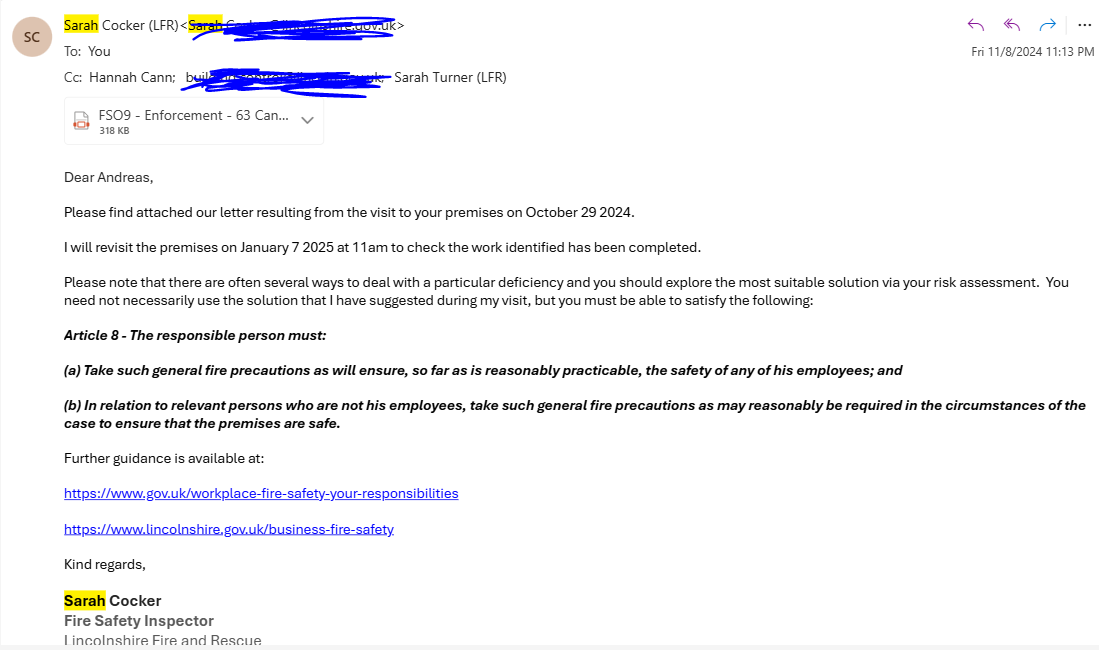
No Request for Maintenance Records:
-
- Nowhere in follow-up communications did the authorities specifically request maintenance records for the fire alarm or emergency lighting systems.
- In my appeal document, I clearly stated that the fire alarm system and emergency lighting were functional and regularly maintained, yet no specific request for proof of maintenance was made.
- The absence of such requests indicates a lack of due diligence in assessing compliance before escalating to enforcement.
- Typically, before issuing a formal enforcement notice, authorities should attempt to gather all relevant information to accurately assess compliance. Not requesting these records indicates a lack of due diligence.
Failed to Communicate Properly: they did not make reasonable efforts to gather information or clarify issues before issuing the enforcement notice.
Initial Observations:
No Request for Maintenance Records: They never asked for fire alarm maintenance records or emergency lighting maintenance records. This could indicate a failure to properly assess compliance before issuing the enforcement notice. Typically, authorities should request relevant documentation as part of their due diligence.
Lack of Clear Legal References: In their responses, they often failed to cite specific legislation or case law, especially regarding the fridges in escape routes and fuse board enclosures. This lack of precision can demonstrate procedural shortcomings.
Absence of Constructive Dialogue: Although you made multiple attempts to understand their position and provide evidence, they seemingly did not engage in a productive dialogue to resolve issues informally.
Supporting Evidence from my Documents:
My detailed emails request specific legal references and attempts to discuss the matter rationally.
The Freedom of Information (FOI) request where I sought clarity and evidence.
The council’s enforcement notice and follow-up emails — I can analyze whether they explicitly requested fire alarm or emergency lighting maintenance records.
Here are the procedural missteps by the fire safety authorities
- Failure to Request Essential Documentation:
- The authorities never requested fire alarm maintenance records or emergency lighting maintenance records before issuing the enforcement notice. This is evident from in my appeal, where you emphasized that no such requests were made and that the fire alarm system was functional.
- Typically, before issuing a formal enforcement notice, authorities should attempt to gather all relevant information to accurately assess compliance. Not requesting these records indicates a lack of due diligence.
-
Lack of Specific Legal References:
- The enforcement notice and subsequent communications lacked specific legal references or case law to justify their claims. For instance:
- The demand for a 5-year EICR was made, but no specific legislation was cited. ( Email 18th Dec about sending FOI and EICR )
- Claims about the fire risk of fridges and fuse boards were presented without solid legal backing, case law, or peer-reviewed studies.
- Proper enforcement procedures should include citing the exact legal basis for compliance requirements. This lack of legal references suggests procedural shortcomings
Escalation Without Exploring Informal Resolution:
- I repeatedly attempted to discuss the matter informally, providing evidence of compliance and seeking legal clarifications. The authorities moved directly to formal enforcement without considering an informal resolution.
- Many of the deficiencies noted, such as minor gaps in fire doors and the positioning of fridges, could have been addressed with a simple advisory letter. This would align with proportionality principles in enforcement.
Misapplication of Legislation:
- The authorities treated the HMO as a commercial property rather than a dwelling house. You provided evidence, including references to council tax classification, indicating that the property is taxed and classified as a residential dwelling.
- Applying incorrect legal standards could indicate a misinterpretation of the law, which may invalidate the grounds for enforcement and subsequent cost recovery.
Inconsistent and Vague Requirements:
- The enforcement notice demanded compliance with standards like fire-resistant enclosures for fuse boards but failed to specify the exact legal basis or relevant standards.
- The vague nature of these requirements complicates compliance and demonstrates a lack of clear guidance.
Evidence of Compliance Ignored:
- I submitted a satisfactory Electrical Installation Condition Report (EICR), demonstrating compliance with electrical safety standards.
- You also confirmed that the fire alarm and emergency lighting systems were functional and appropriately maintained. The enforcement notice disregarded this evidence.
If the intention is to highlight deficiencies, such as a lack of maintenance, the correct procedure should be followed. Firstly, they should write to me formally, requesting the necessary documents to verify compliance. If these documents are not available, they could issue an enforcement notice. However, a formal letter requesting clarification would be more appropriate initially.
If they confirm through a responsible person that maintenance tasks, such as those for emergency lighting, have not been completed, and there is no response to their inquiries, they may reasonably assume that no maintenance has taken place.
It appears they are basing their conclusions on statements from untrained individuals found on the premises who may not be fully aware of our maintenance procedures. This makes it challenging to substantiate their claims in court, despite our efforts to fulfill these responsibilities
Defense Argument:
Failure to Follow Proper Procedures and Verify Compliance Before Escalation
- Lack of Due Diligence:
-
-
- The fire safety authorities should have first requested documentation related to the maintenance of the fire alarm system, emergency lighting, and any other relevant fire safety measures or any maintenance of the house.
- If the authorities genuinely believed there was a lack of maintenance, they should have contacted the Responsible Person to confirm whether proper records were available.
- Instead of issuing an enforcement notice prematurely, the authorities could have issued an informal advisory letter requesting documentation. This approach would be consistent with the principle of proportionality and fairness.
-
- Absence of a Proper Investigation:
-
-
- The authorities seemingly relied on statements from untrained occupants of the property to assess compliance. These individuals are not qualified to comment on technical maintenance procedures.
- No formal request for maintenance records was made, despite your willingness to provide evidence of compliance. This disregard for an available solution demonstrates a failure to properly investigate the situation before escalating.
-
- Procedural Missteps:
-
-
- According to Regulatory Reform (Fire Safety) Order 2005 (RRFSO), enforcement authorities should make reasonable efforts to ascertain compliance before issuing a formal enforcement notice.
Fire Safety Order - If there were concerns about the maintenance of emergency lighting or fire alarms, it was the responsibility of the authorities to request these records directly from the Responsible Person.
- Had they issued a request for documentation and received no response, only then would it be reasonable to consider further action.
- According to Regulatory Reform (Fire Safety) Order 2005 (RRFSO), enforcement authorities should make reasonable efforts to ascertain compliance before issuing a formal enforcement notice.
-
- Impact of Procedural Failures:
-
- The premature escalation to an enforcement notice without seeking maintenance documentation not only bypassed due process but also unjustly subjected you to legal proceedings and financial burdens.
- The decision to seek costs for legal expenses is disproportionate, considering their procedural failures contributed to the escalation of this matter.
Issuing an enforcement notice without requesting maintenance records for the fire alarm and emergency lighting systems is a significant procedural flaw. Here’s why this approach is problematic and potentially unjust:
Issuing an enforcement notice without requesting maintenance records for the fire alarm and emergency lighting systems is a significant procedural flaw. Here’s why this approach is problematic and potentially unjust:
1. Failure to Verify Compliance Properly:
- Proper Assessment Standard: The standard procedure for assessing compliance involves requesting maintenance records to verify whether fire alarm systems and emergency lighting are maintained correctly.
- Lack of Verification: By failing to ask for these records, the authorities made assumptions about non-compliance based on limited information.
- Inadequate Evidence: Relying solely on statements from untrained tenants, rather than verifying facts with the Responsible Person (you), is an improper method of assessment. Tenants are typically not qualified to assess technical maintenance standards.
2. Breach of Fair Process and Due Diligence:
- Regulatory Reform (Fire Safety) Order 2005 (RRFSO): Fire Safety Order The RRFSO emphasizes that enforcement should be based on factual assessments, not assumptions. Proper documentation like maintenance records is essential to demonstrate compliance.
- Proportionality: Issuing a formal enforcement notice without first requesting evidence violates the principle of proportionality. The authorities should have attempted an informal approach, such as requesting records or issuing an advisory letter, before escalating to enforcement.
3. Missed Opportunity for Resolution:
- Informal Resolution: If the authorities had requested the maintenance records, you could have demonstrated compliance and addressed any concerns. This approach could have resolved the matter without formal enforcement.
- Evidence of Compliance: Your fire alarm system and emergency lighting were functioning, yet the authorities never verified this through formal requests for records. If they had asked, you could have provided the necessary documentation to demonstrate proper maintenance.
4. Questionable Grounds for Enforcement:
- Insufficient Basis: An enforcement notice based on incomplete information — without factual verification — undermines its legitimacy.
- Reliability of Testimony: Statements from tenants who may not fully understand fire safety maintenance cannot be considered a reliable basis for enforcement. The fire safety authorities are expected to base their actions on evidence and proper investigation.
The authorities’ decision to issue an enforcement notice without requesting maintenance records or verifying compliance through the Responsible Person is procedurally flawed. It contradicts the principles of fairness, proportionality, and thorough investigation that underpin effective enforcement. This procedural failure strengthens your argument that the enforcement notice and the subsequent application for costs are unreasonable.
If you’d like, I can help incorporate these points into your formal appeal or defense.
Based on these points, there is a strong case to argue that the fire safety authorities acted prematurely and without due diligence, which undermines the justification for seeking costs. The lack of procedural fairness and inadequate effort to engage in an informal resolution before escalating to formal enforcement further supports the argument against their application for costs.
What procedure would be deemed reasonable before the fire authority issues an enforcement notice?
Before issuing an enforcement notice, fire authorities are generally expected to follow a fair and proportionate procedure, in line with principles of good enforcement practice and public law. Here’s what’s deemed reasonable procedure:
- Initial Inspection or Visit
The fire authority should conduct an inspection and document any potential deficiencies or breaches.They should explain their findings during or after the visit and provide an opportunity for discussion.
- Informal Communication and Advice
Best practice under the Regulators’ Code (which applies to public enforcement bodies in the UK) recommends:
- Offering informal advice and guidance first.
- Giving the responsible person an opportunity to voluntarily comply.
- Providing clear written communication outlining the issues and how they can be rectified without formal enforcement action.
- Opportunity for Representation
The responsible person (you) should be given a chance to:
- Respond to the identified deficiencies.
- Ask for clarification or evidence.
- Make representations or suggest alternative solutions.
- Timeframe for Voluntary Compliance
A reasonable period should be given to rectify the issues informally. Only if the responsible person fails to act within this timeframe should enforcement escalate.
- Proportionality and Necessity
Enforcement notices should be a last resort, only after:
- Informal efforts have failed.
- There’s clear evidence of ongoing non-compliance or a serious immediate risk.
- Clear Legal Basis
The notice should reference the specific legal duties breached (typically under the Regulatory Reform (Fire Safety) Order 2005).
Fire Safety Order
It must specify what actions are required, why, and by when.
In other words:
The authority is supposed to educate and encourage compliance before they enforce. If they skip informal steps or fail to engage meaningfully, this can be challenged as unreasonable or disproportionate.
Enforcement and sanctions for non-compliance (accessible)
My Examination of Enforcement Letter and Appeal to Court
Conclusion:
Given the procedural errors, lack of proper investigation, and my demonstrated cooperation, I request that the application for costs be denied. The financial burden resulting from the authorities’ premature and disproportionate response should not fall on a Responsible Person who acted in good faith.
Closing Statement:
The request for £1,472.17 in court costs from the fire safety authorities is unfair and unjustified due to their failure to follow proper procedures.
Before issuing the enforcement notice, the authorities never asked for essential maintenance records for the fire alarm and emergency lighting systems. These records are key to assessing compliance, and I would have provided them if requested. Ignoring this basic step shows a lack of proper investigation and a failure to act fairly.
Instead of properly checking facts, the authorities relied on statements from untrained occupants of the property. These individuals are not qualified to assess maintenance standards, and their opinions cannot replace factual evidence. The authorities should have contacted me, the Responsible Person, to get accurate information. By skipping this step, they made incorrect assumptions.
The decision to issue a formal enforcement notice right away—without first trying to address the issues informally—was excessive. A simple letter requesting documents would have been more reasonable. If the authorities had followed a fair process, we could have resolved any concerns without the need for court action.
Requesting costs of £1,472.17 for a flawed and rushed process is unreasonable. It is not right to make me pay for mistakes that could have been avoided if the authorities had followed proper procedures. I acted in good faith to comply and resolve the situation, but the authorities chose a harsh approach instead of working together.
For these reasons, I respectfully request that the application for costs be denied. Making me pay for the consequences of their poor investigation would be unfair and unjust.
Had the authorities followed the correct procedures, they would have:
-
- Communicated directly with the Responsible Person to seek maintenance documentation.
- Given proper and specific legal references to justify their claims.
- Issued a preliminary advisory letter to address potential issues informally.
- Evaluated the existing evidence of compliance, including the satisfactory EICR and confirmation of functioning emergency systems.
The premature escalation to a formal enforcement notice, compounded by vague and inconsistent justifications, is a disproportionate response that contradicts the principles of proportionality and fairness outlined in enforcement guidance. The Responsible Person’s willingness to cooperate and address concerns was evident from the outset, yet the authorities chose a punitive approach rather than constructive dialogue.
Imposing costs for a process that was flawed from the beginning shifts the financial burden of the authorities’ own errors onto the Responsible Person, who acted in good faith to comply. The requested costs appear punitive rather than compensatory, serving no reasonable purpose other than to penalize a Responsible Person who has already taken all reasonable steps to ensure compliance.
For these reasons, the application for costs of £1,472.17 should be rejected. Holding the Responsible Person financially liable for the authorities’ inadequate and unjustifiable approach would constitute a severe miscarriage of justice.
Annexure Capture 1

Annexure Capture 2

Annexure Capture 3

Annexure Capture 4

Annexure Capture 5

Annexure Capture 6
Click Here to See Full Email
Annexure Capture 7

Annexure Capture 8

Annexure Capture 9

Annexure Capture 10

Annexure Capture 11

Annexure Capture 12

Annexure Capture 13

Annexure Capture 14

Annexure Documents Proofs